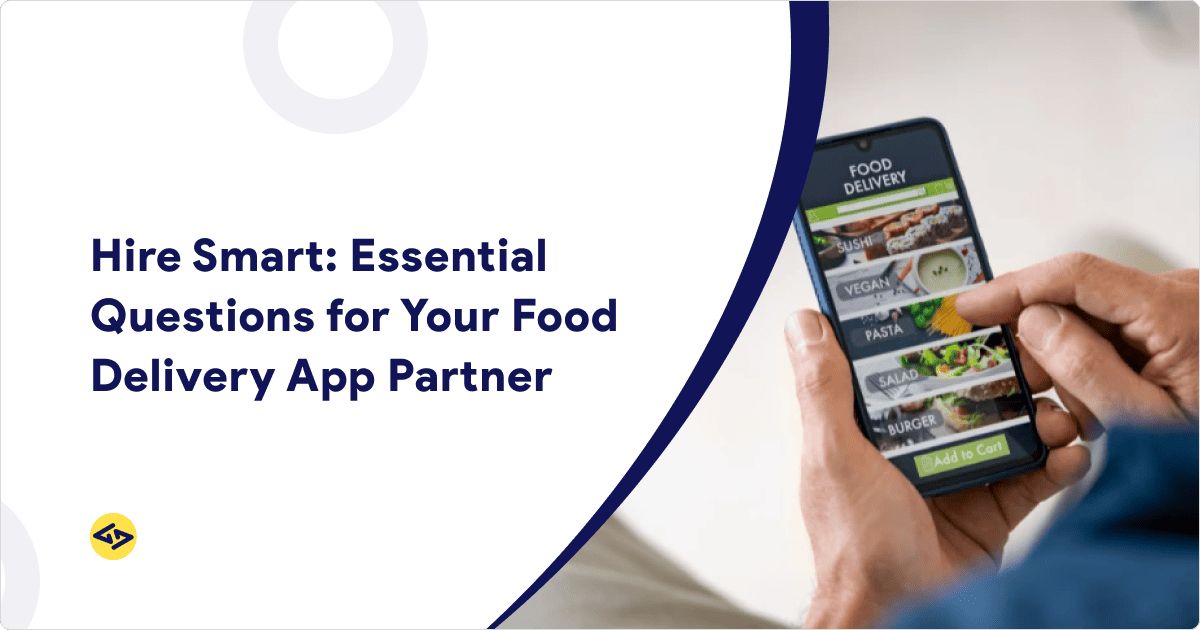
Vetting a food delivery app development company means evaluating three things most founders skip: who will actually build it, what you own when they’re done, and whether their architecture will hold when you scale. The ten questions below are designed to surface all three.
Most vetting calls go the same way. The agency shows a portfolio deck, walks through their process slide, names a few technology frameworks, and closes with a timeline range. It all sounds reasonable. Founders sign. Then the problems start.
The issue isn’t that founders ask the wrong questions — it’s that every experienced agency has rehearsed answers for every question on the standard list. The real signal is in what happens when you push past the prepared answer.
This post gives you 10 specific questions to ask before hiring a food delivery app development company — covering portfolio, team, cost, ownership, security, scalability, and communication. For each question, you’ll find what a strong, confident answer sounds like and what deflection or vagueness actually signals. Use it as a checklist before your next vetting call.
If you want to understand what the end result should look like before you start vetting, our guide on building a food delivery app development company is a useful starting point.
So, Which Questions Should You Ask Before Hiring a Food Delivery App Development Company?
1. What food delivery apps have you actually shipped — and can I test them?
The direct answer to this question is either a live App Store link or a test environment you can access. If it’s neither, the conversation should stop there.
A portfolio slide tells you the agency completed a project. A live app tells you whether it runs well. When you test a real food delivery app, you learn things a case study can’t communicate: how fast the menu renders, whether real-time order tracking updates smoothly, how the app recovers from a failed payment attempt. These are the details that define whether an app survives a real launch day.
Ask specifically about the business models behind each app. There’s a meaningful difference between building a single-restaurant ordering app, a multi-vendor marketplace with an independent driver network, and a platform that aggregates from multiple kitchens and dispatches third-party couriers. If a team has only built one type, they don’t yet know how the other two fail under load.
Also ask whether they’ve built for your specific target market — user expectations shift sharply between a US audience, a UAE audience, and a Southeast Asian one. An agency that has only shipped apps for one region may not understand what your users expect. For example, US users typically lean toward Apple Pay and Google Pay with SMS-based order updates, while other markets have their own default payment rails and communication habits. These aren’t minor details. They’re the difference between an app that feels local and one that feels imported.
Strong answer: They hand you a device or credentials without hesitation. They can describe a specific failure in a past build and what they changed because of it.
Weak answer: Screenshots. A PDF case study. “We’ve built similar apps” without a name you can look up.
For context on how the leading platforms set the bar technically, see our breakdown of how leading food delivery apps are built. And for an example of a live restaurant delivery app we’ve shipped, see the Chowman food delivery app case study.
2. Who specifically will work on my project — and what is their capacity?
The person selling you the project is rarely the person building it. This is the question most founders skip, and the one that matters most after the contract is signed.
Ask for the names and profiles of the developers and designers who will actually be assigned. Ask about their specific experience with food tech development — not general mobile app work. Ask whether your project will be their primary assignment or one of several running in parallel.
Developer turnover mid-project is one of the most common causes of budget overruns in food delivery app builds. A developer who joins halfway through needs weeks to understand the codebase — the logic behind delivery zone configurations, the driver dispatch system, how order status transitions are handled. You’re paying for that learning curve.
Also ask how communication works day-to-day. What are the overlapping hours if the team is offshore? Who is your single point of contact when something goes wrong? The most common complaint from founders after a bad agency experience isn’t the code quality — it’s the silence. Weeks without updates, and a launch date that keeps moving with no explanation.
Strong answer: They introduce you to the actual team before you sign, name a dedicated project manager, describe their update cadence, and are upfront about timezone overlap.
Weak answer: “We’ll assign the best resources for your project” — with no names, no communication structure, and no answer on timezone overlap.
3. What is your tech stack — and why did you choose it for food delivery specifically?
The rationale matters more than the stack itself. Any team can name current frameworks. What separates experienced food delivery app developers is knowing why one choice outperforms another for this specific use case.
Cross-platform frameworks like Flutter or React Native reduce cost by roughly 30–40% for an equivalent feature set compared to building separate native apps. That makes them the right choice for most MVPs. Native development — Swift for iOS, Kotlin for Android — makes sense when deep device integration or peak performance is the priority and budget allows.
For a food delivery platform specifically, ask how they handle real-time order tracking and delivery dispatch. This is where most architectures either perform cleanly or create expensive problems later. WebSocket implementation, push notification reliability, and GPS polling frequency have significant effects on both user experience and infrastructure cost at scale.
For food delivery apps, the backend architecture must support three simultaneous real-time feeds: customer order status, restaurant acceptance and preparation, and driver location. Teams that haven’t built this before underestimate the concurrency requirements.
Strong answer: They explain tradeoffs in plain language: “We use Flutter for MVPs because it reduces build time and cost significantly. If you later need custom hardware integrations, we’d revisit.”
Weak answer: They list every possible framework — Swift, Kotlin, Flutter, React Native, and three backend options — implying equal depth in all of them. Generalism at this level is usually thin expertise across the board.
For a deeper breakdown of these tradeoffs — Flutter vs React Native vs native, and how to choose a backend for real-time order tracking — see our guide on choosing the right food delivery app tech stack.
4. What do I own when the project is complete — code, IP, documentation, everything?
This is the question most founders avoid because it feels confrontational. It is also the one that determines whether you can ever change development partners.
When the engagement ends, you need full, unencumbered ownership of: all source code in a structured repository, design source files (Figma, Sketch), API documentation, database schemas, deployment configurations, and credentials to every third-party service integrated into the build.
The specific risk to probe: does the agency use any proprietary internal libraries — frameworks they’ve built for reuse across their client base — that aren’t fully transferable? If your app depends on their internal tools, migrating to a new team may require a partial or full rebuild.
Strong answer: They describe a structured handover: a GitHub repository with documentation, deployment instructions, and access credentials. They’ve done it before and can describe what it looks like.
Weak answer: Vague language about “standard handover.” Or a suggestion that you’ll want to stay with them for ongoing updates — which may be true, but shouldn’t be framed as the only workable option.
📋 iCoderz has built food delivery platforms across single-restaurant, multi-vendor, and logistics-aggregator models — in the US and internationally. If you want to talk through your specific requirements, discuss your project here.
5. What features do you recommend for my business model — and which ones can wait?
A development company with real food delivery experience will ask about your business model before recommending features. The right feature set for a cloud kitchen serving one city is structurally different from the right feature set for a multi-vendor marketplace with independent driver management.
More importantly: experienced teams know which features look good in demos but get disabled or ignored six months post-launch. AI-powered personalization, loyalty reward systems, and voice ordering fall into this category for most early-stage platforms. Getting them built takes budget away from the core experience — which is what users actually judge you on.
|
Feature |
Single Restaurant |
Multi-Vendor Marketplace |
Cloud Kitchen / Aggregator |
|---|---|---|---|
|
Real-time order tracking |
Essential |
Essential |
Essential |
|
Driver network management |
Optional |
Core |
Core |
|
Vendor onboarding portal |
Not needed |
Core |
Core |
|
Commission & payout system |
Not needed |
Core |
Core |
|
Loyalty / rewards program |
High value |
Medium value |
Low priority (early stage) |
|
AI recommendations |
Nice to have |
High value at scale |
High value at scale |
To understand what makes delivery platforms stand out in competitive markets, our breakdown of the DoorDash business model is worth reading before your vetting calls.
6. How does your development and QA process handle the multi-role architecture of a food delivery app?
Every agency will describe an Agile process. The important question is how they apply it to a system with four interdependent interfaces: customer app, restaurant app, driver app, and admin panel.
Teams that build each interface in isolation and integrate them at the end are setting up a painful final phase. The bugs that surface in integration testing at that stage — order status mismatches, notification delivery failures, driver assignment race conditions — are the most expensive to fix.
Ask about their integration testing milestones. Ask whether QA is a dedicated function or shared with the developers writing the code. Ask what their process is when a bug is discovered during user acceptance testing — is rework included in the project scope, or does it trigger a change request?
Strong answer: Integration testing happens at defined milestones across all roles throughout development, not just at the end. QA is a separate function from development.
Weak answer: Testing is described as a phase that happens after development is complete.
7. How do you handle security and data privacy — and what does that mean for my users?
Your food delivery app will hold three things users are most sensitive about: their payment details, their home address, and their live location. A security breach on any one of these will cost you far more than the build itself — in refunds, legal exposure, and lost trust that doesn’t come back.
You don’t need to understand the technical details to ask the right questions here. Ask whether card data ever touches your servers, or whether it goes directly through a payment provider like Stripe that handles that liability for you. Ask whether your users’ data is protected under US privacy laws — especially if you’re launching in California. Ask when security testing happens during the build, not just whether it happens at all.
A food delivery app collects three categories of sensitive user data simultaneously: payment information, real-time GPS location, and home address. Each carries different legal and liability implications — and a development company that hasn’t thought about this before you asked isn’t the right partner.
Strong answer: They explain how payment data is handled without you having to ask twice. They mention using an established payment gateway so card data never sits on your servers. They bring up privacy compliance for the US market unprompted.
Weak answer: “We take security seriously” or “we follow industry standards” — with nothing behind it. Reassurance without specifics means security was an afterthought, not a design decision.
8. What is a realistic cost and timeline for my specific scope — not a general range?
Published food delivery app development cost ranges are often so wide they provide no useful signal. The actual number depends on four variables: number of user roles, real-time feature complexity, third-party API integrations, and whether you’re building cross-platform or native.
A realistic framework based on current market benchmarks:
|
Scope |
Included Components |
Cost Range (USD) |
Timeline |
|---|---|---|---|
|
MVP — single restaurant |
Customer app, basic admin, payment, tracking |
$20,000–$40,000 |
3–4 months |
|
Mid-complexity platform |
Multi-vendor, driver app, full admin panel |
$50,000–$90,000 |
5–7 months |
|
Full-scale delivery platform |
AI features, multi-region, advanced logistics |
$90,000–$180,000+ |
8–12+ months |
Cross-platform development (Flutter or React Native) typically reduces cost by 30–40% versus building separate native iOS and Android apps. The largest source of cost overruns isn’t scope changes — it’s ambiguous specifications at the start. Ask to see the scope document before signing, not after.
Two things to nail down before you agree to anything: payment structure and what’s not in the quote. Never pay the full amount upfront — a reputable agency works on milestones tied to specific deliverables, with final payment only after you’ve accepted the finished app. And ask explicitly what the quote excludes. Hosting, third-party API subscriptions, app store accounts, and post-launch bug fixes are routinely left out of the headline number and billed separately later.
For a more detailed breakdown of what drives these numbers, see our guide to food delivery app development cost.
9. What does post-launch support actually include — and what triggers additional billing?
“We offer post-launch support” is not a commitment. It is a phrase every agency uses. What you need is a written SLA with defined terms before the contract is signed.
Ask specifically: What is the warranty period for bugs found after launch — 30 days, 90 days? Is bug fixing included or billed at an hourly rate? What is the response SLA for a production outage — 24 hours, 4 hours, 1 hour? Does maintenance cover OS updates when Apple or Google releases a new major version? When does the retainer model begin, and what does it cost?
Most founders discover the answers to these questions after a payment gateway integration breaks three weeks post-launch, or a new iOS update causes crashes on the latest iPhone model. At that point, the project is delivered and the leverage is gone.
Strong answer: They provide a written SLA with specific response times by issue severity and are clear — in writing — about what’s included versus what triggers a new invoice.
Weak answer: Support terms are described verbally or referenced vaguely in the contract. If they matter to your business, they need to be specified.
10. How is the architecture designed to scale — and what does growth cost at the infrastructure level?
Scalability in a food delivery platform means two things: the ability to handle order volume spikes without performance degradation, and the ability to expand to new cities, new product categories (groceries, pharmacy), or new business models without rebuilding the backend.
Ask the team to describe their approach to handling increased load. Ask whether the backend is built on cloud infrastructure that supports horizontal scaling — AWS, GCP, or Azure. Ask about the cost curve: poorly architected food delivery backends become expensive to run before they become difficult to use, because every real-time feature generates persistent server load even when no orders are being placed.
A development team with genuine food delivery experience will also understand modular architecture — the ability to add grocery delivery or B2B catering to the same platform without rebuilding the core. This is what separates platforms built for growth from those that require a full rebuild at scale. See how we approach mobile application development for delivery businesses.
Strong answer: They describe specific architectural tradeoffs — microservices versus monolith, how they handle database reads at scale, load balancing approach — in plain language without prompting.
Weak answer: “We use cloud hosting” with no description of how the backend is structured or how it handles concurrency.
The Question That Separates Real Experience from a Good Pitch
Every question above has a rehearsed answer. A genuinely capable food delivery app development company and a well-marketed generalist will both sound credible when answering what to ask. The differentiation appears under pressure.
Before running through any checklist, ask this: “Tell me about a food delivery project that ran into serious problems — and what changed in your process because of it.”
A generalist agency will describe a “challenging client” or a “scope change.” A team that has genuinely shipped food delivery apps at scale will describe something specific — a race condition in the driver dispatch system under concurrent orders, an undocumented API change from a mapping provider that broke tracking for 6 hours, a restaurant-side app that vendors refused to use because the UI was designed for developers, not kitchen staff.
The specificity of the failure story is the most reliable signal you’ll get about the depth of actual experience. Agencies that have never built anything complex enough to fail in interesting ways haven’t built anything complex enough to handle your project.
Evaluating development partners right now?
Beyond delivery specifically, our team also works with restaurants and food businesses on food & beverage software more broadly — POS integrations, kitchen management, and inventory systems. If you have specific questions about scope, cost, or architecture, our team is available for a direct conversation.
Contact us to discuss your project →