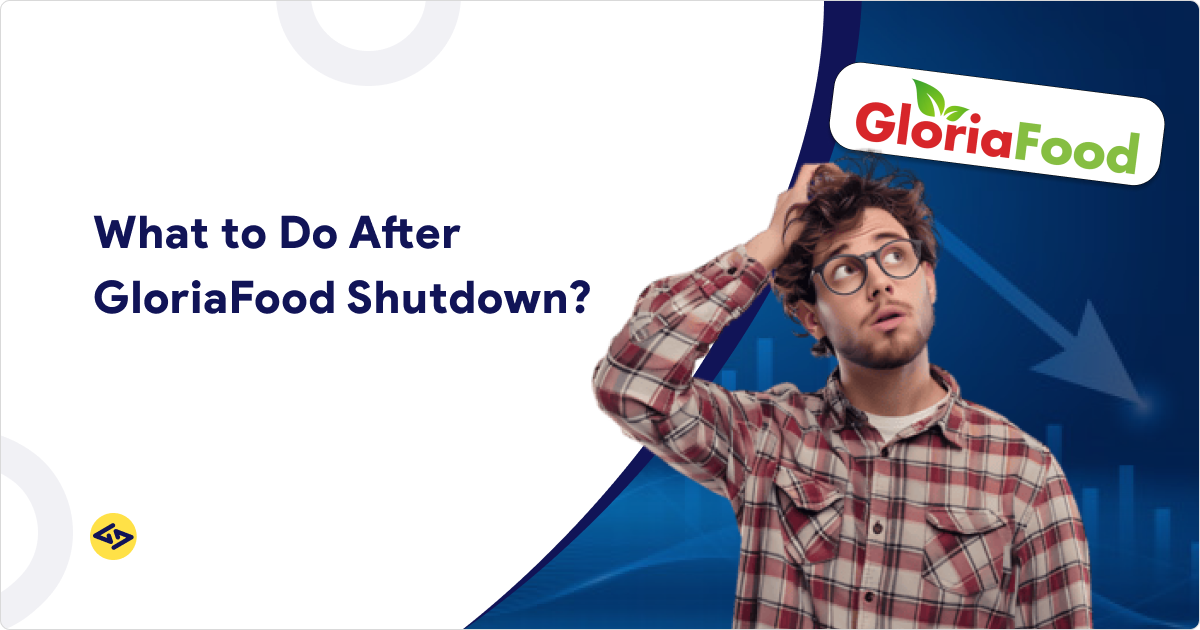
Imagine building your entire online ordering operation on a platform you trust — and then waking up to an email that says it’s shutting down.
That’s exactly what happened to over 123,000 restaurants worldwide when Oracle announced it was retiring GloriaFood. New signups are already closed. The platform goes dark on April 30, 2027. Menus, customer data, delivery zones, order history — all of it, gone overnight because a corporation made a spreadsheet decision.
If you’re wondering what to do after GloriaFood shutdown, you’re not alone — and this guide has the answer.
We cover everything you need: how to back up your data before it disappears, the top GloriaFood alternatives available right now, a step-by-step migration checklist, and how to evaluate whether a custom app is the smarter long-term move.
If you’re figuring out how to migrate from GloriaFood before the April 2027 shutdown, this is the only guide you need to read.
Why Is GloriaFood Shutting Down?
GloriaFood’s shutdown is a direct result of Oracle’s product consolidation strategy. Oracle acquired GloriaFood in June 2021, and after three years of evaluation, it decided the platform does not fit its long-term product roadmap.
What makes this particularly frustrating is that Oracle has not announced a successor product. Restaurants that built their entire ordering workflow on GloriaFood — staff trained, menus configured, payment flows live — now have to rip and replace everything. No migration path was offered. No data export tool was built. The platform simply stops working on April 30, 2027.
More than 123,000 restaurants worldwide actively used GloriaFood before the announcement. Many chose it precisely because it offered a free entry tier and zero commissions — two features that are rare among online ordering platforms. That trust, built over years, has now been broken by a single corporate decision.
The deeper lesson here is one we think every restaurant owner should take seriously: renting software means renting someone else’s priorities. When a vendor decides to shut down — as Oracle just did — you have no say. Your data, your workflows, your customer relationships, are all at risk. That is the structural problem with every SaaS platform, and it is exactly why we believe owning your technology is the smarter long-term move.
What Should You Do First After the GloriaFood Shutdown Announcement?
The most important thing you can do right now is not pick a new platform — it is to back up everything you have. Once GloriaFood goes offline, your data is gone. Oracle has not announced any archival service beyond the shutdown date.
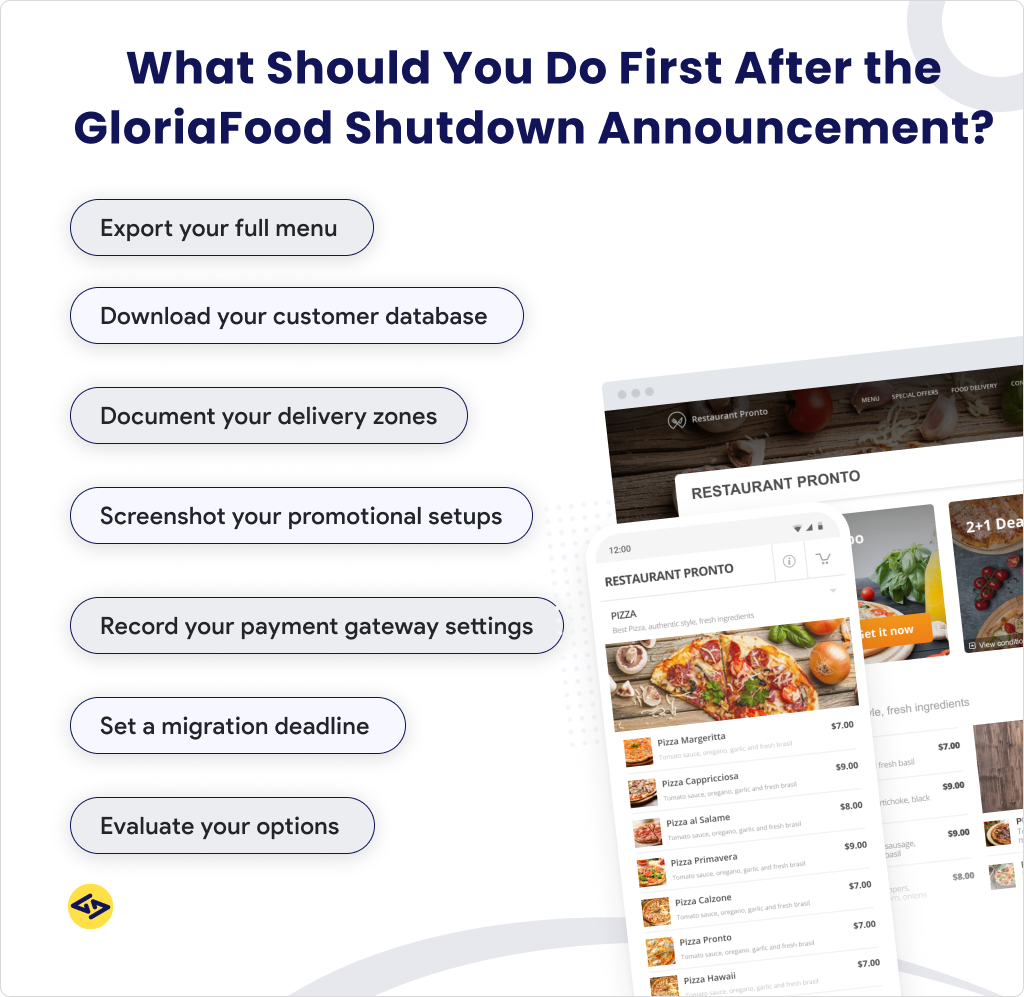
Follow these steps in order:
- Export your full menu — every item, price, description, modifier, and photo. Save them in a structured spreadsheet so they are ready to import into any new platform.
- Download your customer database — every email address, name, and ordering history you can access. This is your most valuable asset as a restaurant. Do not lose it.
- Document your delivery zones — note every zone, its delivery fee, and its minimum order value. Recreating these from memory wastes weeks.
- Screenshot your promotional setups — discount codes, loyalty configurations, and any promotional banners you have running.
- Record your payment gateway settings — processor, fee structure, and any connected accounts.
- Set a migration deadline — we strongly recommend completing your switch by October 2026. That gives you a buffer of six months before the shutdown, enough time to run both platforms in parallel and catch any issues before they affect live orders.
- Evaluate your options — SaaS platform vs custom-built app. The right choice depends on where your restaurant is headed in the next three years.
Do not skip step 6. The restaurants that rush a migration in March 2027 are the ones that end up losing orders during the transition.
The Right Time to Act Is Before the Deadline
GloriaFood’s shutdown is one of the clearest signals the restaurant tech industry has produced in years: you cannot build a serious food business on rented infrastructure.
SaaS platforms serve a purpose — but that purpose is early-stage validation, not long-term competitive advantage. The brands that win over the next five years will own their tech stack, own their customer data, and operate on platforms that scale with them.
We’ve built restaurant apps, food delivery platforms, and multi-delivery solutions for operators at every stage. If you’re ready to stop renting and start owning, talk to us.
Book a Free Consultation with iCoderz →
Top GloriaFood Alternatives in 2026: Which Platform Fits Your Restaurant?
The GloriaFood end of life announcement has pushed thousands of restaurants to evaluate their options fast. Several platforms are positioned as direct GloriaFood replacements. Each has a different pricing model, feature depth, and risk profile. Here is an honest comparison so you can decide what fits your situation.
| Platform | Best For | Monthly Cost | Commission | Key Limitation |
| Deonde | Restaurants wanting branded ordering + delivery management | Subscription-based | 0% | — |
| Ressto | Restaurants needing a clean, self-hosted ordering experience | Subscription-based | 0% | — |
| Custom App (iCoderz) | Restaurants wanting full ownership | One-time build | 0% | Higher upfront cost |
Which GloriaFood Alternative Is Closest to the Original?
Given the GloriaFood end of life timeline — with full shutdown confirmed for April 30, 2027 — the two platforms we recommend evaluating first are Deonde and Ressto
The best GloriaFood alternative is Deonde— it offers commission-free ordering, a fully branded customer experience, and a setup process that independent restaurant owners can manage without a developer.
Ressto.co is a strong second option for restaurants that want a clean, self-hosted ordering experience without monthly commission cuts.
If you want something closer to full platform ownership rather than another SaaS subscription, a custom-built restaurant ordering app through iCoderz is the option worth a serious look.
You own the code, you own the data, and no vendor decision can shut you down.
Why a Custom Food Delivery App Is the Smarter Long-Term Move
Every SaaS platform you pay for monthly is software you are renting, not owning. When GloriaFood shut down, restaurants had no leverage. They could not negotiate, extend, or retrieve anything beyond the shutdown date. That is what renting software actually means.
A custom-built food delivery app changes that equation completely. You own the code. You own the data. You control the roadmap. No vendor can take it away.
Consider the lifetime cost difference. A mid-tier SaaS platform at $150/month costs $9,000 over five years, per location. A restaurant group with three branches pays $27,000 over that same period, for software they will never own and could lose overnight.
A custom app built by a development partner like us typically has a one-time build cost — and after that, you pay only hosting and maintenance. The ownership advantage compounds every year.
Additionally, 52% of customers prefer ordering directly from a restaurant’s own app rather than a third-party platform, according to a US restaurant industry survey.
A branded app — your name, your colours, your logo on the customer’s home screen — is a retention tool that no ordering widget can replicate.
What Features Should Your GloriaFood Replacement Have?
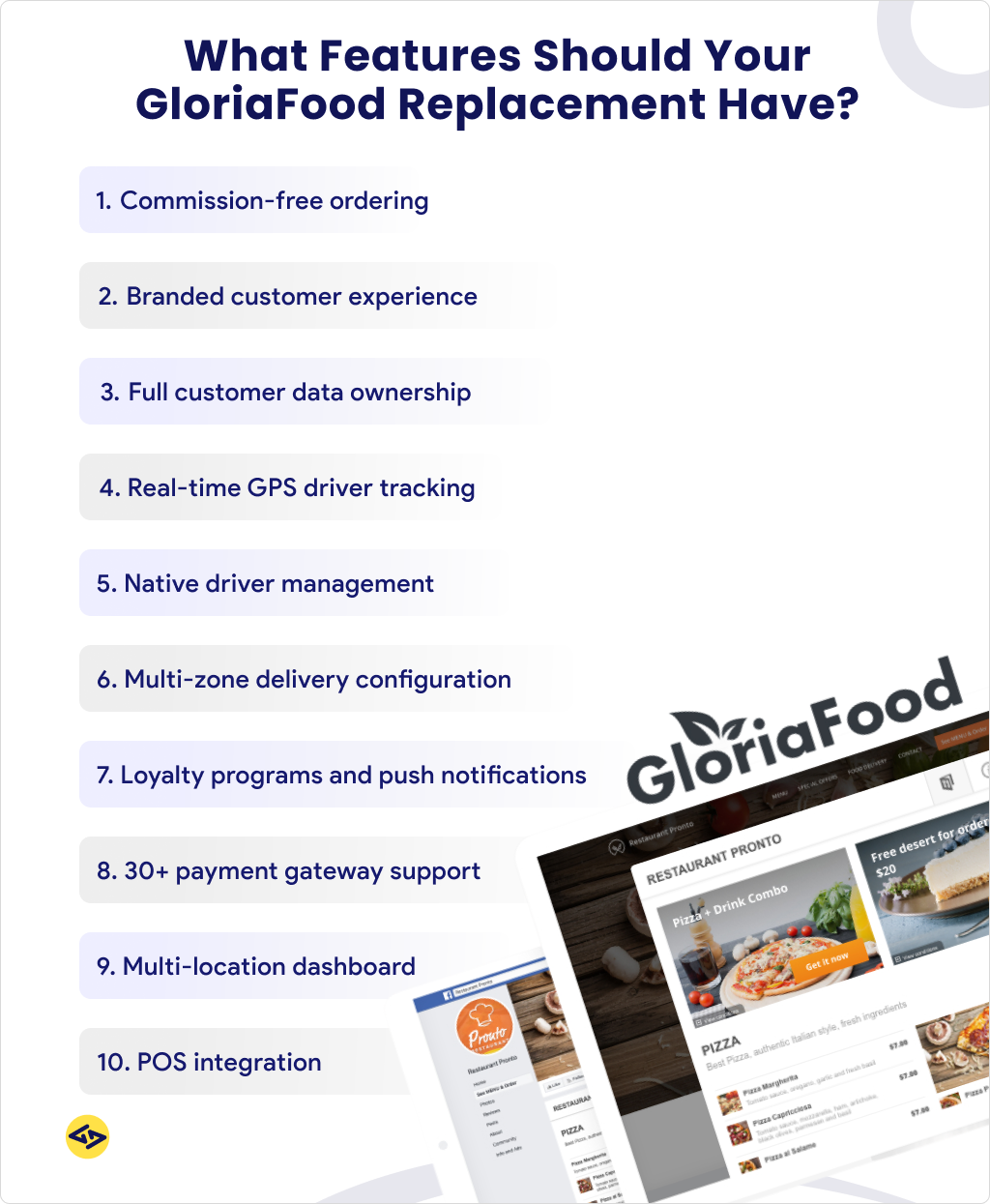
Whether you choose a SaaS alternative or a custom-built app, make sure your new platform covers every item on this checklist:
- Commission-free ordering — you should never pay a percentage of every order to a platform
- Branded customer experience — your logo, your domain, your colours on every screen
- Full customer data ownership — every email and order history belongs to you, not the platform
- Real-time GPS driver tracking — customers expect this; anything less increases support calls
- Native driver management — assign, track, and communicate with your delivery fleet from one place
- Multi-zone delivery configuration — set different fees, radii, and minimum orders per zone
- Loyalty programs and push notifications — repeat orders are where the real revenue sits
- 30+ payment gateway support — your customers use different methods; your platform should handle all of them
- Multi-location dashboard — if you have more than one branch, managing each separately is a workflow nightmare
- POS integration — your ordering system and your in-store system should talk to each other
Most SaaS platforms check six or seven of these boxes. A custom food delivery app development built to your specification checks all of them — because the features are built for your business, not designed for a mass market.
How Do We Help You Migrate from GloriaFood?
We have built over 200 food delivery apps from the ground up — including the Chowman app, one of the most-used branded delivery platforms in its region. Our migration process for GloriaFood restaurants is structured around one goal: zero disruption to live orders.
Here is exactly how we handle it:
- Data export and audit — we review your GloriaFood export and map every asset that needs transferring: menus, zones, customer records, and promotional setups.
- Specification and design — we design the customer app, driver app, and admin panel around your brand and your existing workflow.
- Build and integration — we develop your branded iOS and Android apps, connect your payment gateways, and configure delivery zones and POS integrations.
- Parallel testing — we run your new platform alongside GloriaFood so every flow — ordering, payment, driver dispatch, notifications — is verified before any order goes live.
- Go live and handover — we submit your apps to the App Store and Google Play, then hand over full code ownership. You are never locked into our infrastructure.
A basic app takes 8–12 weeks. A mid-range platform with multi-location support, loyalty programs, and POS integration takes 16–24 weeks.
Everything we build uses widely adopted frameworks. If you involve another development team later, the codebase is fully portable. For a broader look at what a full-stack build includes, visit our restaurant software solutions page.
Turn the Shutdown Into an Upgrade
GloriaFood’s closure is not just a platform going offline — it is a signal that building your restaurant’s future on software you do not own is a risk not worth taking twice.
The restaurants that come out of this situation strongest are the ones that treat the migration as an upgrade. They are not hunting for the cheapest GloriaFood replacement. They are building a branded app they actually own — with customer data under their control and a platform no vendor decision can take from them.
We have spent 13 years building food delivery platforms for exactly this kind of operator. Contact our food delivery app development team and we will show you what a clean migration from GloriaFood to full platform ownership looks like.
Frequently Asked Questions
When is GloriaFood shutting down? April 30, 2027 is the confirmed shutdown date. Existing accounts remain active until then — after which the platform goes fully offline with no data recovery available.
Is GloriaFood still available for new restaurants?
No. GloriaFood stopped accepting new signups after the shutdown announcement. Any restaurant not already on the platform must go directly to an alternative.
What is the best free GloriaFood alternative in 2026?
There is no free alternative that matches GloriaFood’s full feature depth. Square has a free base plan but charges per-transaction fees and is not built specifically for restaurants. Commission-free platforms with proper restaurant tools start at $49–$65/month. A custom-built app eliminates monthly SaaS fees entirely after the initial build.
Will I lose my restaurant data when GloriaFood shuts down?
Yes — if you do not export it first. Oracle has confirmed no data retention or archival service beyond April 30, 2027. Menus, customer records, and delivery configurations become permanently inaccessible once the servers go offline. Export everything now.
How long does it take to build a custom food delivery app?
A basic app with ordering, driver tracking, and admin panel takes 8–12 weeks. A mid-range build with multi-location support and POS integration takes 16–24 weeks. We work in agile sprints, so you see working builds within the first few weeks.
Can I migrate my GloriaFood menu to a new platform?
Yes. Most platforms support menu data transfer. Export your GloriaFood data in spreadsheet format before the shutdown — once it is clean and structured, importing it into a new system typically takes one to two days.