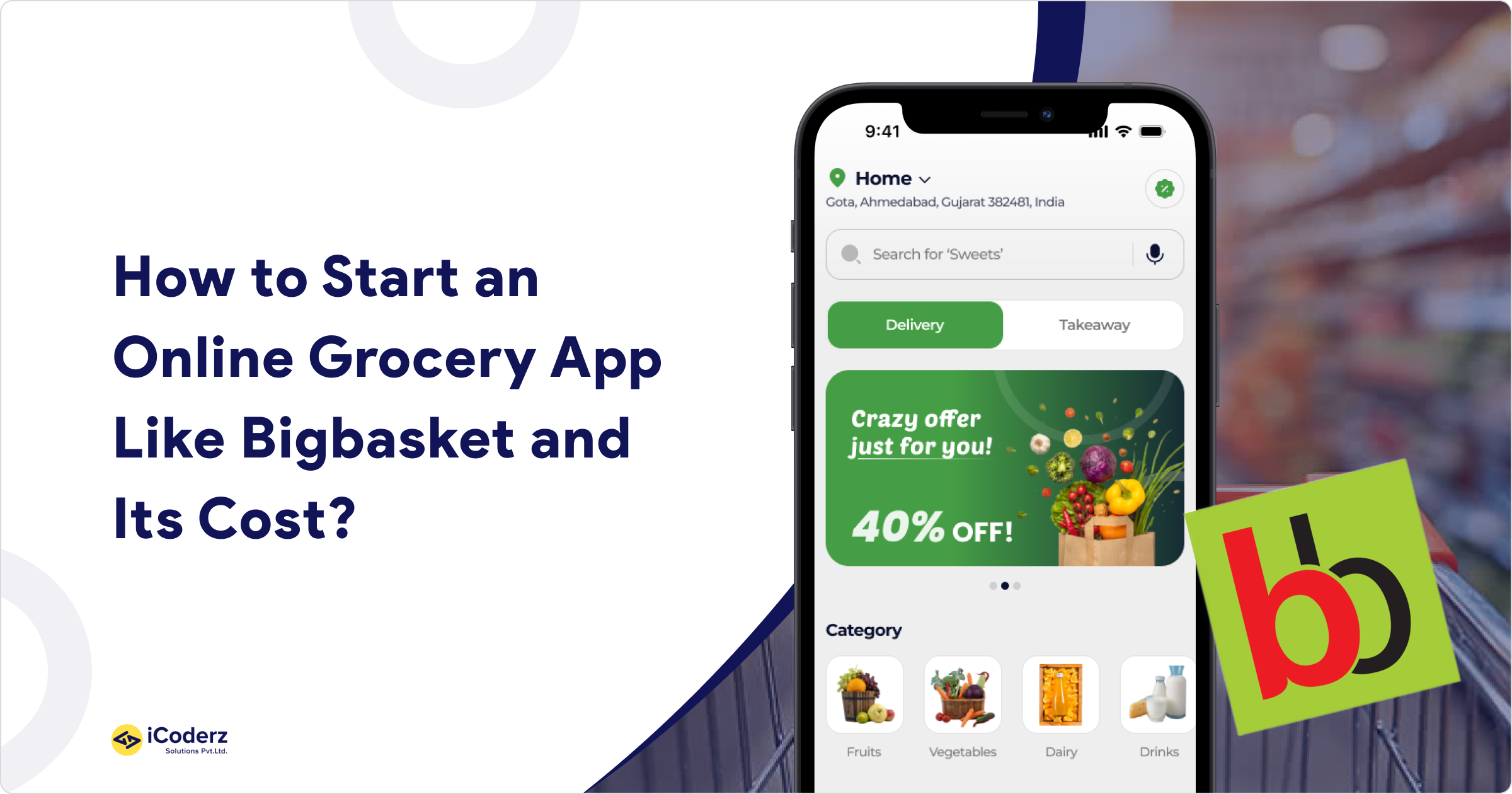
The way we shop for groceries has been transformed. No longer a weekly chore, grocery shopping is now a digital experience delivered to our doorsteps. The global online grocery market, already a behemoth, is projected to reach a staggering USD 992.35 billion by 2033, growing at a compound annual growth rate (CAGR) of over 20%. In this dynamic landscape, Bigbasket stands tall as a pioneer and a success story, proving that a well-executed online grocery model can win immense customer loyalty and scale massively.
If you’re an entrepreneur or business leader inspired to capture a slice of this booming market, you’re in the right place. This comprehensive guide will walk you through exactly how to build an online grocery app like Bigbasket, from conceptualizing your business model to launching a fully-functional product. Crucially, we will demystify the grocery app development cost, providing clear budget estimates so you can plan your investment confidently. You’ll learn about the essential features, the step-by-step development process, and the proven strategies to make your venture a success.
What Is Bigbasket and Why Is It So Popular?
Bigbasket, founded in 2011, is India’s largest online food and grocery store. Its success isn’t accidental; it’s built on a foundation that directly addresses customer pain points. Its business model combines elements of inventory-based and marketplace models, giving it control over quality and a vast selection.
Key Success Factors:
- Wide Product Range: With over 18,000 products from more than 1,000 brands, it serves as a one-stop-shop for all household needs.
- Reliable & Fast Delivery: Bigbasket built its reputation on scheduled delivery slots and a 99.3% on-time delivery rate, a critical trust factor for customers.
- User-Friendly Experience: The app and website allow for easy browsing, comparison, and a seamless checkout process.
- Focus on Freshness & Trust: Its “farm-to-table” supply chain for produce and a no-questions-asked return policy cemented customer loyalty, especially during the pandemic with contactless delivery.
Bigbasket vs. Quick Commerce Apps: Understanding the Models
The online grocery landscape features distinct models catering to different customer needs. Understanding the key differences between a planned-delivery model like Bigbasket and the newer quick-commerce entrants can help you define your own positioning.
| Aspect | Bigbasket Model (Planned Delivery) | Quick Commerce (Blinkit, Zepto, Instamart) |
| Core Value | Wide selection, scheduled convenience, value for money | Ultra-fast delivery (10-90 minutes), impulse/convenience buys |
| Basket Size | Large, weekly/monthly shopping | Small, immediate-need items |
| Customer Mindset | Planned, budget-conscious | Urgent, convenience-driven |
| Operational Base | Large centralized warehouses | Network of micro-fulfillment centers in neighborhoods |
| Pricing & Margins | Competitive pricing, lower delivery cost per item | Often slightly higher pricing, higher logistics cost per order |
Choosing your model depends on your target audience, capital, and the problem you want to solve. You can learn more about the hyperlocal quick-commerce model in our guide on how to build a hyperlocal grocery delivery app.
Types of Online Grocery App Business Models
Choosing the right model is your first strategic decision. Each has different operational needs and cost implications.
- Inventory-Based Model (Like Bigbasket): You own or lease warehouses, manage inventory, and handle last-mile delivery. This offers maximum control over quality and margins but requires significant capital and logistics management.
- Marketplace Model: You create a platform where multiple retailers and brands list their products. You earn via commission on each sale. This is asset-light and allows for rapid catalog expansion but offers less control over delivery and quality.
- Hyperlocal Model (Like Blinkit or Zepto): This model focuses on ultra-fast delivery (often within 10-90 minutes) by partnering with local stores or operating micro-fulfillment centers in dense neighborhoods. Speed is the primary value proposition.
- Subscription-Based Model: Customers pay a recurring fee (weekly, monthly) for curated boxes of groceries or for benefits like free delivery. This ensures predictable revenue and enhances customer retention.
Essential Features of a Grocery App Like Bigbasket
A robust grocery app is a multi-faceted platform serving three key user groups. For a deeper dive into features, explore our blog on must-have grocery mobile app development features.
User Panel
- Registration & Login: Simple sign-up via phone, email, or social media.
- Smart Search & Filters: Find products instantly by category, brand, price, or dietary preference.
- Cart & Secure Checkout: A smooth, multi-step process with saved addresses.
- Multiple Payment Options: Credit/Debit cards, UPI, digital wallets, and Cash on Delivery (COD).
- Real-Time Order Tracking: Live GPS tracking from dispatch to doorstep.
- Ratings, Reviews & Reorder: Build trust and convenience for repeat customers.
Admin Panel (The Command Center)
- Dashboard Analytics: Overview of sales, orders, customer growth, and revenue.
- Product & Inventory Management: Add, edit, and update stock levels in real-time.
- Order & Delivery Management: Assign orders, manage schedules, and update statuses.
- Customer & Vendor Management: Handle user data, queries, and partner onboarding.
- Promotion & Discount Management: Create flash sales, coupon codes, and loyalty programs.
Delivery Partner Panel
- Order Assignment & Acceptance: Receive and accept delivery requests.
- Navigation & Route Optimization: Integrated maps for the fastest route.
- Earnings & Payout Dashboard: Track daily earnings, incentives, and payment history.
- Availability Toggle: Control their working hours seamlessly.
Step-by-Step Guide to Building an Online Grocery App Like Bigbasket
- Market Research & Competitor Analysis: Identify your target audience, analyze giants like Bigbasket and quick-commerce players like Blinkit, and find your unique niche. Studying the top grocery delivery apps is an excellent starting point.
- Choose Your Business Model: Decide on inventory, marketplace, hyperlocal, or a hybrid based on your capital and goals.
- Define Core Features: Prioritize features for your MVP (Minimum Viable Product) and plan for future phases.
- Select the Technology Stack: This critical decision impacts performance, scalability, and cost (detailed in the next section).
- UI/UX Design: Create wireframes and prototypes focused on intuitive navigation and a pleasant shopping experience.
- App Development: The phase where your custom grocery app development takes shape, involving frontend, backend, and API integration.
- Rigorous Testing: Test for functionality, usability, performance, and security across devices.
- Launch & Marketing: Deploy to app stores and initiate targeted marketing campaigns.
- Maintenance & Scaling: Regularly update the app, fix bugs, and add new features to scale your business.
Technology Stack for Grocery App Development
The right tech stack ensures your app is fast, secure, and scalable. Here’s a recommended breakdown:
- Frontend (User Interface): Flutter or React Native for cost-effective, high-performance cross-platform apps. Flutter, in particular, is excellent for building a consistent UI across iOS and Android quickly. Learn why in our dedicated piece on using Flutter for grocery delivery app development.
- Backend (Server Logic): Node.js, Django, or Laravel for robust server-side operations.
- Database: MongoDB (flexible) or PostgreSQL (structured) for managing product catalogs, user data, and orders.
- Payments: Integrate secure gateways like Stripe, Razorpay, or PayPal.
- Maps & Location: Google Maps API or Mapbox for delivery tracking and location services.
- Cloud & Hosting: AWS, Google Cloud, or Azure for reliable, scalable infrastructure.
For a comprehensive analysis, our guide on the best tech stack for a grocery app breaks down the choices used by leading players.
How Much Does It Cost to Build a Grocery App Like Bigbasket?
The cost to develop a grocery app is not a fixed number; it varies based on complexity, features, and team location. Here’s a realistic breakdown:
Cost Breakdown (Approximate)
| App Type | Key Features | Estimated Development Cost |
| Basic MVP | Core catalog, cart, checkout, basic admin panel; single platform. | $10,000 – $25,000 |
| Mid-Level App | Advanced features, real-time tracking, multi-payment, dual-platform (iOS & Android). | $25,000 – $60,000 |
| Enterprise-Grade App | Full-featured platform for all user groups, complex integrations, custom features, scalable backend. | $60,000 – $150,000+ |
Not sure what your app will cost? Get a free personalized estimate based on your specific features, target market, and business model.
Key Factors Affecting Cost
- App Complexity & Features: The number and sophistication of features are the primary cost drivers.
- Platform Choice: Native development for both iOS and Android costs more than a cross-platform solution like Flutter.
- UI/UX Design: Custom, intricate designs cost more than template-based ones.
- Third-Party Integrations: Payments, maps, analytics, and SMS services add to the cost.
- Development Team Location & Structure: Hourly rates vary significantly by region. Grocery app cost in India can be 40-60% lower than in North America or Western Europe for the same quality, making it a popular destination for outsourcing.
For a more detailed estimation tailored to your needs, you can refer to our analysis on the cost to develop a grocery delivery app.
Revenue Model for Online Grocery Apps
To build a sustainable business, you need multiple revenue streams:
- Commission on Sales: Charging retailers a percentage (5-15%) on each order fulfilled through your platform.
- Delivery Fees: A fixed or variable fee per order, often waived for orders above a certain value.
- Subscription Plans: A membership program (like Bigbasket’s “BB Star”) offering benefits like free delivery, early access to sales, and exclusive discounts for a recurring fee.
- Promoted Listings & Ads: Charging brands for premium positioning within search results and category pages.
- Private Label Brands: Developing and selling your own brand of products, which typically have higher margins.
Challenges in Building a Grocery App
- Inventory Management: Synchronizing online stock with physical inventory to avoid overselling.
- Last-Mile Delivery Logistics: Ensuring timely, cost-effective delivery is the most complex operational hurdle.
- Customer Acquisition & Retention: High competition makes attracting and keeping users expensive.
- Price Competition: Constant pressure to offer competitive pricing while maintaining profitability.
- Technical Scalability: Ensuring the app performs flawlessly during peak traffic hours and festivals.
How to Scale Your Grocery App Successfully
- Leverage Data & AI: Implement AI-based product recommendations and dynamic pricing models.
- Build Loyalty: Introduce point-based reward systems and personalized offers.
- Expand Strategically: Move from a single city to a multi-city operation with localized inventory.
- Invest in Infrastructure: Use cloud services for elastic scalability and consider microservices architecture.
Why Choose a Professional Grocery App Development Company?
Partnering with an expert team like iCoderz Solutions accelerates your journey and mitigates risk. A professional grocery app development company provides:
- Faster Time-to-Market: Experienced teams follow agile methodologies to launch your product quickly.
- Scalable & Robust Architecture: They build a foundation that grows with your business, avoiding costly reworks.
- Ongoing Support & Maintenance: Post-launch support is crucial for updates, security patches, and adding new features.
- End-to-End Expertise: From concept and design to development, deployment, and marketing guidance.
We specialize in on-demand app development, bringing deep experience in creating solutions like an on-demand grocery delivery app. Explore our portfolio and services to see how we can help.
Conclusion
Building an online grocery app like Bigbasket is a significant but highly rewarding undertaking. It involves careful planning—from selecting the right business model and defining features to choosing a scalable tech stack. While grocery app development pricing can range from $10,000 for an MVP to $150,000+ for a full-scale platform, this investment opens the door to a vast and growing market.
The long-term potential of a well-executed grocery app is immense. By focusing on solving real customer problems, leveraging the right technology, and planning for scalable growth, you can establish a successful and sustainable online grocery business.Ready to turn your vision into a market-ready app? Book a free 30-minute consultation with our experts and receive a detailed project roadmap with cost breakdown tailored to your idea.