
Nearly half of software developers report using Flutter, the Dart-based framework for cross-platform mobile projects. In some accounts, Flutter’s raw usage rates surpass those of React Native, and the tendency is increasing annually.
According to a 2025 developer poll, Flutter accounted for about 45% of all cross-platform apps, while React Native’s share was smaller. Those who use Flutter are still very interested in sticking with it.
When Dart Entered the Mobile App Development Picture
Dart did not start as a mobile-first language.
Google introduced Dart in 2011 with an ambitious goal, a structured, performant language that could eventually replace JavaScript in web browsers. That plan never materialized at the browser level, but Dart found a much stronger footing elsewhere.
The turning point came in 2017 with Flutter’s first stable release. Flutter positioned itself as a UI toolkit capable of drawing its own interface using Skia, bypassing native UI components entirely. Dart became the language that powered this approach.
From that moment, Dart stopped being “a Google experiment” and started becoming a production language for mobile apps. By 2019–2020, Flutter had gained traction among startups and internal enterprise tools. By 2022, it was powering consumer-facing apps at scale.
Why Dart is Often Compared with React Native
React Native is a framework built on JavaScript and React, while Flutter is tied directly to Dart as both its UI and execution layer. Teams keep comparing them because the goal is the same one codebase that runs on iOS and Android without doubling effort.
Where the Difference Actually Shows Up
Dart’s role in Flutter changes how apps behave once they ship.
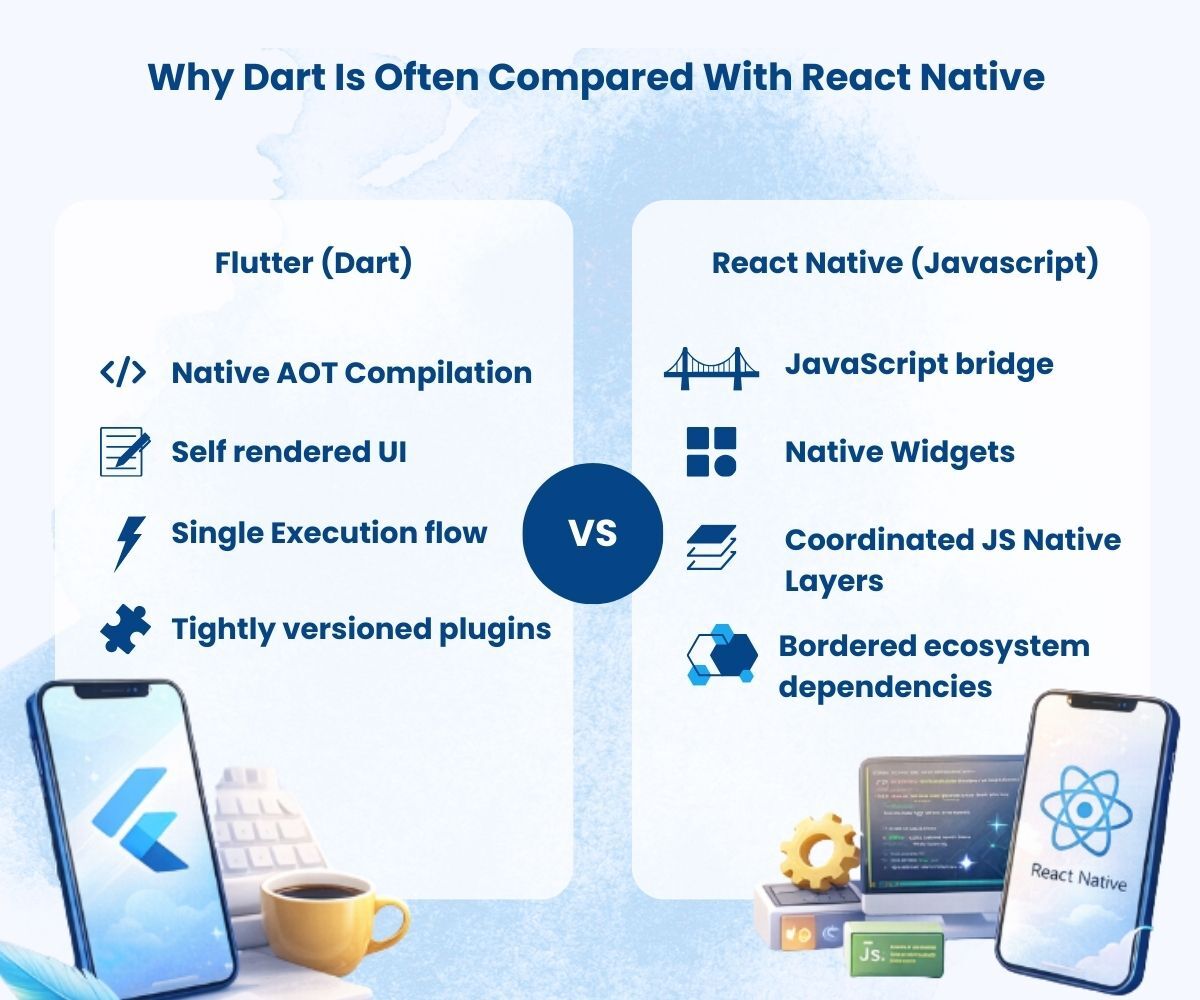
Release builds compile directly to native machine code, which removes the need for an intermediary runtime at execution time.
UI rendering does not depend on native platform widgets, and visual updates, layout calculations, and state changes all run within the same execution flow.
React Native follows a different path. It depends on JavaScript communicating with native components, which adds coordination overhead and makes performance more sensitive to how often logic crosses that boundary.
Although the architecture has improved over time, it still involves coordination between JavaScript and platform-specific layers.
These architectural differences are why teams keep comparing Flutter with React Native when weighing consistency, performance, behavior, and long-term maintenance in cross-platform mobile apps.
This difference shows up in three areas that product teams care about.
1. UI consistency across platforms
- Flutter apps look the same everywhere unless you deliberately change them.
- React Native apps inherit platform-specific UI behavior unless explicitly overridden.
2. Performance predictability
- Dart’s compilation model removes runtime interpretation overhead in release builds.
- Animation-heavy screens, gesture handling, and custom UI transitions tend to behave more predictably.
- React Native performance varies based on how much logic crosses the bridge and how well native modules are written.
3. Dependency Stability
- Flutter plugins are tightly versioned with the framework.
- React Native packages depend on a broader JavaScript ecosystem, which introduces faster innovation but also higher churn.
- Neither approach is “better” by default. The difference is architectural, not philosophical.
Is Dart Reliable Enough for Large Mobile Applications?
Benchmarks and demo apps have nothing to do with reliability. When a product surpasses certain levels, it appears:
- Several cycles of release
- Teams with more than five developers
- Long-term upkeep responsibilities
- OS-level modifications from Google and Apple
Dart performs well here for a few reasons, they are:
Strong Typing and Compile-Time Feedback
Dart’s type system catches a large class of errors before runtime. This matters more as teams grow and features expand. Refactors are safer, and unintended side effects surface earlier.
Clear concurrency model
Dart uses isolates instead of shared-memory threads. Each isolate has its own memory and communicates via message passing. This reduces entire categories of race conditions that plague mobile apps with heavy background work.
Predictable upgrade paths
Flutter releases follow a documented cadence. Breaking changes are announced early and supported by migration tooling. That level of discipline is rare in frontend ecosystems.
This does not mean Dart apps are immune to technical debt. Poor state management or rushed architecture choices still hurt. Dart simply gives teams fewer ways to fail silently.
Dart and AI Integrations
AI features are no longer optional add-ons. Recommendations, content processing, image analysis, and conversational interfaces are becoming standard expectations.
The question is whether Dart holds teams back when AI enters the picture.
Direct On-Device AI
Dart does not compete with Python or C++ for model training. That work still belongs on servers or native layers.
For on-device inference, Flutter apps typically rely on:
- TensorFlow Lite via platform channels
- Core ML integrations on iOS
- ML Kit for vision and text use cases
Dart acts as the orchestration layer rather than the computation engine. This is similar to how React Native handles AI features.
API-Driven AI Workflows
Most production apps consume AI through APIs. Dart handles this well:
- Async networking is built into the language.
- JSON handling is mature.
- Background task management is predictable.
Is There Dart-Native AI Enablement?
There is no widely adopted, Dart-first AI ecosystem comparable to Python’s. That is not a weakness in mobile development contexts.
Mobile apps rarely train or fine-tune models locally. They consume AI outputs. Dart fits this role cleanly.
Teams building AI-heavy mobile apps usually face challenges in data privacy, latency, and UX design rather than language limitations.
Is Dart Taking Over From React Native
Adoption Signals in 2024-2025
Industry surveys and repository metrics point to a few consistent patterns across the mobile ecosystem. Flutter continues to rank among the most starred mobile frameworks on GitHub, reflecting strong developer interest and sustained community activity.
Startup adoption has expanded steadily, particularly in regions outside North America, while enterprise usage has grown for internal tools, finance platforms, and commerce applications.
React Native remains the default choice for teams with established React web stacks, where shared knowledge and component reuse reduce onboarding friction.
Neither framework is displacing the other outright. Instead, adoption patterns suggest a market that is segmenting based on team background, product requirements, and long-term maintenance priorities.
This preference is consistently reflected in developer surveys by Stack Overflow that track framework usage and ecosystem familiarity across web and mobile teams.
Calling Dart “the default” would be inaccurate. Calling it “established and credible” would not.
Can you Rely Solely on Dart for Mobile App Development?
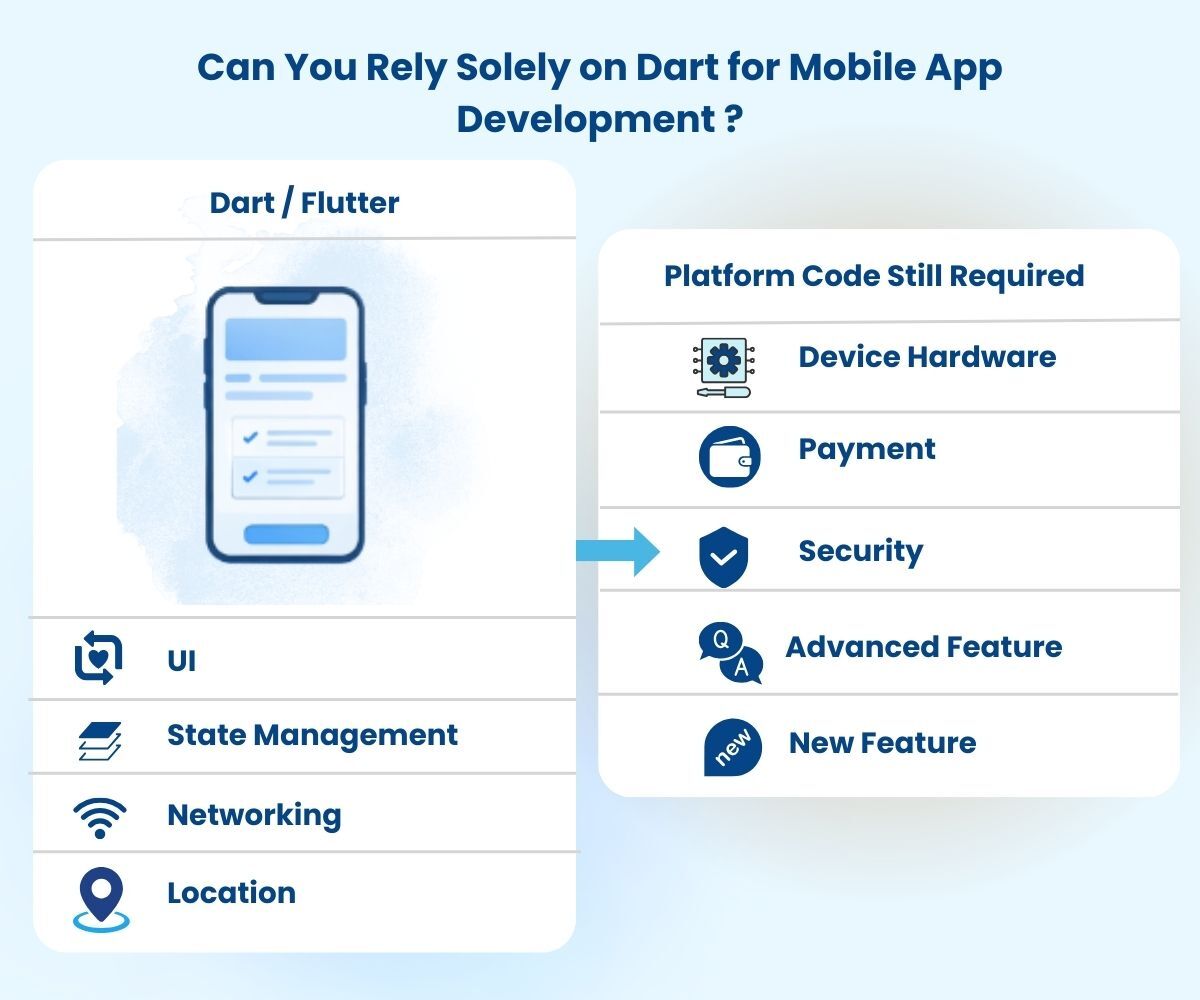
Dart does a lot of the heavy lifting, but no serious mobile team treats it as a one-tool solution.
Dart capabilities:
- Most screens, transitions, and custom components stay entirely in Dart without friction.
- App state, user flows, and data sync logic remain predictable when handled within Dart’s type system.
- API calls, authentication flows, and response handling fit naturally into Dart’s async model.
- Routing, deep links, and multi-step user journeys rarely require platform-specific code.
- Timers, scheduled jobs, and lightweight background work can stay in Dart as long as OS rules are respected.
Where Native Code Still Appears:
- Bluetooth, sensors, and device-specific controls still lean on native APIs.
- Payment SDKs and security-sensitive features often require direct native integration.
- Video pipelines, live filters, and heavy audio work usually step outside Dart.
- When Apple or Google ships something new, native support shows up before Flutter plugins catch up.
Most Flutter apps include small amounts of native code. That does not defeat the purpose of using Dart. It reflects mobile reality.
Teams expecting zero native touchpoints are setting unrealistic expectations, regardless of framework choice.
Final Verdict
Dart is not replacing React Native. It is not eliminating native development. It is not becoming a universal standard.
What it is doing is earning its place as a serious, dependable option for cross-platform mobile apps.
In 2026, choosing Dart through Flutter is a strategic decision rather than a trendy one. It suits teams that value UI control, predictable behavior, and a focused toolchain.
The smarter question is no longer “Is Dart taking over?”
The better question is “Does Dart fit how this product needs to be built and maintained?”
For many teams, the answer is increasingly yes.
Build Your Next App with Dart & Flutter
Get expert guidance on cross-platform mobile app development. Turn your ideas into high-performance apps quickly and efficiently.