Online food delivery is no longer optional for restaurants — it’s a major revenue driver. But as competition grows, restaurant owners face an important decision: build a custom restaurant delivery app or rely on food aggregator platforms like Zomato and Swiggy? This restaurant delivery app vs food aggregator app debate directly impacts customer relationships, profit margins, and long-term business growth.
This guide breaks down the restaurant delivery app vs food aggregator app comparison in plain language: what both models are, how they differ, what each costs, and how to decide which option — or combination — fits your business best.
What Is a Restaurant Delivery App?
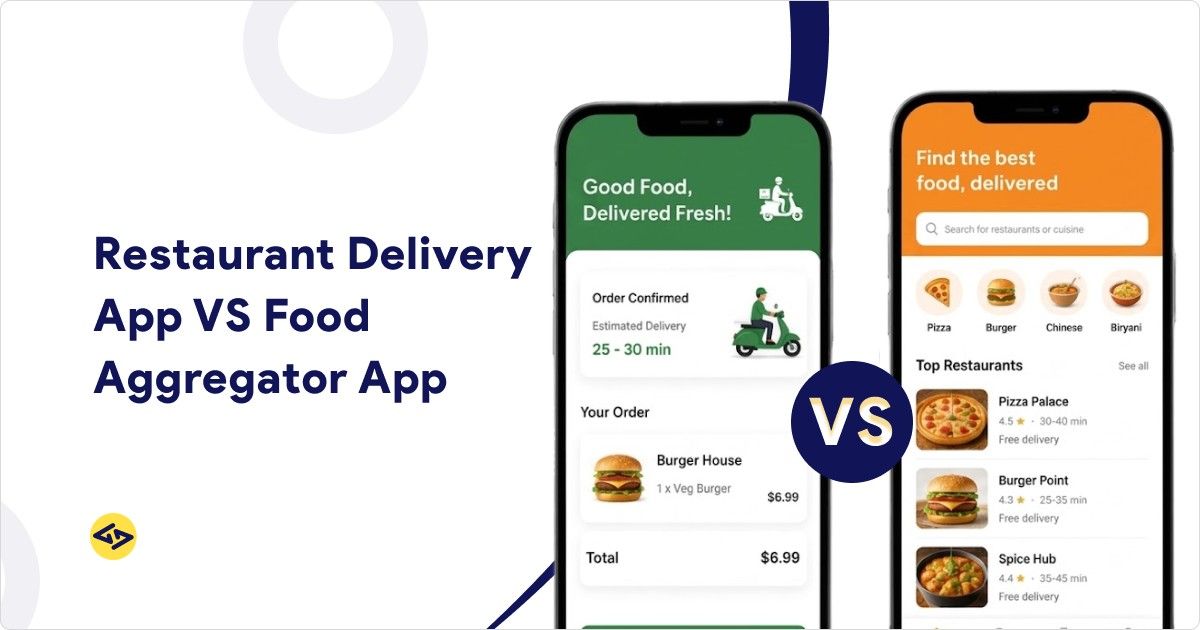
A restaurant delivery app is a dedicated mobile app built for one restaurant or restaurant chain. Customers download it, browse your menu, and order directly from you; no other restaurants are listed alongside yours, and the orders go straight into your system or to your delivery partner.
This is the model behind direct ordering apps for restaurants: every order, every customer profile, and every rupee of revenue routes through a channel you control.
Typical restaurant delivery app features include:
- Online ordering and menu management
- Real-time order tracking for customers and kitchen staff
- Loyalty programs and reward points
- Personalized offers based on order history
- Secure in-app payments
- Push notifications for promotions and reorders
Because the app is custom-built, a restaurant ordering app vs aggregator app comparison almost always starts here: with the question of how much control and customization you actually need.
What Is a Food Aggregator App?
A food aggregator app is a marketplace that lists dozens or hundreds of restaurants in one place, lets customers search and filter by cuisine or rating, and manages delivery logistics on the restaurant’s behalf. Zomato, Swiggy, Uber Eats, and DoorDash are the best-known examples of this model.
Key features of a food aggregator app typically include:
- Restaurant listings with photos and menus
- Search, filters, and recommendation algorithms
- Customer reviews and ratings
- Built-in delivery fleet management
- Multiple payment options and wallets
So how do food aggregator apps work in practice? The platform handles discovery, payments, and delivery, then takes a commission on every order, usually somewhere between 15% and 30%, depending on the market and the services bundled in (delivery, advertising placement, etc.).
Restaurant Delivery App vs Food Aggregator App: Quick Comparison
| Factor | Restaurant Delivery App | Food Aggregator App |
| Customer Data | Full ownership | Limited or no access |
| Branding | Full control | Limited customization |
| Upfront Cost | High (development) | Low to none |
| Ongoing Cost | Maintenance only | 15%–30% commission per order |
| Profit Margin | Higher long-term | Lower per order |
| Customer Reach | Limited initially | High from day one |
Restaurant Delivery App vs Food Aggregator App: Key Differences
This is the heart of any restaurant delivery app comparison. The two models differ across five practical dimensions:
1. Ownership of customer data. With your own app, you own every customer record, order history, and contact detail. With an aggregator, the platform owns that relationship; you rarely even get a customer’s phone number.
2. Branding and customer experience. Your own app is a blank canvas: your colors, your loyalty program, your tone. On an aggregator, you’re one tile among many competitors, with little room to differentiate.
3. Cost structure. A restaurant delivery app means upfront development and ongoing maintenance costs. A food aggregator app means little to no upfront cost, but a recurring commission on every single order, forever.
4. Marketing reach. Your own app needs you to drive downloads and repeat visits. An aggregator app puts you in front of its existing user base on day one, instant exposure, but shared with every competitor on the platform.
5. Profit margins. Direct ordering protects your margins long-term since there’s no per-order cut. Aggregator orders are reliably less profitable per transaction, even when volume is higher.
Benefits of a Restaurant Delivery App
Choosing the own delivery app vs third-party delivery app route pays off in a few clear ways:
- Stronger, more consistent brand identity
- Direct engagement with customers through notifications and offers
- Better long-term profit margins with no per-order commission
- Loyalty and retention tools you fully control
- Complete operational control over pricing, promotions, and data
Benefits of a Food Aggregator App
The food aggregator vs direct ordering comparison isn’t one-sided, though; aggregators offer real advantages, especially early on:
- Faster market access with no app to build first
- Access to a much larger, ready-made customer base
- Easy onboarding, often live within days
- Lower upfront investment, since there’s no development cost
- Built-in logistics, so you don’t need your own delivery fleet
Challenges of Restaurant Delivery Apps
Before committing to a restaurant delivery app for business, it’s worth knowing the trade-offs:
- Higher initial investment in design and development
- Customer acquisition costs, since you must drive your own downloads
- Ongoing app maintenance and updates
- The added responsibility of managing delivery logistics yourself
Challenges of Food Aggregator Apps
Aggregators come with their own friction points:
- High commission fees that eat into thin restaurant margins
- Limited brand visibility compared to a dedicated app
- Heavy competition, since rival restaurants are one scroll away
- Little to no access to customer data for remarketing
Cost Comparison: Restaurant Delivery App vs Food Aggregator App
A fair food delivery business model comparison needs to look at total cost, not just upfront price.
Restaurant delivery app development cost generally covers:
- UI/UX design for the ordering flow
- App development for iOS, Android, or both
- Backend infrastructure (order management, payments, kitchen integration)
- Ongoing restaurant app maintenance cost for updates, bug fixes, and new features
As a rough benchmark, a custom restaurant delivery app typically costs $8,000–$50,000+ depending on platform coverage (iOS, Android, or both), feature depth, and backend complexity. A simple single-restaurant app with basic ordering and payments sits at the lower end; a multi-location chain app with loyalty programs, live order tracking, and POS integration pushes toward the higher end. Ongoing maintenance usually runs 10%–20% of the original build cost per year.
Food aggregator app development cost, from a restaurant’s perspective, isn’t really a development cost at all — it’s:
- Commission charges on every order, typically 15%–30% per transaction
- Marketing spend to stand out within the platform’s search results
- Subscription or “featured listing” fees on some platforms
For a deeper breakdown of timelines and budgeting, our guide on food delivery app development time covers what actually drives cost and schedule on custom builds.
In short: aggregators win on day-one cost, but a restaurant delivery app development cost is a one-time-ish investment that stops bleeding margin on every order once it’s paid off.
Which Option Is Better for Your Business?
There’s no universal answer to “which is better, food aggregator or restaurant app” — it depends on where your business is right now.
Choose a restaurant delivery app if:
- You already have an established brand and loyal customer base
- You see meaningful repeat order volume
- You want long-term growth, margin control, and direct customer data
Choose a food aggregator app if:
- You’re a new restaurant or a small, single-location business
- You need fast visibility without a marketing budget
- You want to test demand before investing in your own platform
Hybrid Approach: Best of Both Worlds
Many successful restaurants don’t actually choose one model — they run both, deliberately. The hybrid approach is simple: use aggregator apps for discovery and reach, and use your own app for retention and loyalty. List on Swiggy or Uber Eats to capture new customers who are browsing, but actively encourage repeat customers to switch to your direct app with loyalty points, exclusive discounts, or faster checkout. Over time, this shifts your highest-value, most loyal customers onto the channel with the best margins, while the aggregator keeps bringing in fresh foot traffic.
This is exactly the strategy explored in our piece on how to build a food delivery app, which walks through balancing acquisition and retention without picking just one channel.
For most restaurants, the ideal strategy is to start with aggregator apps for visibility and gradually shift loyal customers to a branded delivery app for higher profitability.
Final Verdict
Both models work, they’re just optimized for different goals. A food aggregator app gets you customers fast with minimal investment, while a restaurant delivery app builds long-term brand equity and protects your margins. There’s no one-size-fits-all answer here; the right choice depends on your budget, your current customer base, and how fast you want, or need, to grow. For many restaurants, the smartest path is starting on an aggregator, then graduating to a custom app once order volume justifies the investment.
Ready to Transform Your Food Delivery Business?
Consult with our experts to choose the right app model for your restaurant and accelerate growth.

FAQs
Is a restaurant delivery app better than a food aggregator app?
It depends on your stage of growth. A restaurant delivery app offers better long-term margins and brand control, while a food aggregator app offers faster reach with no upfront app-building cost.
Which model is more profitable for restaurants?
Over time, a restaurant delivery app is typically more profitable per order since there’s no recurring commission. Aggregators can drive more volume, but at a lower margin per transaction.
Do small restaurants need their own delivery app?
Not necessarily right away. Many small restaurants start on aggregator platforms to build visibility, then invest in a custom app once they have steady repeat orders to justify the cost.
Can restaurants use both models?
Yes — this hybrid approach is increasingly common. Restaurants use aggregators for discovery and their own app for loyalty and retention.
What is the typical restaurant delivery app development cost?
Costs vary widely based on features, platforms (iOS/Android/web), and backend complexity, generally ranging from a few thousand to tens of thousands of dollars for a fully custom build with order management and payment integration.
How do food aggregator apps make money from restaurants?
Primarily through commission on each order, along with optional marketing or featured-listing fees that boost a restaurant’s visibility on the platform.
What features should a custom restaurant ordering app have?
At minimum: online ordering, real-time order tracking, secure payments, and a loyalty or rewards system. More advanced builds add personalized offers, kitchen display integration, and delivery tracking.
Is it expensive to maintain a restaurant app after launch?
There is an ongoing restaurant app maintenance cost for server hosting, security updates, and feature improvements, but it’s generally far lower than the cumulative commission fees paid to an aggregator over the same period.
How long does it take to build a custom restaurant delivery app?
Timelines depend on feature scope, but most custom restaurant ordering apps take a few months from design to launch. Our breakdown of food delivery app development time covers this in detail.
What’s the difference between a restaurant app and a general food ordering website?
A restaurant app is typically a native mobile experience tied to one brand, while a food ordering website can serve the same purpose on the web. Our guide on how to build a food ordering website explains how the two fit together.
Is it better to use Zomato or build your own app?
Zomato and similar platforms are better for fast visibility and discovery, especially for new restaurants. A custom app is better once you have a steady customer base and want to protect margins and own customer data long-term.
Can small restaurants compete without aggregator apps?
It’s possible, but harder. Small restaurants without aggregator presence rely entirely on their own marketing, social media, and word-of-mouth to drive app downloads, which usually takes longer to build volume than listing on an established platform.
How much commission do food delivery platforms charge?
Most food aggregator platforms charge between 15% and 30% per order, depending on the market, whether the platform handles delivery, and any added services like advertising or featured placement.