Most software products fail not because the team built poorly — but because they built the wrong thing. The Minimum Viable Product is the most reliable way to find out what the right thing actually is, before spending your full budget on it.
MVP in software development stands for Minimum Viable Product: the smallest working version of a product that lets real users test whether your core idea solves a real problem. The term was coined in 2001 by Frank Robinson, then popularized by Steve Blank and Eric Ries through the Lean Startup methodology.
Three words in that definition carry all the weight:
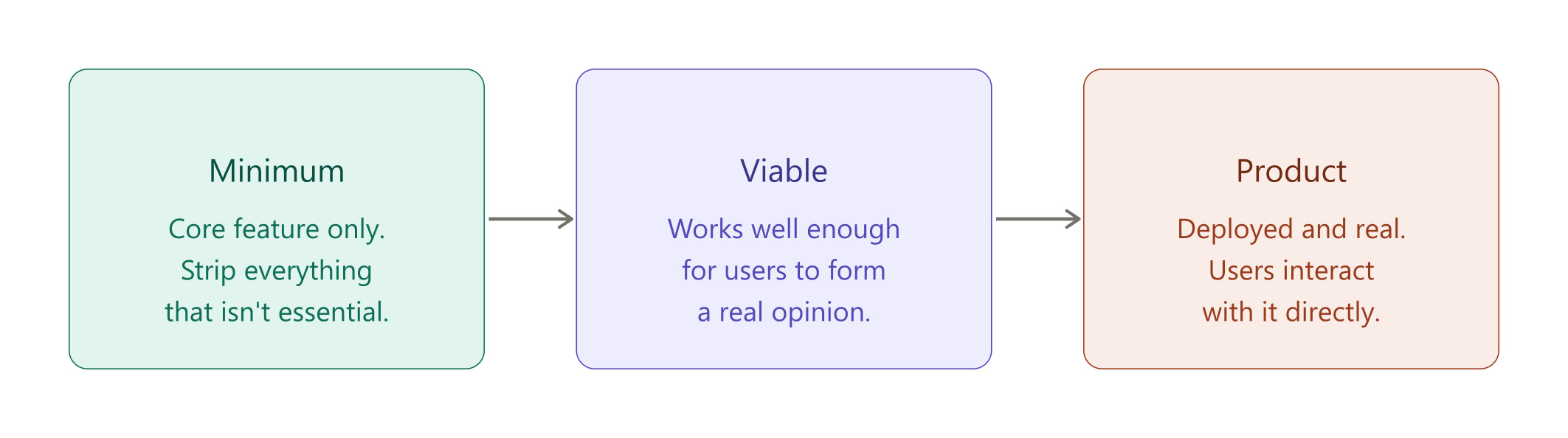
The tension between Minimum and Viable is where most founders go wrong. Cut too much and the product can’t generate real signal. Keep too much and you’ve built a full product before knowing whether anyone wants it. Every feature decision during MVP development is really a negotiation between those two.
Why an MVP matters — and what the data says
The main cause of startup failure is lack of market need — many startups fail because their product isn’t needed by enough people to generate sufficient revenue. Codebridge CB Insights, which analyzed hundreds of startup post-mortems, found this was the single largest failure category they identified.
An MVP addresses this directly by front-loading the most important question: does anyone actually want this?
It does three things nothing else does as well:
Validates with behavior, not opinion. Surveys tell you what people say they’d do. An MVP tells you what they actually do. That gap is where most product assumptions collapse.
Accelerates time to market. A focused MVP can go from scoping to launch in 8–16 weeks. That’s fast enough to test, learn, and adjust before a competitor fills the gap — or before you’ve spent everything on a direction that doesn’t work.
Strengthens investor conversations. A working product with 200 active users is a fundamentally different pitch than a slide deck. It demonstrates execution, not just vision. For startups raising early rounds, an MVP is often the difference between a meeting and a term sheet.
MVP vs. prototype vs. POC — the differences that actually matter
These three terms get used interchangeably. They’re not the same, and confusing them leads to building the wrong thing at the wrong stage.
For a full comparison of all three — including which one to build first depending on your stage — see our breakdown of MVP vs. prototype vs. POC.
|
POC |
Prototype |
MVP |
|
|
Working software? |
No |
Usually no |
Yes |
|
Purpose |
Test technical feasibility |
Test design & user flow |
Test market demand |
|
Audience |
Your dev team |
Designers, stakeholders |
Real early adopters |
|
Question it answers |
Can we build this? |
Does it look/feel right? |
Should we build this? |
An MVP is not a half-built product. It’s a complete product with a deliberately narrow scope.
Not all MVPs are the same type
Most guides treat MVP as a single approach. There are actually several types, each suited to different situations.
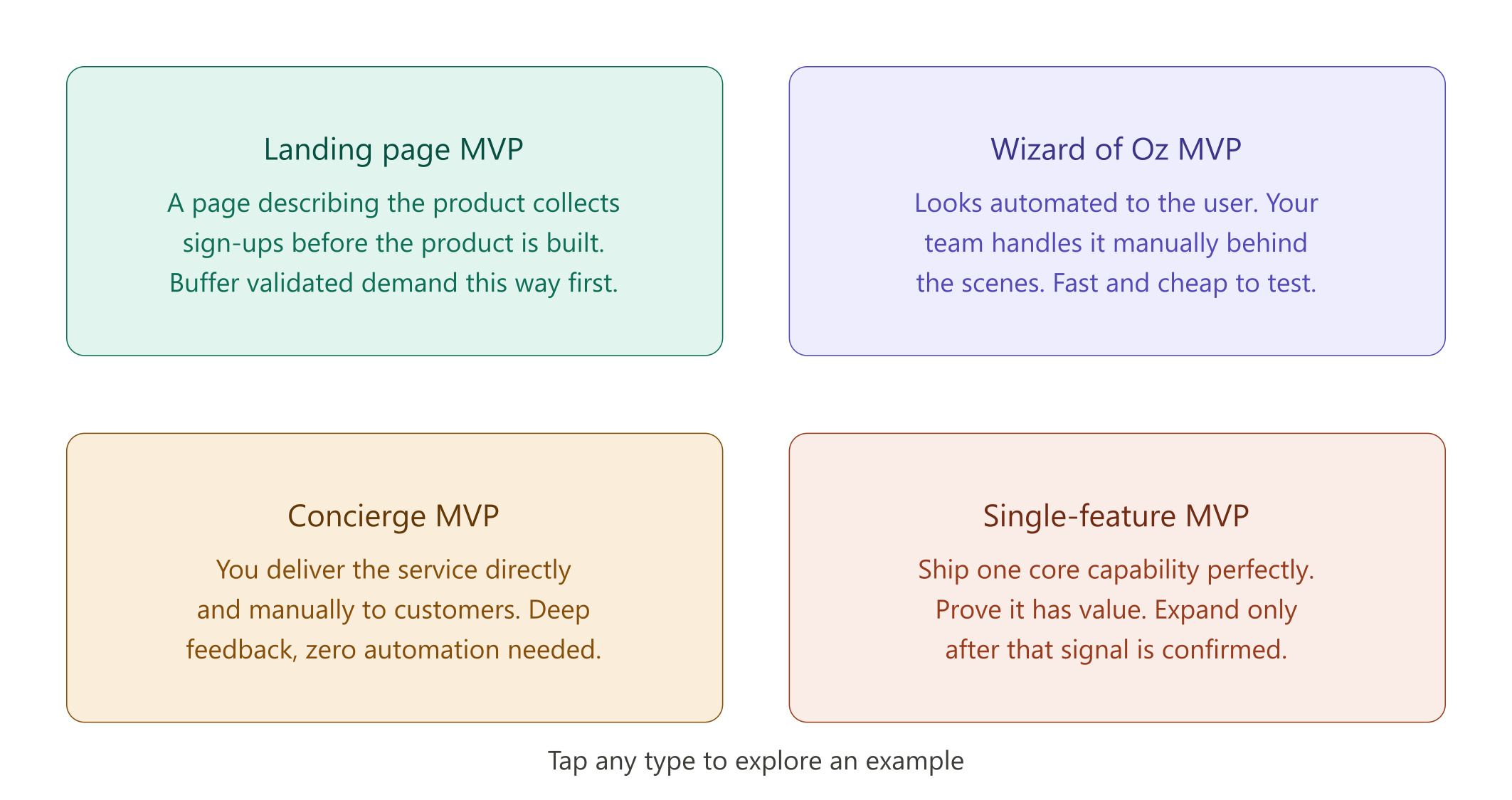
Choosing the right type matters as much as building it well. Dropbox didn’t build sync software first — founder Drew Houston created a video demonstrating software that didn’t yet exist. That video drove tens of thousands of sign-ups overnight, proving demand before a single line of sync code was written. He matched the MVP type to the question he needed to answer: is there demand? Not: can we build this?
Real examples worth studying
Understanding MVP becomes much clearer when you look at how real companies started—with simple experiments instead of fully built products.
Airbnb: Starting with a simple experiment
Airbnb began when its founders needed help paying rent and decided to host guests in their apartment during a conference. They set up a basic website and offered a place to stay with an added personal touch.
This early version wasn’t a scalable platform—it was a simple test to see if people would actually be willing to stay in someone else’s home. That initial validation helped shape what would later become a global business. (Source: Airbnb)
Dropbox: Explaining the product before building it
Dropbox faced a technical challenge: building the product would take significant time and effort. Instead of jumping straight into development, founder Drew Houston validated the idea first.
He created a simple video demonstrating how the product would work and shared it with potential users. The response showed strong interest, proving that the problem was real and worth solving before investing in building the full product. (Source: Lenny’s Newsletter – Drew Houston)
Buffer: Validating demand with a landing page
Buffer’s founder Joel Gascoigne took an even simpler approach. He created a basic landing page that explained the idea of scheduling social media posts.
There was no actual product at first—just a concept and an option for users to sign up. When people showed interest, it confirmed there was demand, allowing him to move forward with building the product. (Source: WhoAPI interview with Joel Gascoigne)
How to build an MVP — overview steps
This is a high-level map of the process. For a detailed, stage-by-stage walkthrough including feature scoping, tech stack selection, and how to structure your first user tests, see our complete guide to MVP development.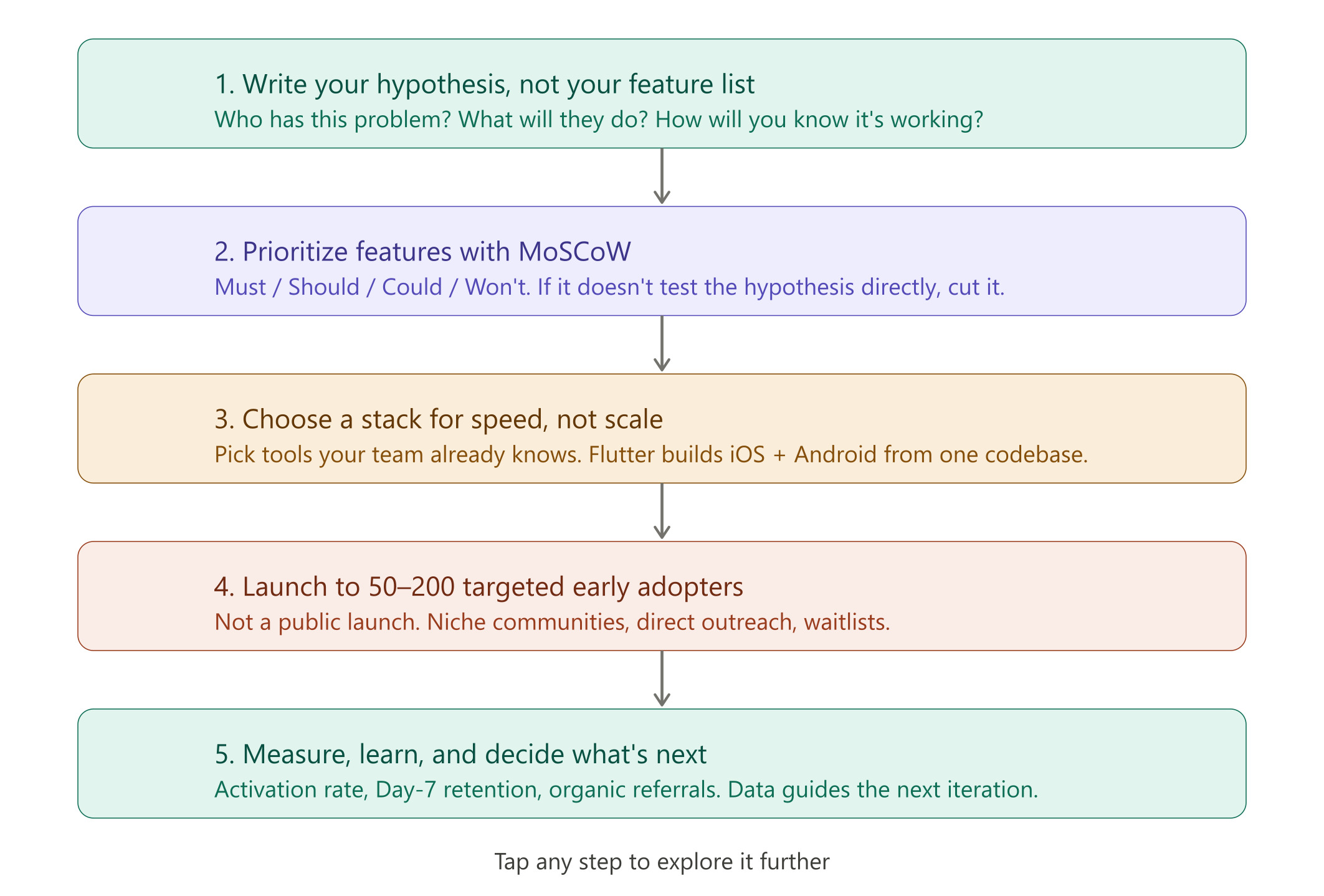
The word “MVP” gets used to justify almost anything
Because the definition requires judgment rather than a formula, the term MVP is commonly used — either deliberately or unwittingly — to refer to a much broader notion, ranging from a prototype-like product to a fully-fledged and marketable product.
In practice, this means two failure modes:
Launching too early with something that’s broken or missing the structural features users need to form a real opinion — then misreading the poor response as product failure when it was really execution failure.
Renaming a full product “MVP” to justify a 9-month build. If it takes that long, it’s not an MVP — it’s a v1 with a different label.
The right question before every build decision: does this help us learn whether the core idea works? If yes, it belongs. If not, it waits.
Is MVP only for startups?
No. While startups frequently use MVPs to validate their business ideas, established companies also use them to test new product concepts. Wikipedia
Enterprises use the MVP approach when launching new product lines, entering new markets, or building internal tools where the requirements aren’t yet well-defined. The agile MVP development methodology translates equally well to large organizations — the principle is the same: test before you scale.
This is particularly relevant for SaaS products, where the feature scope can expand rapidly and the cost of building the wrong thing compounds quickly. Our guide on SaaS app development cost covers how MVP thinking directly reduces early-stage spend for SaaS builds. We’ve refined our SaaS development services specifically for MVPs to help you prioritize core features and scale effectively.
When your MVP is ready to grow
You’re looking for signal, not perfection. These indicators suggest your MVP has generated enough validated learning to justify the next investment:
- Users return without re-acquisition (organic retention)
- Some users refer others without incentive
- At least 40% say they’d be “very disappointed” if the product disappeared — Sean Ellis’s widely used product-market fit benchmark
- Feature requests are additions, not replacements for what you built
When these appear, the question shifts from “should we build this?” to “how do we scale it?” For what comes next, see our guide on how to promote your MVP once you have early traction.
Working with an MVP development partner
If you’re working with an external team, scope clarity is the most valuable input you can provide. A good development partner will push back on a bloated feature list — that’s a signal they understand the process, not a problem.
At iCoderz Solutions, we’ve built MVPs across fintech, healthtech, edtech, and marketplace verticals for founders in the US and India. The most common issue isn’t founders who don’t understand what an MVP is — it’s founders who’ve already decided on the solution before validating the problem.
If you’re at that early stage, our MVP development services are structured around the validation process above.
FAQ on MVP:
What does MVP stand for in software development? Minimum Viable Product — the smallest functional version of a product that tests a core hypothesis with real users.
What is the difference between an MVP and a prototype? A prototype demonstrates how a product looks and flows — usually non-functional, built for design feedback or investor demos. An MVP is working software that real users interact with to solve a real problem.
How long does it take to build an MVP? A properly scoped MVP typically takes 8–16 weeks from kick-off to first users. If it’s taking significantly longer, the scope is likely too large for an MVP.
How much does MVP development cost? Costs vary by platform (web vs. mobile vs. both), complexity, and development team. A focused mobile MVP with an experienced offshore team typically runs $15,000–$60,000. Web-only MVPs can be leaner. The more important variable is whether the scope is genuinely minimal enough to serve as a test, not a launch.
Can you build an MVP without coding? Yes, for many product types. No-code platforms like Bubble and Webflow allow non-technical founders to ship functional MVPs — particularly for marketplace, SaaS, and content products. For technically complex products (real-time data, heavy backend logic, hardware integration), a development partner is usually necessary.
What comes after an MVP? Once you have retention signals and early product-market fit evidence, you move into iterative feature development based on user data. The next phase is typically an MMP (Minimum Marketable Product) — a version ready for broader market release.
Is MVP development only for startups? No. Enterprises use the same approach when launching new products, entering adjacent markets, or validating internal tool investments. The principle — test before you scale — applies regardless of company size.