In the high-stakes world of custom software development, misaligned requirements are the leading cause of “Technical Debt” and massive budget overruns. A Software Requirement Specification (SRS) document is the formal blueprint that prevents these risks. It documents every functional and non-functional requirement before a single line of code is written, ensuring a smooth transition from concept to code.
What is an SRS?
A Software Requirement Specification (SRS) document is a structured report that describes the features, behavior, and constraints of a software application. It serves as a technical contract between stakeholders and engineers, ensuring the final product aligns with business goals and technical feasibility.
How is the SRS Useful in Software Engineering?
For a professional software development company, the SRS is the “North Star” of the project lifecycle. Its utility spans every phase of the SDLC (Software Development Life Cycle):
A. Agreement Between Customer and Supplier
It forces the client to define exactly what they want and allows the developer to confirm what is technically achievable. It eliminates the “I thought you meant this” conversations that derail projects.
B. Reducing Development Effort
By identifying contradictions (e.g., “The system must be offline” vs. “The system must sync in real-time”) during the documentation phase, you avoid the 10x-50x cost of fixing these errors during the coding or testing phase.
C. Basis for Estimation
Without a structured srs format in software engineering, project managers cannot accurately calculate the “Man-Hours” or the budget required for hiring software developers.
D. Software Validation (QA)
The Quality Assurance (QA) team uses the SRS as their primary reference to create “Validation Test Suites.” If a feature is not in the SRS, it doesn’t exist for the testers.
Decoding Requirement IDs: What is “SRS-NFR-01”?
In professional software engineering, requirements are assigned unique identifiers for Traceability. You will often see codes like SRS-FR-01 (Functional) or SRS-NFR-01 (Non-Functional).
- SRS: Identifies the document.
- FR (Functional): Defines what the system does (e.g., “The user can click a Login button”).
- NFR (Non-Functional): Defines how well the system performs (e.g., “The login process must be secure”).
- 01: The unique index number for that specific requirement.
Why use IDs? They allow developers to tag code (e.g., // Implementing SRS-NFR-01) and testers to link bugs directly to a specific requirement, ensuring 100% project coverage.
8 Essential Software Requirement Specification Characteristics
To align with the IEEE 830-1998 standard and the modern ISO/IEC/IEEE 29148:2018, a professional Software Requirement Specification (SRS) document must be:
- Unambiguous: Every requirement must have only one interpretation. Avoid vague terms like “user-friendly.”
- Complete: No missing logic or “to be determined” (TBD) sections.
- Consistent: No two requirements should conflict (e.g., conflicting access levels).
- Verifiable: Every requirement can be tested and measured via a “Pass/Fail” metric.
- Traceable: Every requirement can be traced back to a business goal and forward to a test case.
- Modifiable: The document must be structured to allow for updates without breaking the logic.
- Correct: Validated by both the client and the lead software architect.
- Ranked for Importance: Clear distinction between “Must-have” and “Nice-to-have” features.
The Standard Structure of SRS in Software Engineering
A high-ranking SRS follows a standardized, hierarchical structure. This ensures that whether you are doing web development or mobile app development, the team can find information instantly.
1.0 Introduction
- 1.1 Purpose: Define the goal of the document.
- 1.2 Scope: Detailed boundaries of the project.
- 1.3 Glossary: Definitions of technical/domain terms.
2.0 Overall Description
- 2.1 Product Perspective: Is this a standalone product or part of a legacy ecosystem?
- 2.2 Operating Environment: Defining browser compatibility (e.g., Chrome v110+) and OS versions for iOS development and Android development.
- 2.3 Design and Implementation Constraints: Regulatory, hardware, or API limitations.
3.0 System Features & Components (The “What”)
This is where the Functional Requirements live, detailing every click, swipe, and data calculation.
4.0 Non-Functional Requirements (The “How Well”)
This covers Security, Availability, Scalability, and Maintainability.
Enterprise-Grade Components: Lessons from Global Standards
Based on international project standards (like the Enabel SRS Detailed Annex), a truly robust SRS must include these “Tender-Grade” components:
A. Role-Based Access Control (RBAC) Matrix
A professional SRS defines a Permission Matrix. You must explicitly state which user roles (Admin, Editor, Viewer, Guest) have “Create, Read, Update, Delete” (CRUD) rights for every module.
B. Environmental & Hosting Infrastructure
The SRS must define the System Environments:
- Development Environment: Where the coding happens.
- Staging Environment: Where the client reviews the software.
- Production Environment: The live server (AWS, Azure, or On-premise).
- Hardware Constraints: Minimum CPU, RAM, and Disk space requirements for hosting.
C. Data Migration Requirements
If you are replacing a legacy system, the SRS must define the Data Migration Strategy.
- What data is being moved?
- How will it be mapped?
- What is the acceptable “Data Loss” threshold (usually 0%)?
D. Error Management & Resilience
A “High-Availability” SRS defines how the system handles failure.
- Graceful Degradation: If a third-party API fails, what does the user see?
- Error Logging: Every critical error must be logged with a timestamp and User ID for auditing.
E. Quality Assurance & Acceptance Criteria
The SRS should specify the Acceptance Criteria—the exact conditions under which the client will agree the project is “Done.” This includes Performance Testing and User Acceptance Testing (UAT).
Functional vs. Non-Functional Requirements: The Technical Deep Dive
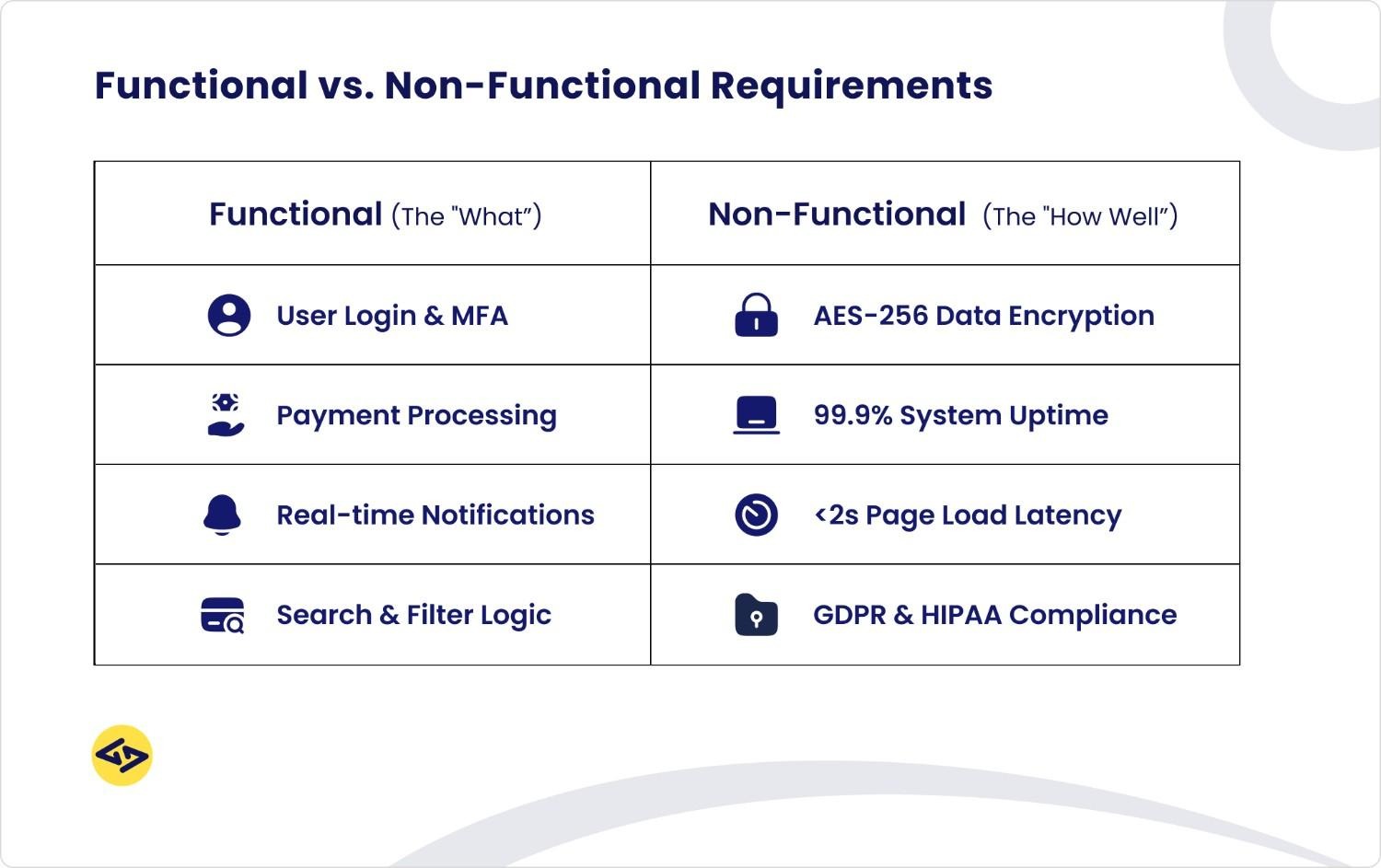
The most important components of srs in software engineering are categorized into Functional and Non-Functional tiers.
Functional Requirements (FR)
These describe the system’s behavior.
- Example: “The system shall allow the Admin to deactivate user accounts.”
- Input/Output: Define exactly what the input is and what the expected output must be.
Non-Functional Requirements (NFR)
These describe the quality of the system’s performance.
- Security (SRS-NFR-01): “The system shall use AES-256 encryption for all data at rest.”
- Scalability (SRS-NFR-02): “The database shall support horizontal scaling to handle 50,000 concurrent users.”
- Portability (SRS-NFR-03): “The application shall be compatible with both Linux and Windows server environments.”
Comparative Analysis: SRS vs. PRD vs. User Stories
To rank for comparison-based searches, we must distinguish between different documentation types used in enterprise software solutions.
| Feature | SRS (Technical Spec) | PRD (Product Spec) | User Stories (Agile) |
| Primary Audience | Developers & Architects | Product Managers | Scrum Teams |
| Level of Detail | High Technical Detail | Business Vision | Narrative/Task-based |
| Primary Goal | Technical Accuracy | Product-Market Fit | Incremental Delivery |
| Best For | Complex Engineering | Market Launch | Rapid Prototyping |
Software Requirement Specification Document Example
Here is a practical software requirement specification document example for a “Global Logistics Platform”:
| ID | Category | Technical Specification | Priority |
| SRS-FR-01 | User Roles | Implement a Role-Based Access Control (RBAC) for 5 distinct user levels. | Critical |
| SRS-FR-12 | Geo-Tracking | The system shall update GPS coordinates every 60 seconds via Google Maps API. | High |
| SRS-NFR-01 | Security | Multi-Factor Authentication (MFA) must be mandatory for all Admin logins. | Critical |
| SRS-NFR-09 | Compliance | The software must comply with GDPR data residency laws for European users. | Critical |
Common Pitfalls to Avoid in an SRS
- Over-Specification: Don’t tell the developer how to code (e.g., “Use a For-loop”). Tell them the result (e.g., “Calculate the sum of all invoices”).
- Subjective Language: Avoid terms like “Fast,” “Reliable,” or “Robust.” If it isn’t a number, it isn’t a requirement.
- Static Documentation: An SRS shouldn’t gather dust. It must be a “Living Document” that evolves during the hiring of dedicated developers.
- Lack of Visuals: A 50-page text document is hard to read. High-quality SRS docs include Use-Case Diagrams, Data Flow Diagrams (DFDs), and Wireframes from the UI/UX design team.
How iCoderz Solutions Crafts the Perfect SRS
At iCoderz Solutions, we follow a rigorous “Discovery Phase” to ensure your Software Requirement Specification (SRS) document is bulletproof:
- Stakeholder Interviews: We talk to everyone from the CEO to the end-user to find hidden requirements.
- Technical Feasibility: We validate every requirement against modern tech stacks to ensure your project is buildable and scalable.
- Traceability Mapping: We ensure every functional feature is linked to a business outcome (ROI).
- Maintenance Planning: Our SRS documents include post-launch support and software maintenance guidelines.
Major Benefits of SRS in Software Engineering
- Investment Protection: You spend 10% on documentation to save 50% on future rework.
- Architectural Clarity: Helps architects choose the right frameworks for web development.
- Clear Milestones: It turns vague ideas into a transparent, executable project roadmap.
Build Your Next Software Solution with iCoderz
Don’t gamble with your development budget. At iCoderz Solutions, we believe that great software starts with great documentation. Our team of experts is ready to help you craft a flawless Software Requirement Specification (SRS) document and build a solution that scales.
Whether you need enterprise software, a high-traffic web platform, or a cutting-edge mobile app, our engineers bring precision and transparency to every project.
Contact iCoderz Solutions Today to get a professional blueprint for your next software project.
FAQ: Common Questions About SRS
1. What is the most important part of an SRS?
The Functional Requirements are the core, as they define the features and data handling logic of the software.
2. What are the main benefits of srs in software engineering?
The main benefits of srs in software engineering include accurate cost estimation, risk mitigation, and a clear “Definition of Done” for the QA team.
3. Can I use an SRS for an Agile project?
Yes. While Agile uses User Stories, a “Lean SRS” is often used to maintain a high-level technical overview of the system architecture and security protocols.
4. What are the components of SRS in software engineering for FinTech?
For FinTech, the SRS must include extra sections on Data Encryption, Audit Trails, and Regulatory Compliance (e.g., PCI-DSS).