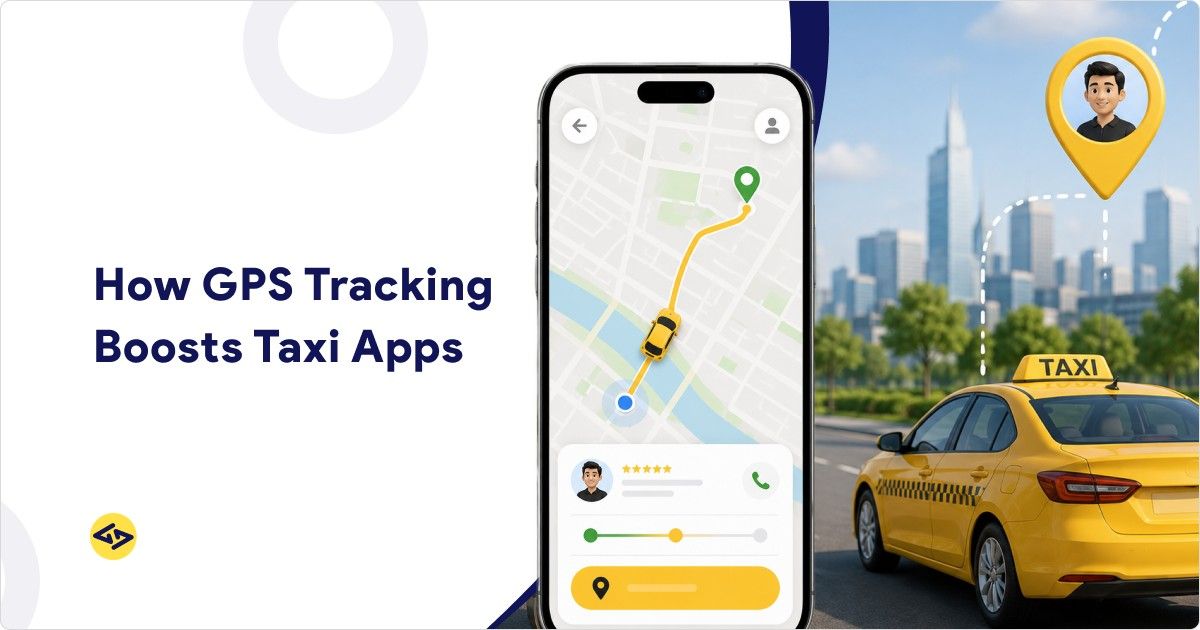
The ride-hailing industry has witnessed exponential growth, with the global market expected to reach $344.4 billion by 2030. At the heart of this transformation lies one critical technology: GPS tracking in taxi booking apps. Real-time location tracking has become the backbone of modern transportation services, enabling everything from instant driver allocation to accurate fare calculation.
GPS Tracking in Taxi Apps powers essential features such as live driver tracking, route optimization, accurate ETA predictions, and enhanced passenger safety. For passengers, it means knowing exactly when their ride will arrive. For drivers, it provides the fastest and most efficient routes. For taxi businesses, it offers complete fleet visibility, helping reduce operational costs, improve driver productivity, and deliver a seamless customer experience.
In this guide, we’ll explore how GPS tracking for taxi apps enhances performance across every touchpoint—from faster ride matching and accurate ETA calculations to improved safety features and AI-powered optimization.
What Is GPS Tracking in a Taxi Booking App?
GPS tracking in taxi booking apps is a location-based technology that enables real-time monitoring of vehicles, drivers, and passengers throughout the entire ride journey. Using satellite signals and mobile network data, it provides precise geographical coordinates that power features like live driver tracking, route navigation, and trip monitoring.
The system works through a sophisticated ecosystem: driver smartphones receive GPS satellite signals to determine exact coordinates, transmit this data through mobile internet, and process it via Google Maps API for taxi apps or similar services to display on interactive maps. The system continuously updates location data every 3-10 seconds, providing seamless live location tracking taxi app functionality.
GPS is essential for modern ride-hailing app development because it enables automated driver-passenger matching, builds customer trust through transparency, ensures safety via real-time monitoring, and eliminates manual dispatch coordination. According to industry research, apps with real-time GPS tracking taxi app features see 42% higher customer retention and 35% fewer cancellations compared to traditional dispatch systems.
How GPS Tracking Improves Taxi Booking App Performance
Real-Time Driver Tracking and Faster Ride Matching
Passenger live tracking functionality updates the driver’s position on the map every few seconds, creating smooth animated movement that passengers can follow. This real-time visibility reduces passenger anxiety, allows them to time their exit from buildings, and helps identify the correct vehicle.
Modern GPS-based taxi booking systems use geospatial algorithms to instantly calculate distances between passenger locations and all available drivers, evaluating physical proximity, actual driving distance, estimated arrival time, and driver ratings. This intelligent matching happens in milliseconds, reducing average pickup times by 40-60%. Research shows that every 30-second reduction in pickup time increases customer satisfaction scores by approximately 8%.
Route Optimization and Accurate ETA
Route optimization for taxi apps analyzes current traffic conditions, historical patterns, road closures, weather conditions, and time of day to suggest optimal paths. The taxi app navigation system continuously recalculates routes during trips, automatically rerouting when conditions change.
Using real-time traffic data, GPS navigation for taxi booking apps can reduce trip times by 15-30% during peak hours while decreasing fuel consumption by 10-20%. For fleet operators running hundreds of vehicles, this translates to significant cost savings. Understanding these cost implications is crucial when planning taxi booking app development.
Taxi app ETA calculation uses sophisticated algorithms considering current driver location, distance to pickup, real-time traffic, historical speed data, and driver behavior patterns. These estimates update continuously, maintaining 85-95% accuracy. Accurate ETAs are among the top factors influencing customer satisfaction, with precise predictions resulting in 28% higher retention rates and 45% fewer cancellations.
Enhanced Fleet Management and Safety
GPS-enabled fleet tracking software provides real-time location and status of every vehicle on centralized dashboards. This GPS fleet tracking system offers live map views, color-coded status indicators, trip history replay, and geofencing alerts.
Taxi dispatch software with GPS tracking identifies idle vehicles and suggests drivers relocate to high-demand zones, provides heat maps showing booking concentration, and optimizes driver positioning during peak hours. Fleet operators using GPS-based management report 15-25% improvements in vehicle utilization rates.
For safety, modern taxi booking app features include live trip sharing with driver details and real-time location updates, SOS button integration with automatic GPS coordinate sharing, and emergency location tracking. GPS data combined with accelerometer sensors also provides driver safety feedback on speeding, harsh braking, and route compliance.
Key GPS Features Every Taxi Booking App Should Have
For comprehensive feature planning, explore our detailed guide on taxi booking app features.
Customer App: Live driver tracking with continuous map updates, dynamic ETA calculations, route preview before booking, trip sharing with emergency contacts, and saved locations.
Driver App: Turn-by-turn navigation with voice guidance, route optimization suggestions, demand heat maps, and ride request alerts with distance and earnings preview.
Admin Panel: Real-time fleet monitoring dashboard, driver tracking and analytics, geofencing and service area management, comprehensive trip reporting, and driver performance dashboards.
Benefits of GPS Tracking for Taxi Businesses
GPS tracking benefits for taxi apps deliver substantial business value:
- Lower Operational Costs: 10-20% fuel savings through route optimization, reduced maintenance costs, and decreased administrative overhead
- Better Fleet Utilization: 15-30% increases in revenue per vehicle through optimized positioning and reduced idle time
- Higher Customer Retention: 42% higher retention rates with real-time tracking features
- Reduced Cancellations: 35% fewer cancellations when accurate ETAs are provided
- Improved Driver Productivity: More trips per shift through faster navigation and better positioning
- Increased Profitability: Higher revenue per vehicle, lower per-trip costs, and data-driven decision making
For businesses exploring different business models, understanding these benefits is essential—learn more about taxi app revenue models.
AI + GPS: The Future of Taxi Booking Apps
The next evolution combines GPS tracking in taxi booking apps with artificial intelligence. AI-powered taxi app development represents cutting-edge technology offering competitive advantages.
AI Route Optimization analyzes historical data to predict traffic patterns before they occur, reducing average trip times by an additional 12-18% compared to standard GPS navigation. Smart Driver Matching goes beyond proximity, considering behavioral compatibility, driver familiarity with areas, and multi-factor analysis.
Traffic Prediction achieves 75-85% accuracy in predicting conditions 15-30 minutes in advance. Dynamic Pricing combines GPS location data with demand patterns for micro-zone pricing and predictive surge pricing. Demand Forecasting using AI can improve driver utilization by 20-35% through predictive positioning.
Technologies Used for GPS Tracking
Building robust taxi booking app GPS tracking requires integrating multiple technologies. Understanding this tech stack for taxi booking app development is essential:
Frontend: Flutter or React Native for cross-platform development with smooth map animations and native performance.
Backend: Laravel or Node.js for API development, with Node.js particularly suited for real-time location updates via WebSocket support.
Maps & Navigation: Google Maps API (comprehensive features, global coverage) or Mapbox (customization, cost-effectiveness for high-volume usage).
Database: PostgreSQL with PostGIS extension for geospatial queries, or MongoDB for flexible schema and fast write performance.
Cloud: AWS, Google Cloud, or Azure for scalable infrastructure, real-time databases, and serverless processing.
Location Services: GPS satellites, geofencing for virtual boundaries, and geolocation APIs for background tracking.
Challenges in GPS-Based Taxi Booking Apps
GPS Accuracy in Urban Areas: Dense environments create signal interference, with accuracy degrading from 5-10 meters to 20-50 meters. Solutions include combining GPS with Wi-Fi/cellular triangulation and using sensor fusion.
Battery Consumption: Continuous GPS polling can drain 15-25% battery per hour. Mitigation includes adaptive polling intervals, geofencing to reduce unnecessary tracking, and using Wi-Fi/cellular location when high precision isn’t needed.
Weak Internet Connectivity: Solutions include offline map caching, local data queuing with sync when connectivity returns, and SMS-based backup communication.
Privacy Concerns: Address through end-to-end encryption, clear data retention policies, user controls over data sharing, and GDPR/CCPA compliance.
API Cost Management: Google Maps API costs can reach $1,000-$5,000+ monthly for high-volume apps. Optimization strategies include caching layers, combining multiple providers, and monitoring API calls.
Understanding these challenges is crucial when planning your project—explore detailed cost breakdowns in our taxi booking app development cost guide.
Cost of Integrating GPS Tracking
| App Type | Estimated Cost | Timeline |
| Basic GPS Integration | $15,000 – $30,000 | 2-3 months |
| Advanced GPS Features | $40,000 – $80,000 | 4-6 months |
| Enterprise Taxi Platform | $100,000 – $250,000+ | 6-12 months |
Basic integration includes simple driver tracking, route display, and basic navigation. Advanced features add real-time traffic, route optimization algorithms, heat maps, and analytics. Enterprise platforms include AI-powered features, multi-city support, and advanced fleet management.
Key ongoing costs include Google Maps API usage ($1,000-$5,000/month for high-volume apps), cloud infrastructure ($300-$2,000/month), and third-party services. White label taxi app solutions can reduce initial development costs by 40-60%.
Future Trends in GPS-Based Taxi Booking Apps
Explore more emerging technologies in our guide on taxi booking app development trends.
AI-Powered Navigation will understand contextual factors and learn individual driver routing styles. Autonomous Vehicle Integration will require sub-10cm GPS accuracy and V2I communication. 5G-Powered Tracking enables sub-100ms latency and ultra-precise indoor positioning.
IoT-Enabled Fleet Tracking will integrate in-vehicle sensors with GPS for engine diagnostics and predictive maintenance. Augmented Reality Navigation will overlay visual waypoint markers and building identification in the real world.
Why Choose iCoderz Solutions for Taxi Booking App Development?
iCoderz Solutions brings comprehensive experience in taxi booking app development with proven capabilities:
- 50+ successful ride-hailing projects with expertise in both multi-city taxi booking app platforms and taxi app development for local cab businesses
- Advanced GPS implementation with optimized battery management and scalable architecture handling millions of location updates
- AI-powered dispatch systems with machine learning for route optimization and predictive demand forecasting
- Secure and scalable architecture with 99.9% uptime SLA and GDPR/CCPA compliance
- Specialized solutions including EV taxi booking app development and taxi app development in USA
Ready to Build a GPS-Enabled Taxi Booking App?
Contact iCoderz Solutions today to discuss your project requirements and receive a detailed proposal.
Conclusion
GPS tracking has transformed from a feature to the fundamental backbone of modern taxi booking apps. Platforms with advanced GPS capabilities see 42% higher customer retention, 35% fewer cancellations, and 10-20% operational cost reductions—competitive advantages that determine market success.
The future belongs to platforms combining GPS technology with AI-powered features like predictive optimization and smart matching. For businesses entering the ride-hailing market, investing in scalable, secure GPS-enabled solutions is essential.
Partner with iCoderz Solutions for specialized expertise in taxi booking app development. Contact us today to transform your transportation business with cutting-edge GPS tracking technology.
Turn Your Taxi App Idea into Reality
Build a GPS-powered taxi app with real-time tracking, smart dispatch, and seamless rider experiences.

Frequently Asked Questions
What is GPS tracking in a taxi booking app?
GPS tracking uses satellite signals to monitor real-time vehicle locations, enabling live tracking, route navigation, and accurate ETAs through mapping APIs.
How does GPS tracking improve app performance?
GPS enables faster ride matching (40-60% quicker pickups), accurate ETAs (85-95%), route optimization (15-30% time savings), and better fleet management.
What are the benefits for taxi businesses?
10-20% fuel savings, 15-30% better fleet utilization, 42% higher customer retention, and 35% fewer cancellations.
Which GPS API is best?
Google Maps API offers comprehensive features; Mapbox provides customization and cost-effectiveness. Many apps use both strategically.
How much does GPS integration cost?
Basic integration: $15,000-$30,000; Advanced features: $40,000-$80,000; Enterprise platforms: $100,000-$250,000+.
Can AI improve GPS tracking?
Yes—AI enhances GPS through predictive route optimization (12-18% faster), intelligent matching, traffic prediction (75-85% accuracy), and demand forecasting (20-35% better utilization).