Doorstep milk delivery is no longer just a milkman on a bicycle; it’s becoming a full-fledged digital business. Rising demand for fresh, trustworthy dairy products, combined with consumers who want convenience without daily phone calls or cash payments, is pushing the dairy industry online.
That shift is exactly why entrepreneurs and existing dairy owners are investing in a milk delivery app business model built around subscriptions, automation, and recurring revenue. Unlike one-time grocery orders, milk delivery is a daily habit — which means predictable, repeatable income if the business model is set up correctly.
In this guide, you’ll learn how a milk delivery app business model actually works, the different types of models available, how these apps make money, what features and technology you need, and how much it costs to build one.
What Is a Milk Delivery App Business Model?
Definition
A milk delivery business model is a system that connects customers, dairies or vendors, and delivery staff through a digital platform — typically a mobile app — to automate ordering, scheduling, payments, and delivery of milk and dairy products.
How It Works
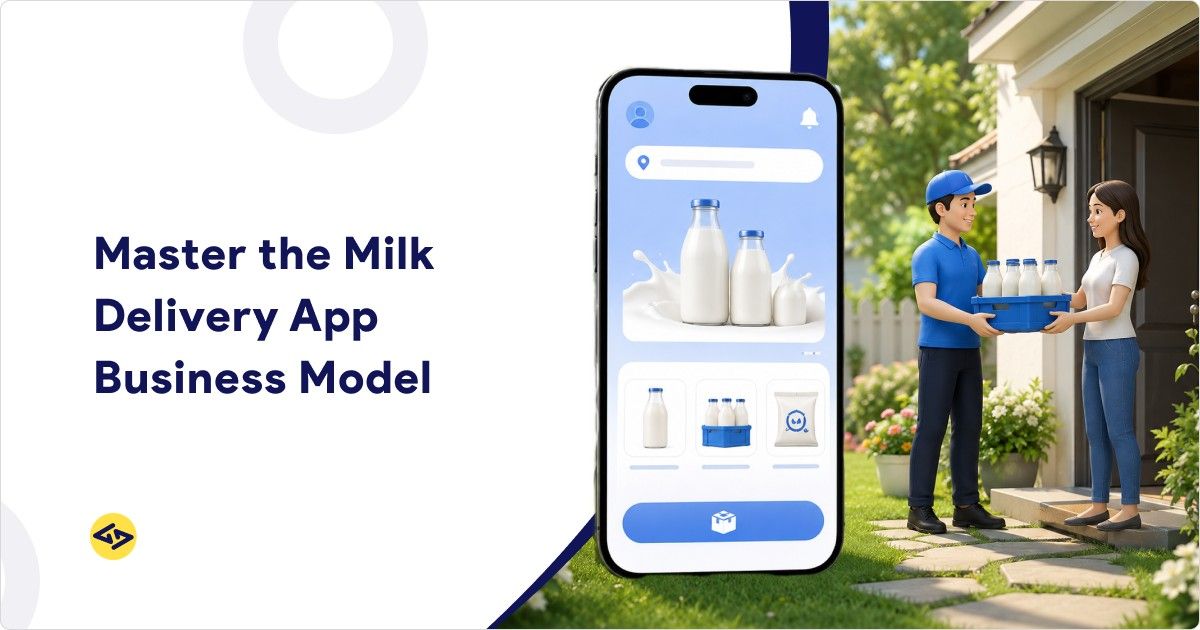
At its core, the model replaces manual milkman rounds with an app that lets customers subscribe to daily or weekly milk plans, pause or modify orders, pay digitally, and track deliveries — while the business gets automated billing, route planning, and demand visibility.
Why It Is Becoming Popular
Urban households want reliability and hygiene assurance; dairies want fewer missed collections and better cash flow. An app satisfies both sides, which is why online milk delivery business model adoption is growing quickly across tier-1 and tier-2 cities.
Why Start a Milk Delivery App Business?
Milk is a daily-use product, which gives this business a few structural advantages over typical e-commerce:
- Rising demand for fresh dairy products as consumers move away from unbranded, unreliable sources.
- Convenience-driven consumers who want to skip daily phone calls to the local vendor.
- Recurring daily orders that create a steady, near-guaranteed demand pattern.
- Predictable subscription revenue instead of one-off, unpredictable sales.
- Hyperlocal business opportunities — you don’t need to compete nationally to be profitable.
- Digital payments and automation that reduce collection losses and manual errors.
If you’re evaluating whether to enter this space, our guide on how to start an milk delivery business walks through the practical first steps.
How Does a Milk Delivery App Business Model Work?
A typical milk delivery app workflow looks like this:
- Customer Registration — Users sign up with basic details and delivery address.
- Subscription Selection — Customers choose daily, alternate-day, or weekly plans.
- Daily Order Scheduling — The app auto-generates orders based on the subscription.
- Vendor/Dairy Management — Orders are routed to the correct dairy or vendor for fulfillment.
- Delivery Assignment — Delivery staff are assigned routes and daily order lists.
- Payment Collection — Wallets, UPI, cards, or auto-debit handle billing.
- Customer Notifications — Alerts for delivery status, low wallet balance, or plan renewal.
- Order Management — Admins track pending, completed, and modified orders in real time.
This workflow is what makes the milk delivery app business model so different from generic delivery apps — it’s built around repetition and predictability, not one-off transactions.
Types of Milk Delivery App Business Models
Not every milk delivery business should be built the same way. Here are the five common structures:
Subscription-Based Model
Customers commit to recurring daily or weekly deliveries, paid in advance — the backbone of most successful subscription-based milk delivery app businesses.
On-Demand Delivery Model
Customers order milk and dairy products as needed, similar to instant grocery delivery, without a fixed subscription.
Marketplace Model
The app connects multiple dairies and vendors to customers, earning through commission rather than owning the milk supply itself.
Dairy-Owned Delivery Model
A single dairy brand runs its own app to sell directly to consumers, keeping full control over quality and pricing.
Hyperlocal Delivery Model
Focused on a specific neighborhood or city zone, optimizing for fast, low-cost delivery within a tight radius.
| Business Model | Best For | Revenue Potential | Scalability |
| Subscription-Based | Dairies wanting predictable income | High | High |
| On-Demand | New markets testing demand | Medium | Medium |
| Marketplace | Multi-vendor platforms | High | High |
| Dairy-Owned | Established dairy brands | Medium-High | Medium |
| Hyperlocal | Single-city startups | Medium | Low-Medium |
Revenue Models for Milk Delivery Apps
If you’re wondering how does a milk delivery app make money, most platforms combine several of these streams:
- Subscription Plans — recurring payments for daily/weekly milk delivery.
- Delivery Charges — flat or distance-based fees on smaller orders.
- Product Commission — a cut from vendor or dairy sales through the marketplace model.
- Premium Memberships — priority delivery slots or discounted rates for loyal users.
- Advertisement Revenue — in-app ad space for dairy or grocery brands.
- Vendor Listing Fees — charges for dairies to list their products on the platform.
- In-App Promotions — sponsored placements for new products.
- Cross-Selling Dairy Products — paneer, curd, ghee, and bread bundled with milk orders.
This combination is what defines a strong milk delivery app revenue model — relying on subscriptions for stability while layering in commission and cross-selling for growth.
Key Features Required for a Successful Milk Delivery App
Customer App
Registration, subscription management, daily order modification, an in-app wallet, payment gateway, notifications, and order history.
Delivery App
Route optimization, real-time delivery tracking, an earnings dashboard, and order status updates for delivery staff.
Admin Panel
Customer management, vendor management, inventory tracking, reports, analytics, and promotions — all in one dashboard.
A deeper breakdown of these capabilities is available in our detailed post on features for milk delivery app.
Technology Stack for Milk Delivery App Development
The right milk delivery app technology stack balances performance, cost, and scalability:
- Frontend: Flutter, React Native
- Backend: Laravel, Node.js
- Database: MySQL, PostgreSQL
- Cloud: AWS, Google Cloud
- Payment Gateway: Stripe, Razorpay, or region-specific providers
- Push Notifications: Firebase Cloud Messaging
- Maps & GPS: Google Maps API for route optimization and live tracking
This stack supports both a lean MVP and a fully scalable milk delivery app architecture as the business grows.
Cost to Build a Milk Delivery App
Costs vary depending on complexity, but a general breakdown looks like this:
| App Tier | Includes | Typical Investment Range |
| Basic App | Core ordering, subscriptions, payments | Lower end |
| Standard App | Multi-vendor support, route optimization, analytics | Mid-range |
| Enterprise App | AI features, multi-city scalability, custom integrations | Higher end |
Factors affecting the milk delivery app cost include:
- Number and complexity of features
- Platforms (iOS, Android, web)
- UI/UX design depth
- Third-party integrations (payments, maps, SMS)
- AI capabilities
- Ongoing maintenance and support
For exact figures based on your requirements, see our detailed breakdown on the cost to develop a milk delivery app.
AI in Milk Delivery Apps
AI in milk delivery apps is quickly moving from “nice-to-have” to a competitive necessity:
Demand Forecasting
Predicts daily milk quantity needs per zone, reducing wastage and shortages.
Smart Route Optimization
Cuts delivery time and fuel cost by calculating the most efficient routes.
Customer Behavior Analysis
Identifies patterns to reduce churn and improve subscription retention.
Personalized Recommendations
Suggests complementary dairy products based on order history.
Fraud Detection
Flags suspicious payment activity or delivery discrepancies.
Inventory Prediction
Helps dairies and vendors plan procurement more accurately.
Explore more in our dedicated post on ai features for milk delivery apps.
Benefits of a Subscription-Based Milk Delivery Business
- Predictable recurring revenue
- Higher customer retention
- Better inventory planning
- Reduced operational costs
- Automated billing
- Improved customer experience
Learn more about implementation in our guide on subscription based milk delivery app development.
Challenges in Running a Milk Delivery Business
No business model is without friction. Common challenges include:
- Delivery logistics across scattered addresses
- Inventory management for a perishable product
- Customer retention in a price-sensitive market
- Seasonal demand fluctuations
- Payment collection delays
- Route optimization for early-morning delivery windows
- Maintaining product freshness end-to-end
How to Scale Your Milk Delivery Business
Once the core model is working, growth typically comes from:
- Expanding into new service areas
- Adding dairy products beyond milk (curd, paneer, ghee)
- Launching referral programs
- Introducing loyalty rewards
- Partnering with local dairies for supply reliability
- Automating operations using AI
For strategies specific to keeping subscribers longer, check out milk delivery customer retention.
Mistakes to Avoid
- Ignoring subscription management complexity
- Poor delivery planning during peak hours
- Weak inventory tracking leading to shortages
- Limited payment options frustrating customers
- No dedicated customer support
- Choosing the wrong technology stack for future scale
Future Trends in Milk Delivery Apps
- AI-powered operations across forecasting and routing
- IoT-enabled dairy supply chains for freshness tracking
- Smart, flexible subscriptions
- Contactless delivery options
- Sustainable, eco-friendly packaging
- Electric delivery fleets
- Voice-based ordering for convenience
Stay ahead of the curve with our breakdown of milk delivery app development trends.
Why Choose iCoderz Solutions for Milk Delivery App Development
Building a milk delivery app isn’t just about writing code — it’s about designing a system that can handle daily recurring orders, dairy logistics, and payment automation without breaking down as you scale.
iCoderz Solutions brings:
- Deep expertise in milk delivery app development
- Custom and white-label solutions for dairies and startups alike
- Scalable architecture built for multi-city expansion
- Robust subscription management systems
- AI-powered automation for forecasting and routing
- Secure payment gateway integration
- Ongoing support and maintenance after launch
Whether you need a fully custom build or want to explore a white label milk delivery app development option to launch faster, our team can help you get there.
Ready to build your milk delivery app? Contact iCoderz Solutions today to discuss your project.
Conclusion
The right milk delivery app business model does more than digitize a milkman’s route — it creates recurring revenue, improves customer retention, and streamlines dairy operations from procurement to doorstep delivery.
Choosing the right monetization strategy, technology stack, and scalable architecture upfront makes the difference between a side project and a real, growing business. Entrepreneurs and dairy owners who adopt AI-driven automation and subscription-based delivery today are the ones best positioned to lead this market tomorrow.
If you’re ready to turn this model into a working product, start an milk delivery business with the right technology partner — reach out to iCoderz Solutions for expert milk delivery app development services.
Build Your Milk Delivery App
Launch a profitable milk delivery business with a scalable app, subscription model, secure payments, and smart automation.

Frequently Asked Questions (FAQ)
What is a milk delivery app business model?
It’s a digital system connecting customers, dairies, and delivery staff to automate milk ordering, subscriptions, payments, and delivery tracking.
How does a milk delivery app make money?
Primarily through subscription plans, delivery charges, product commissions, premium memberships, and cross-selling dairy products.
Which business model is best for a milk delivery startup?
Subscription-based models generally offer the most predictable revenue, though marketplace models scale well for multi-vendor operations.
How much does it cost to build a milk delivery app?
Costs depend on features, platforms, and AI integration — ranging from a basic MVP to a fully custom enterprise solution.
What are the key features of a milk delivery app?
Subscription management, wallet and payment gateway, route optimization, delivery tracking, and an admin panel for vendor and inventory control.
How long does it take to develop a milk delivery app?
A basic version can take a few weeks, while a full-featured, multi-vendor app with AI capabilities takes several months.
Can AI improve a milk delivery business?
Yes — AI supports demand forecasting, route optimization, personalized recommendations, and fraud detection, reducing costs and improving retention.
Is a subscription model profitable for milk delivery?
Yes, subscriptions create predictable recurring revenue and significantly higher customer retention compared to one-off ordering.
Which technology stack is best for milk delivery app development?
A combination like Flutter or React Native for the frontend, Node.js or Laravel for the backend, and cloud infrastructure like AWS offers strong scalability.
Why invest in a milk delivery app business?
Because milk is a daily-use, recurring-demand product — making it one of the most stable categories for building a subscription-driven digital business.