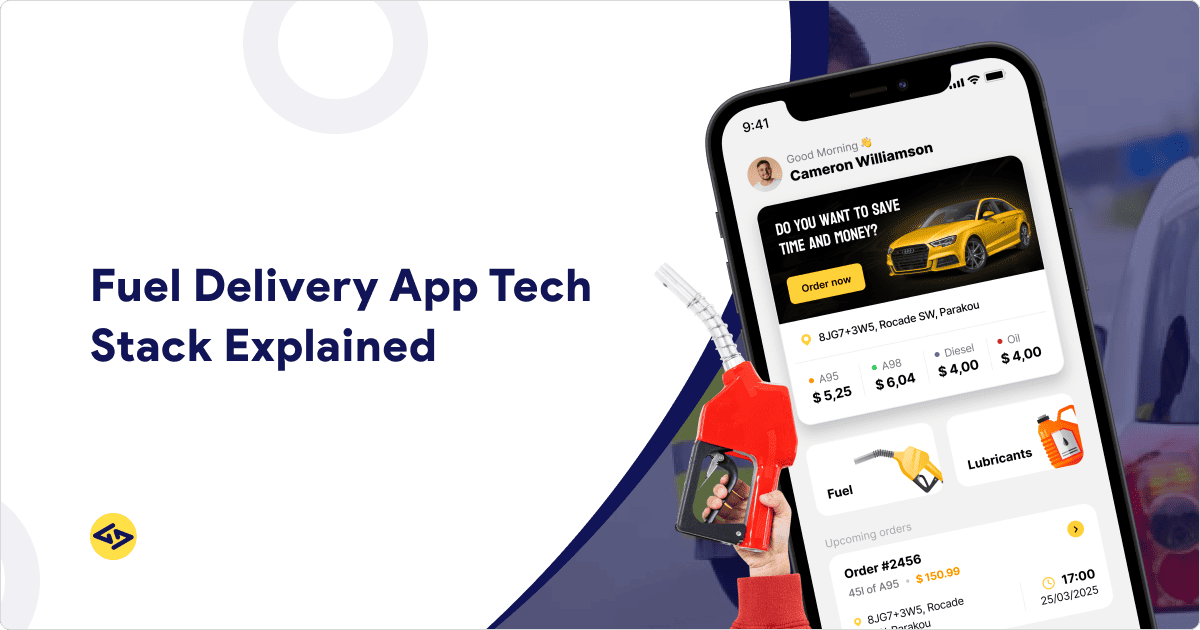
The on-demand fuel delivery industry is swiftly reshaping how energy reaches businesses and consumers. From stranded commuters needing an emergency top-up to logistics fleets requiring bulk diesel, the demand for convenience is skyrocketing. However, to fulfill these demands, businesses need more than just a truck and a driver—they need a purpose-built platform supported by a robust fuel delivery app tech stack.
Choosing the right technology determines your platform’s performance, responsiveness, and ability to scale. Whether you are a startup looking to disrupt the local market or an enterprise expanding your fleet, the underlying fuel delivery app architecture is the foundation of your success.
In this guide, we will break down the essential technologies required to build a scalable, secure, and high-performing fuel delivery app solution.
What Is a Fuel Delivery App?
A fuel delivery mobile app is an on-demand platform that connects fuel providers with customers (B2C) or businesses (B2B) requiring refueling services. Much like food delivery apps, these platforms rely on real-time data to coordinate logistics.
A complete fuel delivery app solution typically consists of three interconnected digital products:
- Customer App: For users to order fuel, track drivers, and pay securely.
- Driver App: For delivery agents to receive orders, navigate via GPS, and manage deliveries.
- Admin Panel: For business owners to manage inventory, fleets, pricing, and analytics.
Successful platforms like Cafu (UAE) and Booster (USA) rely on this tripartite structure to ensure seamless operations. To replicate this success, you must partner with a fuel delivery app development company that understands the nuances of this ecosystem.
Core Features of a Fuel Delivery App
Before selecting your tech stack, you must identify the features that will drive your application. These features dictate which APIs and backend technologies are necessary.
- User Registration & Profile Management: Secure sign-up via social media, email, or mobile number (OTP).
- Fuel Ordering & Scheduling: Options to select fuel type (Petrol, Diesel, CNG), quantity, and delivery windows.
- Real-Time Delivery Tracking: A critical feature for trust, allowing users to see the fuel truck’s location on a map.
- Secure Payment Gateway: Integration with multiple payment modes including credit cards, wallets, and corporate billing.
- Driver Assignment & Route Optimization: Algorithms that automatically assign the nearest driver and calculate the most efficient route.
- Order History & Invoices: digital receipts for personal tracking or corporate tax filing.
- Admin Dashboard & Analytics: A central hub to monitor total sales, active drivers, and fuel inventory levels.
For a detailed breakdown of necessary functionalities, read our guide on the essential features of a fuel delivery app.
Fuel Delivery App Architecture Overview
The architecture is the blueprint of your software. A well-planned fuel delivery app architecture ensures that data flows smoothly between the user, the driver, and the server without latency.
- Client-Side: This includes the mobile apps (iOS/Android) and the web dashboard.
- Server-Side: The backend logic that processes orders, manages the database, and handles API requests.
- Third-Party Integrations: External services for maps, payments, and SMS.
- Cloud & Infrastructure: The servers where your data lives, ensuring the app is always online.
Must-Have Tech Stack for Fuel Delivery App Development
Selecting the best tech stack for fuel delivery app development depends on your budget, timeline, and scalability needs. Below is the recommended stack used by top-tier fuel delivery app developers.
Frontend (Mobile & Web)
The frontend is the “face” of your app. It must be intuitive and responsive.
- Mobile App Development:
- Cross-Platform App Development: Flutter or React Native. These frameworks allow you to build for both iOS and Android using a single codebase, significantly reducing fuel delivery app development costs and time-to-market.
- Native App Development: Swift (iOS) and Kotlin (Android). Choose native if you require high-performance rendering for complex animations or deep hardware integration.
- Web Dashboard:
- React.js, Vue.js, or Angular: These JavaScript frameworks are perfect for building dynamic, real-time admin panels that dispatchers use to monitor fleets.
Backend Technologies
The backend is the engine of your fuel delivery software development. It handles business logic, such as matching a user’s location with the nearest fuel truck.
- Node.js: Highly recommended for on-demand delivery app development because of its event-driven architecture, making it perfect for handling concurrent connections (like real-time tracking).
- Python (Django/FastAPI): Excellent for apps requiring heavy data processing or AI-based route optimization.
- Java (Spring Boot): Preferred for large-scale enterprise solutions requiring strict structure and security.
Database
You need a database that can handle transactional data (orders) and unstructured data (logs).
- PostgreSQL or MySQL: Reliable relational databases for storing user profiles, order history, and payment records.
- MongoDB: A NoSQL database ideal for storing unstructured data like chat logs or dynamic driver location data.
Cloud & Hosting
To ensure your app doesn’t crash during high demand, you need scalable cloud infrastructure.
- AWS (Amazon Web Services), Google Cloud, or Microsoft Azure: These platforms offer auto-scaling, ensuring server resources increase automatically as your user base grows.
Maps & Location Services
Accuracy is non-negotiable in logistics app development.
- Google Maps API: The industry standard for navigation and geocoding.
- Mapbox: A customizable alternative often used for specific visualization needs.
Payments
- Stripe, Razorpay, or PayPal: Ensure your gateway supports split payments (if you take a commission) and is PCI-DSS compliant.
Notifications
- Firebase Cloud Messaging (FCM) or Twilio: Essential for sending push notifications (“Your fuel is on the way!”) and SMS OTPs.
Why This Tech Stack Matters
You might wonder, why not just use the cheapest option? In on-demand fuel delivery app development, the tech stack directly impacts business viability.
- Scalability: Technologies like Node.js and AWS allow your app to handle 100 users today and 100,000 users tomorrow without rebuilding the system.
- Performance: A laggy app frustrates users. Using efficient fuel delivery app frontend technology like Flutter ensures smooth scrolling and instant updates.
- Data Security: Fuel delivery involves financial transactions and user location data. A modern stack ensures robust encryption standards.
- Ease of Future Upgrades: Popular frameworks have large developer communities, making it easier to hire fuel delivery app developers for future maintenance.
How to Choose the Right Tech Stack
There is no “one size fits all.” Your choice should be based on:
- Business Goals: Are you targeting B2C (speed/UI focus) or B2B (data/reporting focus)?
- Budget: Cross-platform solutions (React Native/Flutter) are generally more cost-effective than building two separate native apps.
- Time-to-Market: If you need to launch quickly to beat competitors, use frameworks that support rapid development like Python (Django) or Node.js.
- Long-term Maintenance: Choose technologies that are widely supported to avoid “tech debt.”
For a deeper dive into how technology choices impact your budget, check our analysis on fuel delivery app development cost.
Challenges in Fuel Delivery App Development
Building a fuel delivery app solution comes with unique hurdles that your tech stack must address.
- Real-time Tracking Accuracy: Latency in GPS can cause drivers to miss locations. Implementing WebSockets for live data transfer is crucial here.
- Regulatory Compliance: Fuel is a hazardous material. Your app may need to integrate with government databases or safety compliance tools.
- Payment and Fraud Risks: Secure APIs are needed to prevent chargebacks and ensure secure corporate billing.
- Fleet Management: Integrating with IoT sensors on fuel trucks to monitor tank levels requires specialized APIs and custom fuel delivery app development expertise.
Cost Considerations
The fuel delivery app development cost and tech stack are intrinsically linked.
- MVP (Minimum Viable Product): Using Flutter + Firebase can keep costs low for a startup launch.
- Enterprise-Grade: Using Native (Swift/Kotlin) + AWS Microservices + Custom AI algorithms will require a higher investment but offers unmatched performance.
Consulting with a specialized mobile application development firm can help you balance feature requirements with your budget.
Future Trends in Fuel Delivery App Technology
To stay competitive, your on-demand fuel delivery app tech stack should be ready for future integrations:
- AI-Powered Route Optimization: AI can predict traffic and fuel consumption patterns to save delivery costs.
- IoT Fuel Sensors: Connecting the app directly to a customer’s smart tank to trigger auto-refilling orders.
- EV Charging Integration: As the market shifts, many fuel apps are expanding to become “energy delivery” apps.
- Predictive Analytics: Analyzing user data to predict when a fleet will need refueling before they even place an order.
Understanding evolving business models is key. For example, look at the Booster fuel delivery business model to see how they leverage tech for corporate efficiency.
Conclusion
Building a successful on-demand refueling app demands more than just an idea; it requires a strategic blend of technology and execution. A scalable tech stack for fuel delivery apps forms the backbone of your business, ensuring speed, security, and long-term reliability.
Whether you are deciding between Android development or iOS, or choosing the right cloud provider, every decision impacts your user’s experience.
Ready to transform your fuel delivery operations?
At iCoderz Solutions, we specialize in fuel delivery app development services that prioritize scalability and performance. Our team combines innovation with reliability to build future-ready solutions tailored to your business model.
Contact us today to schedule a demo or consultation with our experts.
Build Your Fuel Delivery App With the Right Tech Stack
Partner with experts to design, develop, and scale a secure, real-time fuel delivery platform built for reliability, performance, and growth.

Frequently Asked Questions (FAQ)
Q: What is the best tech stack for a fuel delivery app?
A: For most startups, a combination of Flutter (Frontend), Node.js (Backend), and MongoDB (Database) offers the best balance of performance and cost.
Q: How much does it cost to build a fuel delivery app?
A: The cost varies based on features and platform (Native vs. Cross-platform). It generally ranges from $15,000 for a basic MVP to $60,000+ for a full-featured custom solution.
Q: Can I integrate IoT with my fuel delivery app?
A: Yes, IoT integration is highly recommended for real-time monitoring of fuel truck levels and smart tank automation for B2B clients.