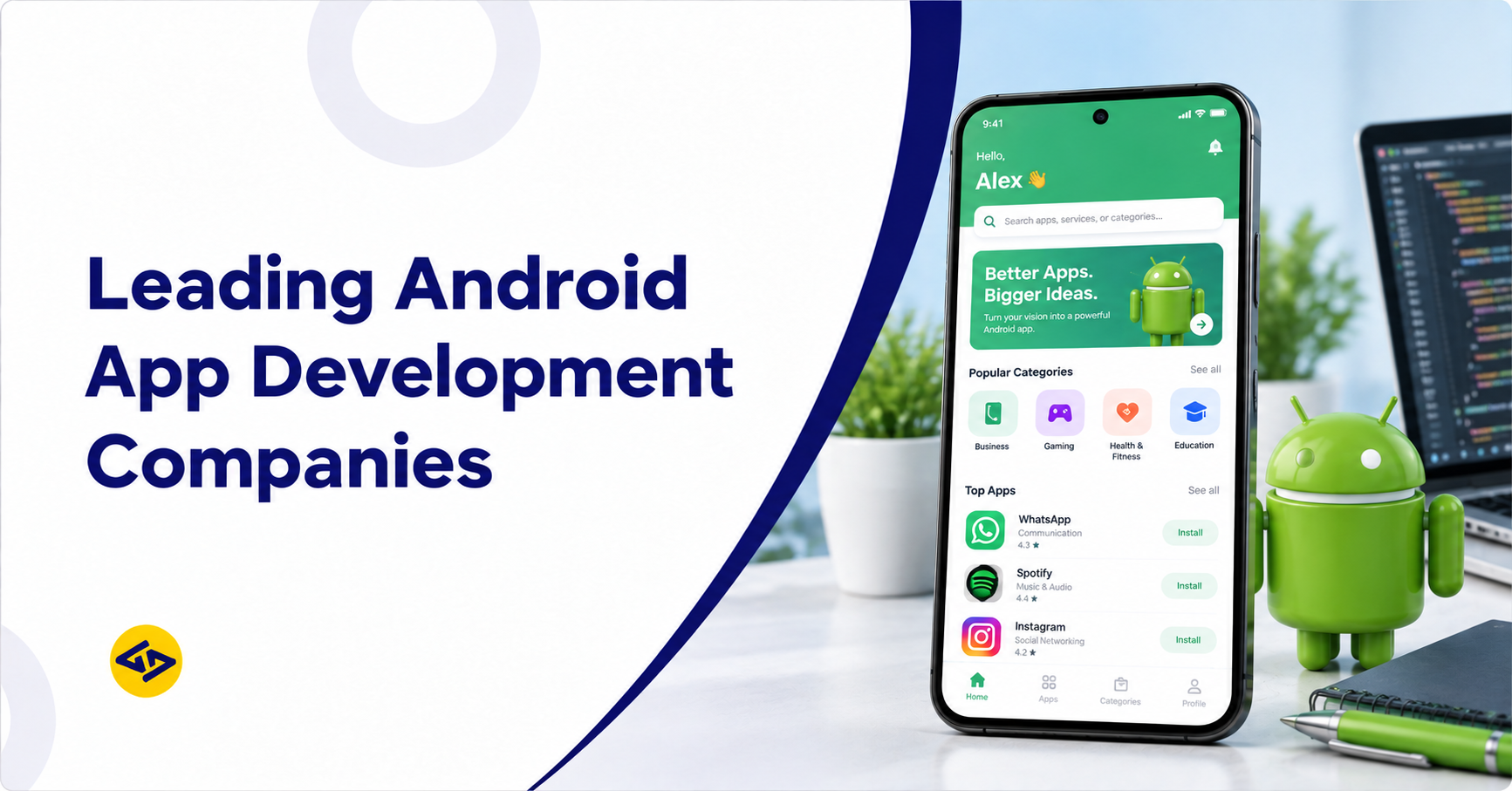
The top Android app development companies in 2027 combine native Kotlin expertise, solid backend and API skills, clear pricing, and reliable post-launch support. Android runs on the majority of smartphones worldwide, so an Android app gives startups and enterprises access to a very large audience.
The problem is choosing. Hundreds of agencies claim to be experts, and their pricing, skills, and communication vary widely. A wrong pick often means missed deadlines, rework, and a budget that keeps growing.
This guide lists ten Android app development companies, compares them side by side, and explains how to evaluate any vendor yourself. If you are also weighing mobile options more broadly, see our Android development services overview.
How we selected these companies: we looked at Android expertise, publicly visible portfolios, review-platform reputation, service range, and engagement models. The list is not a ranking. Different companies suit different projects.
Quick Answer: Which Android App Development Company Should You Choose?
The right company depends on your project. Use this as a starting shortlist, then verify with portfolios and references.
- Best for startups: companies with MVP experience and flexible engagement models, such as iCoderz and other firms on this list that offer dedicated teams.
- Best for enterprise solutions: firms with security, integration, and long-term support experience.
- Best for custom Android development: teams with strong native Kotlin/Java skills and in-house UI/UX.
- Best for cost-effective development: India-based teams often offer lower hourly rates than US-based agencies.
- Best for global businesses: companies with delivery experience across multiple countries and time zones.
Top Android App Development Companies in 2027
All ten companies below are presented in the same format. The order reflects the brief for this article, not a ranking.
1. iCoderz
- Founded: Company materials cite 2009–2011 (the company describes itself as 15+ years in business)
- Company size: 70+ developers, designers, and engineers (per company profile)
- Android development expertise: Native Android with Kotlin, plus cross-platform builds with Flutter and React Native
- Services: Custom mobile apps, web development, UI/UX design, white-label development, maintenance and support
- Industries served: Food delivery, grocery, taxi booking, logistics, healthcare, real estate, and other on-demand sectors
- Notable strengths: 650+ projects delivered across 35+ countries (company-reported); recognized on Clutch in multiple years, including a 2023 Clutch Champion award
- Best for: Startups and SMBs building on-demand and marketplace-style apps
- Why consider them: Strong on-demand app experience and flexible team models
- Website: icoderzsolutions.com
2. Quavento Technologies
- Android development expertise: Builds Android, iOS, and cross-platform apps designed for Indian devices and network conditions
- Services: Mobile app development, custom software (SaaS, MVPs, ERP, CRM), websites, Shopify and ecommerce, SEO, paid media, and branding
- Industries served: SMEs, manufacturers, startups, and D2C brands in India
- Notable strengths: One team handles both the build and the marketing, so tracking, speed, and conversion are planned from the start
- Best for: Indian SMEs and D2C brands that want an app plus digital marketing from one agency
- Why consider them: Written scope and price, and in-person meetings available in Pune
- Website: quaventotechnologies.com
3. CodeSpace Infotech
- Android development expertise: Builds mobile apps for Android and iOS
- Services: Mobile app development, web application development, UI/UX design, ecommerce applications, CMS development, QA and testing, maintenance and support, and AI-enabled applications
- Industries served: Healthcare, maritime, banking and fintech, luxury sports, e-learning, retail and ecommerce, and real estate
- Notable strengths: Broad industry mix and a full lifecycle service list, from design to testing and support
- Best for: Businesses in regulated or niche sectors that need a single partner for design, build, and support
- Why consider them: Ask for Android case studies in your industry to confirm depth
4. Foxy Technologies
- Founded: 2013
- Company size: 11–50 employees (LinkedIn)
- Android development expertise: Native and hybrid Android and iPhone apps with APIs and scalable backends
- Services: Android and iPhone app development, game development, web development, and 3D design
- Industries served: Startups and small businesses across sectors
- Notable strengths: Small, focused team with a low listed hourly rate (around $25/hour on DesignRush)
- Best for: Startups and small businesses with modest budgets
- Why consider them: Lower entry cost, with a stated minimum budget range of 1,000–10,000 on DesignRush
- Website: foxytechnologies.com
5. EthicsComputer
- Founded: 2018
- Company size: Small team (directories list single-digit to low double-digit headcount)
- Android development expertise: Custom web and mobile app development
- Services: Custom software, web and mobile development, AI automation, cybersecurity and VAPT audits, cloud and managed IT, and compliance services
- Industries served: Businesses across India
- Notable strengths: Combines app development with cybersecurity services; the company states ISO 27001:2022 certification
- Best for: Businesses that want app development together with security audits and compliance support
- Why consider them: Useful if security is a priority, though you should confirm Android-specific case studies
- Website: ethicscomputer.in
6. Ardorsys Technologies
- Founded: 2017
- Company size: 10–49 employees
- Android development expertise: Android, iPhone, and hybrid apps; GoodFirms lists Android as about 30% of its mobile focus
- Services: Mobile app development, web design and development, software development, and digital marketing
- Industries served: Automotive, banking and finance, education, healthcare, and others
- Notable strengths: Listed hourly rate under $25 and a Clutch profile with verified client reviews, including an Android app built from scratch for a software company
- Best for: Startups and SMBs looking for budget-friendly Android and web development
- Why consider them: Cost-effective option with publicly reviewed work
- Website: ardorsys.com
7. Black Marlin Technologies
- Founded: 2014
- Company size: Directory listings vary, from about 10 to 200 employees
- Android development expertise: The company is primarily positioned as a digital marketing and web agency, so ask for Android case studies
- Services: Digital marketing, SEO, website design and development
- Industries served: Businesses worldwide that need web presence and online growth
- Notable strengths: Strong digital marketing focus, useful if you need app promotion alongside development
- Best for: Businesses that want app launch marketing and web presence from the same partner
- Why consider them: Good fit when growth marketing matters as much as the build
- Website: blackmarlintechnologies.com
8. PinakinVox
- Founded: 2025
- Company size: 10–49 employees (The Manifest)
- Android development expertise: Native Kotlin plus cross-platform React Native and Flutter, with Swift for iOS
- Services: Custom software, mobile apps, UI/UX, cloud and DevOps, AI integrations, Shopify, and SaaS development
- Industries served: Fintech, logistics, healthcare, and ecommerce
- Notable strengths: DPIIT-recognized company with published price ranges and Clutch-verified reviews; the company states 30 days of post-launch support in every project
- Best for: Startups launching MVPs that want senior engineers and transparent pricing
- Why consider them: A newer company founded by engineers with 10+ years of experience, so check references and recent projects
- Website: pinakinvox.com
9. EnactOn Technologies
- Founded: 2013
- Company size: Roughly 50–100 employees, depending on the directory
- Android development expertise: Android, iOS, and cross-platform apps
- Services: Custom software, mobile apps, web development, SaaS, ecommerce, browser extensions, and AI-powered software
- Industries served: Affiliate, cashback, coupon, and rewards platforms, plus startups and enterprises
- Notable strengths: The company reports 500+ products delivered for 350+ clients across 65+ countries; Clutch reviews describe MVP builds delivered in about two months
- Best for: Startups building MVPs and affiliate or rewards platforms
- Why consider them: Product-company background and a listed rate of about 25–49/hour (MobileAppDaily)
- Website: enacton.com
10. NextGen Fusion
- Android development expertise: Offers dedicated Android app development with a focus on UI performance, API connectivity, push notifications, and long-term maintainability
- Services: Android app development, websites, ecommerce, SEO, software, and digital products
- Industries served: Businesses looking for measurable online growth
- Notable strengths: Combines Android development with web and SEO services
- Best for: Small and mid-size businesses that need an app together with web and search visibility
- Why consider them: Ask for Android case studies and client references before committing
- Website: nextgenfusion.in
Comparison of the Top Android App Development Companies
Use this table for a quick vendor comparison. Details come from company websites and public directory listings, so confirm current information before you shortlist.
| Company | Android Expertise | Services | Best For | Company Size |
| iCoderz | Kotlin, Flutter, React Native | Custom apps, web, UI/UX, white-label, support | Startups, on-demand apps | 70+ |
| Quavento Technologies | Android, iOS, cross-platform | Apps, software, web, SEO, branding | Indian SMEs and D2C brands | Not disclosed |
| CodeSpace Infotech | Android and iOS apps | Apps, web, UI/UX, QA, AI-enabled apps | Regulated and niche sectors | Not disclosed |
| Foxy Technologies | Native and hybrid Android | Apps, games, web, 3D design | Budget-conscious startups | 11–50 |
| EthicsComputer | Custom mobile apps | Software, apps, AI, cybersecurity | Security-focused businesses | Small team |
| Ardorsys Technologies | Android, iOS, hybrid | Apps, web, software, marketing | Startups and SMBs | 10–49 |
| Black Marlin Technologies | Confirm via case studies | Digital marketing, SEO, web | Apps plus growth marketing | Varies by source |
| PinakinVox | Kotlin, Flutter, React Native | Software, apps, AI, cloud | MVP-stage startups | 10–49 |
| EnactOn Technologies | Android, iOS, cross-platform | Software, apps, SaaS, extensions | MVPs, affiliate platforms | ~50–100 |
| NextGen Fusion | Dedicated Android development | Android apps, web, SEO | SMBs needing app plus web | Not disclosed |
How We Selected the Best Android App Development Companies
A good Android app development company is one with proven Android experience, verifiable work, trustworthy reviews, a full-stack skill set, and transparent pricing. We used five criteria.
Android Development Expertise
We looked for native Android capability: Kotlin and Java, modern Android architecture (such as MVVM and Jetpack components), and strong Android UI/UX practices that follow Material Design.
Portfolio and Case Studies
We favored companies with publicly verifiable work: relevant projects, varied app complexity, and experience across industries. A portfolio you can actually check matters more than a long client list.
Client Reviews and Reputation
We considered Clutch and other reputable review platforms, client feedback, and industry recognition. Reviews are most useful when they describe project scope, budget, and outcomes.
Services and Technical Capabilities
An Android app is rarely just an app. We looked at whether companies cover:
- Custom Android apps
- Backend and API development
- UI/UX design
- AI/ML integration
- Cloud integration
- Maintenance and support
Pricing and Engagement Models
We looked for flexibility: fixed price, dedicated developers, time and materials, and long-term support plans. Clear estimates beat vague quotes.
What Services Do Android App Development Companies Offer?
Android app development companies design, build, test, launch, and maintain Android apps, and many also handle backend systems and cross-platform builds. Typical services include the following.
- Custom Android app development: Apps built around your specific workflows and users.
- Android UI/UX design: Interfaces that follow Material Design and Android usability conventions.
- Android MVP development: A lean first version to validate your idea quickly.
- Enterprise Android apps: Secure apps with complex integrations and multiple user roles.
- Android app modernization: Migrating legacy Java apps to Kotlin and current architecture.
- Android app maintenance: OS updates, bug fixes, performance tuning, and monitoring.
- API and backend development: Servers, databases, and APIs that power the app.
- Wear OS development: Apps for Android smartwatches.
- Android TV development: Apps for smart TVs and streaming devices.
- AI-powered Android applications: Recommendations, chat assistants, and on-device intelligence.
- Cross-platform app development: Flutter or React Native apps that run on Android and iOS.
If you need Android and iOS together, explore our mobile application development services.
How Much Does Android App Development Cost in 2027?
Android app development cost in 2027 typically ranges from about $15,000 for a basic MVP to $100,000 or more for an advanced app. AI-powered apps often run higher. These are planning estimates, not universal market prices. Your actual quote depends on scope.
| App Type | Estimated Cost |
| Basic Android MVP | 15,000–30,000 |
| Medium-complexity app | 30,000–60,000 |
| Advanced Android app | 60,000–100,000+ |
| AI-powered Android app | 80,000–150,000+ |
What Affects Android App Development Cost?
- Features: More screens and flows mean more development hours.
- UI/UX complexity: Custom animations and design systems cost more than standard layouts.
- Backend requirements: User accounts, real-time data, and admin panels add scope.
- Third-party integrations and APIs: Payments, maps, and CRM connections add effort.
- AI/ML functionality: Model integration, data work, and testing raise costs.
- Security requirements: Healthcare and fintech apps need additional safeguards.
- Development location: Hourly rates differ by region. Vendors in India often charge less than vendors in the USA or Western Europe.
- Testing: More device coverage means more QA time.
- Post-launch maintenance: Budget for ongoing updates and support.
For a deeper breakdown, read our guide to Android app development cost.
How Long Does It Take to Build an Android App?
A typical Android app takes about 3 to 6 months from planning to launch. The exact timeline depends on scope.
| Development Stage | Typical Duration |
| Research and planning | 1–3 weeks |
| UI/UX design | 2–5 weeks |
| MVP development | 8–14 weeks |
| Testing | 2–4 weeks |
| Deployment | 1–2 weeks |
Complex integrations, AI features, multiple user roles, and enterprise requirements can extend this. Clear requirements at the start are the best way to protect your timeline.
Want the full process? See how to create an Android app step by step.
Native Android vs. Cross-Platform Development
Native Android apps are built specifically for Android using Kotlin or Java. Cross-platform apps use one codebase, with Flutter or React Native, to run on multiple platforms.
Native Android Development
- Built with Kotlin (preferred by Google for new Android development) or Java
- Best for platform-specific functionality such as advanced camera, sensors, or background services
- Strong performance and full access to Android capabilities
Cross-Platform Development
- Uses Flutter or React Native
- Shared codebase for Android and iOS
- Potentially reduced duplicated development work
Which Approach Should You Choose?
| Factor | Native Android | Cross-Platform |
| Performance | Excellent | Very good |
| Android-specific features | Excellent | Depends on integration |
| Code reuse | Lower | Higher |
| Development efficiency | Focused on one platform | Often higher |
| Best for | Complex Android apps | Multi-platform products |
Rule of thumb: choose native if Android is your main platform or you need deep device features. Choose cross-platform if you need Android and iOS fast on a tighter budget.
How to Choose the Best Android App Development Company
To choose the best Android app development company, check relevant experience, verify reviews, confirm technical and security capability, compare pricing models, and make sure you own your code. Work through these ten steps.
1. Check Android Development Experience
Ask how many Android apps they have shipped and whether any resemble yours. Experience in your industry shortens the learning curve.
2. Review Their Portfolio
Open the live apps on Google Play. Look at design quality, performance, and update history.
3. Verify Client Reviews
Read reviews on Clutch and similar platforms. Look for specifics on communication, deadlines, and budget accuracy, not just star ratings.
4. Evaluate Technical Expertise
Confirm Kotlin or Java skills, modern architecture, and experience with the integrations you need.
5. Ask About Security
Ask about secure data storage, authentication, encryption, and compliance (for example GDPR or HIPAA if relevant).
6. Compare Pricing and Engagement Models
Get written estimates from at least three vendors. Compare fixed price, time and materials, and dedicated team options.
7. Check Communication and Project Management
Ask about sprint cycles, reporting, tools, and time-zone overlap. Poor communication is a common cause of project trouble.
8. Understand Post-Launch Support
Confirm what is included after launch: bug fixes, OS updates, and monitoring.
9. Confirm Ownership and IP Rights
The contract should clearly state that you own the source code and design assets.
10. Ask About Scalability
Check that the architecture and team can grow with your user base.
If you plan to hire dedicated engineers, our guide on how to hire Android developers covers the process.
Questions to Ask Before Hiring an Android App Development Company
Use this checklist in your vendor calls:
- How many Android apps have you developed?
- Can you show relevant case studies?
- Do you use Kotlin or Java?
- Do you provide UI/UX design?
- Can you build the backend and APIs?
- How do you handle app security?
- What testing process do you follow?
- Who owns the source code?
- What post-launch support is included?
- How do you estimate development costs?
- How do you handle scope changes?
- Can you scale the development team if required?
Android App Development Trends to Watch in 2027
These trends affect what you build and how much it costs.
- Generative AI and AI assistants: In-app assistants and smart search are becoming standard expectations.
- On-device AI: Running models on the phone improves speed and privacy.
- AI-powered personalization: Real-time recommendations drive engagement and retention.
- Wearable integrations: Wear OS support extends your app beyond the phone.
- Foldable-device experiences: Layouts must adapt to larger and flexible screens.
- Voice-enabled interfaces: Voice commands improve accessibility and convenience.
- Privacy-focused development: Users and regulators expect minimal data collection and clear consent.
- IoT-connected Android applications: Apps increasingly control smart devices.
- Modern Android architecture: Jetpack Compose, Kotlin, and modular design improve maintainability.
Your development team’s toolset matters here. See our overview of Android app development tools.
Android App Development for Startups vs. Enterprises
Startups and enterprises need different things from an Android partner.
Startups
- MVP-first approach: Build the core features first.
- Faster validation: Launch, learn from users, then expand.
- Controlled budget: Phase development to match funding.
- Scalable architecture: Start lean, but avoid choices that block growth.
Enterprises
- Security and compliance: Strict data protection and audit requirements.
- Complex integrations: ERP, CRM, and legacy systems.
- Multiple user roles: Permissions, admin tools, and workflows.
- Existing system integration: Compatibility with current infrastructure.
- Long-term maintenance: Dedicated support and release management.
Why Businesses Work With Professional Android App Development Companies
Professional Android firms bring a ready team and tested processes, which lowers risk compared with assembling a team from scratch.
- Experienced developers
- Faster product development
- Access to UI/UX specialists
- Backend and API expertise
- Quality assurance
- Security practices
- Post-launch support
- Easier scalability
Why Choose iCoderz for Android App Development?
iCoderz Solutions is an Ahmedabad-based mobile and software development company with offices in the USA and Sweden. The company reports 650+ projects delivered across 35+ countries and has been recognized on Clutch in multiple years.
What you can expect:
- Android app development expertise (Kotlin, Flutter, React Native)
- Custom mobile app solutions
- UI/UX design
- Backend and API development
- Cross-platform capabilities
- AI integration
- MVP development
- Dedicated development teams
- Post-launch support
Learn more on the iCoderz Solutions website.
Build Your Android App With the Right Development Team
Have an app idea or a project to scope? Our team can review your requirements and suggest a practical plan.
Final Thoughts
There is no universal best Android app development company. The right choice depends on your project’s complexity, budget, industry, technical needs, and support requirements.
Before you decide, compare portfolios, technical expertise, reviews, pricing, communication, security, and post-launch support. A short pilot or a paid discovery phase is a low-risk way to test a vendor before committing.
FAQs About Android App Development Companies
Which is the best Android app development company in 2027?
There is no single best company for every project. The best choice depends on your budget, app complexity, industry, and support needs. Compare portfolios, reviews, and pricing for at least three vendors.
How much does it cost to develop an Android app in 2027?
Planning estimates range from about 15,000–30,000 for a basic MVP to 60,000–100,000+ for an advanced app. AI-powered apps often cost 80,000–150,000+. Your final cost depends on features, design, integrations, and location.
How long does it take to build an Android app?
Most projects take roughly 3 to 6 months, from planning through deployment. MVP development alone usually takes 8 to 14 weeks. Complex integrations can extend the timeline.
How do I choose an Android app development company?
Check relevant Android experience, review the portfolio, read verified client reviews, compare pricing models, and confirm security practices, support, and code ownership.
What should I look for in an Android app development company?
Look for Kotlin and Java expertise, UI/UX capability, backend skills, clear communication, a transparent testing process, and post-launch support.
Is Kotlin better than Java for Android development?
For new projects, Kotlin is generally the preferred choice. It is more concise, has built-in null safety, and is Google’s recommended language for Android. Java is still used in many existing apps.
Should I choose native Android or cross-platform development?
Choose native for complex apps that rely on Android-specific features. Choose cross-platform if you need Android and iOS quickly from one codebase.
Can an Android app development company build the backend too?
Yes. Many companies provide backend and API development, cloud setup, and admin panels along with the app. Confirm this in the scope.
How much does it cost to hire Android developers?
Rates vary by region and experience. Offshore teams, especially in India, commonly cost less per hour than teams in the USA or Europe. Ask for rates for dedicated developers versus fixed-price projects.
Can startups hire an Android app development company?
Yes. Many agencies specialize in startups, offering MVP development, flexible budgets, and dedicated teams that scale with your product.