Quick Answer:
A POC tests technical feasibility — 1–2 weeks, $2K–$10K, internal only. A Prototype tests user experience — 1–3 weeks, $3K–$15K, shown to investors and testers. An MVP is a live, working product that tests real market demand — 6–16 weeks, $15K–$80K+. Most products need all three stages, in that order.
You have an idea. You’re ready to build. And someone asks: “Should we start with a POC, a prototype, or go straight to an MVP?”
If those three terms feel interchangeable, you’re not alone — and that confusion costs startups real money. This guide explains each stage in plain language: what it is, what it produces, how much it costs, and when to use it. By the end, you’ll know exactly which one fits where you are right now.
Why Getting This Right Matters
Here’s a scenario that plays out constantly. A founder skips early validation, hires a team to build the full product, and six months and $80,000 later discovers users don’t want the core feature. Not a rare story — it is the default outcome when teams skip the validation sequence.
42% of startups fail because they build something nobody needs.
Source: CB Insights — Top Reasons Startups Fail. Analysis of 111 startup post-mortems.
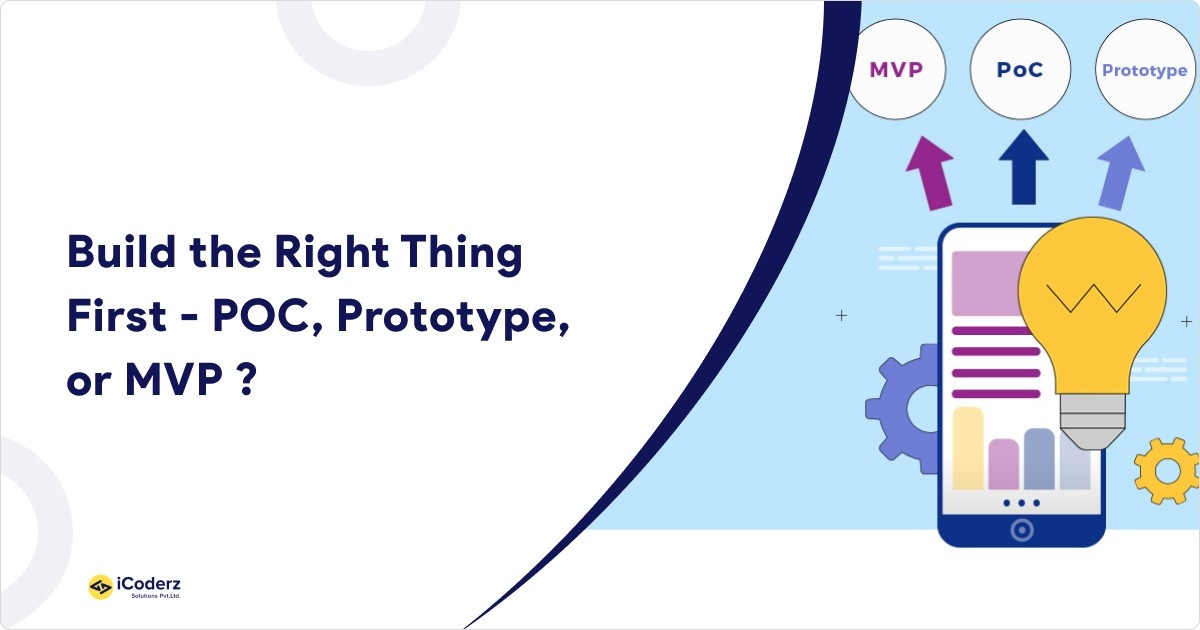
A POC, prototype, and MVP each answer a different question at a different cost:
⦁ POC → “Can this be built technically?”
⦁ Prototype → “Will people understand how to use it?”
⦁ MVP → “Will real users pay for and stick with this?”
Skip a stage and you carry that risk into the next one. Get the sequence right and you validate assumptions cheaply — before they become expensive mistakes. Our software consulting team’s first question to every new client is: “Which stage are you actually at?” The answer changes everything.
What is a Proof of Concept (POC)?
A POC is the earliest form of validation. Its only job: prove that the core technical mechanism behind your idea can actually work.
It is not a product. You don’t show it to users or investors. It’s a focused internal experiment — a code snippet, a script, a small API test — to confirm technical feasibility before you invest in design or full development.
When do you need one?
Use a POC when your product depends on something technically uncertain: an AI or machine learning model, real-time data processing at scale, an unfamiliar third-party integration, or any novel technical approach your team hasn’t proven before. Two weeks on a POC is cheaper than discovering a fundamental flaw six months into a build.
Example: A client came to us wanting an AI recommendation engine for a B2B procurement app. Before touching design, we ran a two-week POC on the ML model with their early dataset. The model couldn’t deliver accurate results yet — we identified a data enrichment step needed first. That two-week test saved four months of misdirected development.
| POC at a Glance | |
|---|---|
| Core question | Can this be built technically? |
| Audience | Internal dev team only |
| Output | Code demo, script, or technical experiment |
| Timeline | 1 – 2 weeks |
| Typical cost | $2,000 – $10,000 |
| Next step | Prototype or straight to MVP if design risk is low |
What is a Prototype?
Once technical feasibility is confirmed — or if the technology is standard and the risk is around UX — the next question is: will people understand and want to use this?
A prototype is an interactive, visual simulation of your product. It looks and feels real but has no working backend, no live data, no transactions. It is user experience made tangible — before a line of production code is written.
Low-fidelity vs. high-fidelity
Low-fidelity: Basic wireframes or clickable flows. Built in hours. Good for early team alignment and quick user testing.
High-fidelity: Pixel-perfect interactive mockups in Figma or Adobe XD. Used for investor presentations and detailed usability testing with real users.
Why this matters: IBM’s Design Thinking research found organisations that prototype before development significantly reduce rework costs. Fixing a navigation issue in Figma takes an hour. Fixing it post-launch takes a sprint.
Source: IBM Enterprise Design Thinking
Before we write a line of code on any project at iCoderz, we prototype. It’s the single most cost-effective step in product development — and it feeds directly into our UI/UX design services.
| Prototype at a Glance | |
|---|---|
| Core question | Will users understand and want to use this? |
| Audience | Users, investors, stakeholders, dev team |
| Output | Clickable mockup — no real backend (Figma, Adobe XD) |
| Timeline | 1 – 3 weeks |
| Typical cost | $3,000 – $15,000 |
| Next step | Validate with real users → build MVP |
What is an MVP (Minimum Viable Product)?
An MVP is the first real, working version of your product — live in the market, with real users, real data, and real feedback. Not a demo. Not a mockup.
The key word is “minimum.” An MVP is the smallest version that delivers genuine value and tests your core business assumption before you invest in everything else. If the minimum isn’t working, the full product won’t either.
Famous MVPs:
• Airbnb — started as one apartment, no payment system, no reviews.
• Dropbox — launched with a demo video only. No product existed.
None of these were polished. All validated the core assumption with minimal investment.
The four types of MVP
MVP Type What it means Best for
Single-feature One core feature only, everything deferred to v2 Most early-stage startups
Concierge Service delivered manually before automating Marketplaces, logistics apps
Wizard of Oz Looks automated — humans do the work behind the scenes AI-powered products in early testing
Landing page Sign-up or pre-order page — tests demand before any build Pre-launch demand validation
When we build MVPs at iCoderz, we always start single-feature. Get one thing live, get real user feedback, then decide what to build next based on actual behaviour — not assumptions.
| MVP at a Glance | |
|---|---|
| Core question | Will real users pay for and stick with this? |
| Audience | Real users in the target market |
| Output | Live, functional product with core feature(s) |
| Timeline | 6 – 16 weeks |
| Typical cost | $15,000 – $80,000+ |
| Next step | Iterate on data, scale features, raise funding |
POC vs Prototype vs MVP: Full Comparison
| Aspect | POC | Prototype | MVP |
|---|---|---|---|
| Core question | Can this be built? | Will users understand it? | Will users pay for it? |
| Audience | Internal dev team | Investors, testers, stakeholders | Real users in market |
| Output | Code demo / script / API test | Clickable mockup — no backend | Live, functional product |
| Timeline | 1 – 2 weeks | 1 – 3 weeks | 6 – 16 weeks |
| Typical cost | $2K – $10K | $3K – $15K | $15K – $80K+ |
| Built with | Raw code, scripts, APIs | Figma, Adobe XD, UXPin | Flutter, React, Node.js |
| Next step | Prototype or straight to MVP | Validate UX → build MVP | Iterate, scale, raise funding |
Which One Does Your Startup Need Right Now?
Start with a POC if:
⦁ Your product uses AI, ML, real-time processing, or untested technology
⦁ There’s a technical mechanism you haven’t proven can work at scale
⦁ You want to de-risk before spending on design or development
Relevant: AI Development · Software Development Services
Start with a Prototype if:
⦁ Technology is standard but UX is uncertain
⦁ You need something visual for investors or stakeholder sign-off
⦁ You want user testing data before committing a dev budget
Relevant: Figma Design Services · UI/UX Design
Start with an MVP if:
⦁ Technical approach and design direction are validated
⦁ You have a clear audience and a defined problem to solve
⦁ You’re ready for real users, real data, and real market feedback
Relevant: MVP Development · SaaS Development · Mobile App Development
The two most expensive mistakes: (1) skipping straight to an MVP without validating technology or UX first, and (2) getting stuck in POC or prototype mode and never shipping. Move through each stage quickly — don’t skip them, and don’t camp in them.
“Minimum” Is the Most Misunderstood Word in Tech
Most teams say they’re building an MVP. Then they describe five user roles, a custom analytics dashboard, multilingual support, and native iOS and Android from day one. That’s not an MVP — that’s a v1.0 with six months of assumptions baked in.
74% of high-growth startups fail due to premature scaling.
Source: Startup Genome Global Ecosystem Report. Building too much before validating demand is the leading cause of failure.
A true MVP answers one question: will people pay for and stick with this core value? To find out, use this test:
1. Write your product’s core value in one sentence.
2. Identify the single feature that proves or disproves that value.
3. Build only that. Get 100 real users. Measure retention.
4. Then decide what to build next based on what they actually do.
If that feels dangerously incomplete — that discomfort is the point. Our software consulting team helps startups cut scope to what matters and build a roadmap from validated assumptions outward.
5 Mistakes That Cost the Most Time and Money
1. Over-engineering the MVP
Founders pack everything into v1. The result: a six-month, $120K build that still doesn’t validate the core idea. If you’re not slightly embarrassed by your MVP, it’s probably too polished.
2. Skipping the POC for complex technology
For AI, real-time data, or novel integrations — skipping the POC means you might invest months in design and development before discovering the core mechanism doesn’t work. Two weeks on a POC is cheap insurance.
3. Building features nobody asked for
Founders build what they imagine users want, not what prototype testing revealed they need. Watch what users do in usability testing — not what they say. Let behaviour drive your feature list.
4. Treating the prototype as final
A prototype is for learning. If usability testing shows a problem, fix it in Figma in an hour — not in code after launch, which costs a sprint. That’s the entire point of prototyping first.
5. Never moving past the MVP
Set clear success criteria before you launch — a retention rate, revenue threshold, or active user count. When you hit them, the MVP has done its job. Build v2 from what you learned.
Build Your POC, Prototype, or MVP with iCoderz
We’ve helped startups across the US, UK, UAE, and India at every stage — from Figma prototypes for investor pitches to full MVP builds shipped in 8–14 weeks. Tell us where you are and we’ll tell you exactly what to build next.
Not sure which stage is right for you?
Talk to the iCoderz team. We’ll look at your idea, budget, and timeline — and tell you exactly where to start.
Frequently Asked Questions
What is the difference between MVP and prototype?
A prototype is a clickable mockup with no real backend — it tests user experience before code is written. An MVP is a live, functional product in the market. A prototype comes before the MVP and tests whether users understand the product; an MVP tests whether they’ll pay for it.
Is a POC the same as an MVP?
No. A POC tests technical feasibility internally — typically 1–2 weeks. An MVP is a live product with real users testing market demand — 6–16 weeks. A POC comes before both the prototype and MVP, and many products need one before the MVP is built.
Do I need a POC before an MVP?
Only if your product relies on technically uncertain components — AI models, novel integrations, real-time processing at scale. If your MVP uses standard technology (a typical SaaS dashboard, delivery app, or marketplace), you can usually skip the POC and go straight to prototype or MVP development.
How much does it cost to build an MVP?
A focused single-feature MVP typically costs $15,000–$30,000. A more complex product with multiple user roles, integrations, and cross-platform support runs $40,000–$80,000+. Cost depends heavily on scope clarity upfront — which is one reason a prototype phase is worth the investment first.
What tech stack do you recommend for an MVP?
For mobile-first MVPs: Flutter — one codebase, iOS and Android, fast iteration. For web apps and SaaS: React or Next.js with Node.js. For AI-heavy MVPs: Python with FastAPI. We recommend the stack that gets you to market fastest at the lowest scaling cost — not the most technically impressive option.