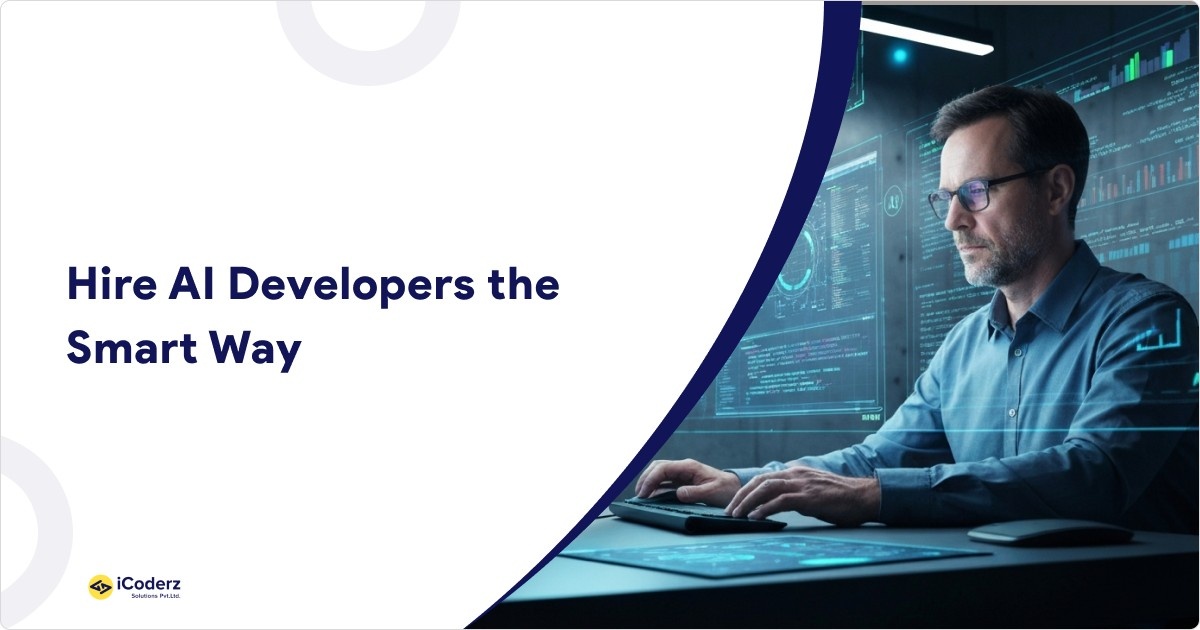
Artificial intelligence has moved from experimental to essential. But hiring the right AI developer in 2026 is one of the hardest talent challenges any technology leader faces. Demand has grown faster than supply for five consecutive years, compensation has hit record highs, and the cost of a misaligned hire — in runway, morale, and product quality — is enormous.
How to hire AI developers is a common question for startups and businesses looking to build AI-powered products. Whether you are a CTO scoping an internal ML platform, a startup founder integrating large language models, or an HR manager sourcing rare specialist talent, this guide covers everything: the roles that exist, the skills that matter, where to find candidates, what it costs, and how to screen effectively.
Why AI Developer Talent Is Hard to Find |
The talent gap in AI is structural, not cyclical. Three compounding forces drive it:
- Skills scarcity: True AI engineers must combine software engineering, applied mathematics, statistical reasoning, and hands-on experience with modern frameworks. That combination is genuinely rare — LinkedIn consistently ranks AI/ML Engineer among the fastest-growing roles globally.
- Salary inflation: Senior AI engineers in the US now command $180,000–$300,000+ in total compensation. Even mid-level roles regularly exceed $130,000. For most businesses, building a full in-house team is financially unfeasible.
- Risk of the wrong hire: AI projects fail silently. A developer who oversells their skills can spend months producing models that look functional but perform poorly on real-world data. Unlike traditional software bugs, model failures are often invisible until they cause business damage.
| 💡 Insight: McKinsey’s research shows 72% of organisations report difficulty hiring qualified AI talent. Many now turn to dedicated agencies or offshore specialists to close the gap at 40–70% lower cost. |
Source: → McKinsey: The State of AI (mckinsey.com)
What Does an AI Developer Do? |
“AI developer” is a broad umbrella. The role you need depends entirely on your use case. Here are the five core specialist profiles:
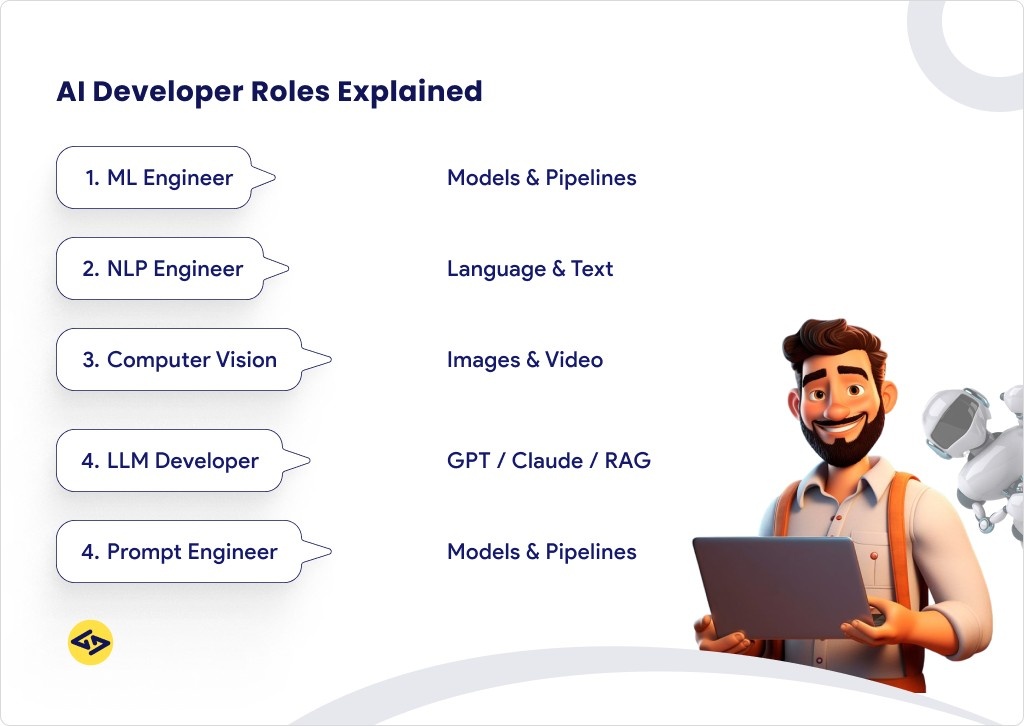
Machine Learning (ML) Engineer
Designs, trains, and deploys predictive and classification models. Responsible for data pipelines, feature engineering, model evaluation, and productionising ML systems. Core stack: Python, TensorFlow, PyTorch, Scikit-learn, MLflow, Kubeflow.
NLP Engineer (Natural Language Processing)
Builds systems that understand and generate human language — chatbots, sentiment analysis, document classification, summarisation, and entity recognition. Deep expertise in transformer architectures (BERT, GPT, T5) and the HuggingFace ecosystem.
Computer Vision Engineer
Develops image and video analysis systems — object detection, facial recognition, defect detection in manufacturing, medical imaging, and autonomous vehicle perception. Primary tools: OpenCV, YOLO, CNNs, vision transformers (ViT).
LLM Developer (Large Language Model)
Specialises in building applications on top of large language models such as GPT-4, Claude, Gemini, or open-source alternatives like LLaMA and Mistral. Core responsibilities include retrieval-augmented generation (RAG), fine-tuning, API integration, prompt management, and evaluation pipelines.
Prompt Engineer
Optimises how AI models are instructed to produce consistent, accurate, and safe outputs at scale. Increasingly critical for enterprise LLM deployments. Combines knowledge of model behaviour, system design, and UX thinking.
Not sure which role fits your project? Our AI Consulting team can scope your requirements and recommend the right specialist mix.
Skills to Look For When You Hire AI Developers |
Must-Have Technical Skills
- Python proficiency — the primary language of ML/AI development
- Strong mathematical foundation: linear algebra, calculus, probability and statistics
- ML frameworks: TensorFlow, PyTorch, or JAX (at least one to production level)
- Data manipulation: Pandas, NumPy, SQL
- Model deployment and MLOps: Docker, Kubernetes, CI/CD, experiment tracking (MLflow, W&B)
- Cloud AI platforms: AWS SageMaker, Google Vertex AI, or Azure ML
- Version control and collaborative development (Git)
Nice-to-Have Skills
- Data engineering: Apache Spark, Airflow, dbt
- Vector databases: Pinecone, Weaviate, Chroma, Qdrant
- Reinforcement learning or generative AI pipeline experience
- Domain knowledge relevant to your industry (healthcare, fintech, retail, logistics)
Red Flags to Avoid
- Cannot explain standard evaluation metrics — precision, recall, F1, AUC-ROC, BLEU, ROUGE
- Portfolio consists only of Kaggle notebooks with no production deployments
- No experience handling data quality issues, missing values, or distribution shift
- Avoids discussing model limitations, bias, or failure modes
- Cannot distinguish supervised, unsupervised, and reinforcement learning in practice
Where to Hire AI Developers |
Freelance Marketplaces
Platforms like Upwork, Toptal, and Turing offer access to vetted AI freelancers. Suitable for short-term tasks or proof-of-concept work. Quality varies significantly — always review portfolios and conduct technical assessments before engagement.
Job Boards & Direct Hiring
LinkedIn, Indeed, and specialist boards like AI Jobs (aijobs.net) and MLconf are useful for building an in-house team. Expect 3–6 months time-to-hire, salaries 2–3× offshore rates, and significant HR overhead. Best for companies with long-term, full-time AI requirements.
GitHub & Open Source Communities
Reviewing contributions to popular AI repositories on GitHub or engaging with communities like Hugging Face and Papers With Code can surface highly capable, practice-oriented developers who may not be actively applying.
Dedicated AI Development Agencies
For most businesses, a dedicated AI development company offers the strongest combination of speed, cost-efficiency, and risk management. You get an assembled, specialised team — with no recruitment burden, no HR risk, guaranteed SLAs, and full IP protection from day one.
→ Explore iCoderz Dedicated AI Teams
How to Hire AI Developers: Step-by-Step Guide |
Knowing where to look is only half the battle. The real challenge is executing a hiring process that consistently identifies skilled, reliable AI talent — and filters out the rest. Follow these eight steps to hire with confidence.
Step 1: Define Your AI Project Scope
Before you post a single job description, get clarity on what you are actually building. Answer these questions internally:
- What business problem does AI need to solve?
- Is this a one-time project, an ongoing product feature, or a long-term platform?
- What data do you have, and is it labelled, structured, or clean?
- What does success look like — and how will you measure it?
Vague project scope leads to mis-hires. The clearer your requirements, the more accurately you can match a role type (ML Engineer, NLP, LLM Dev, etc.) and a hiring model (freelancer, agency, or in-house).
Step 2: Choose the Right AI Role
Based on your project scope, identify the specific specialist you need — not just a generic “AI developer.” Refer to Section 2 of this guide for full role breakdowns. A common mistake is hiring a machine learning generalist when the project demands a dedicated NLP or computer vision expert.
Step 3: Decide Your Hiring Model
Choose from three primary models based on timeline, budget, and project length:
- Freelancer — Best for short-term tasks, prototypes, or augmenting an existing team with a specific skill gap.
- In-house hire — Best for long-term, full-time AI roadmaps where deep product knowledge is critical. High cost, slow to recruit.
- Dedicated AI agency — Best for most businesses. Faster deployment, lower cost, built-in accountability, and a full team rather than a single developer.
Step 4: Write a Precise Job Description or Project Brief
A strong AI job description should include:
- The specific AI domain (ML, NLP, CV, LLM, generative AI)
- Required frameworks and tools (Python, PyTorch, TensorFlow, HuggingFace, etc.)
- Whether the role is research-focused, engineering-focused, or both
- Deployment environment (cloud provider, on-premise, edge)
- Deliverables — models, APIs, dashboards, documentation
- Seniority level and engagement type (contract, full-time, agency)
Avoid listing every buzzword in AI. Specificity attracts the right candidates and deters poor fits.
Step 5: Source & Shortlist Candidates
Use the hiring channels covered in Section 4 to build your shortlist. At this stage, prioritise:
- Portfolio review — have they deployed models to production, not just Kaggle notebooks?
- GitHub activity — do they contribute to real projects or open-source AI libraries?
- Domain relevance — does their experience align with your industry or use case?
- Communication clarity — can they explain complex concepts simply? This matters enormously in AI.
Step 6: Run a Structured Technical Assessment
Never rely on a CV alone. A credible AI developer should pass a two-stage technical screen:
- Stage 1 — Technical interview: Use the 10 questions in Section 8 of this guide to assess fundamentals, problem-solving approach, and real-world experience.
- Stage 2 — Practical exercise: Assign a time-boxed task relevant to your actual project (e.g. design a RAG pipeline architecture, evaluate a model on a sample dataset, or debug a failing training loop). Pay candidates for this work — it signals professionalism and attracts serious applicants.
Step 7: Validate References and Past Work
For senior or high-stakes hires, always speak to previous clients or employers. Ask specifically:
- Did the model actually reach production — and perform as expected?
- How did they handle setbacks when the model underperformed?
- How did they communicate progress and limitations to non-technical stakeholders?
For agencies, ask for a relevant case study with measurable outcomes, not just a client logo list.
Step 8: Onboard with a Clear AI Project Charter
Once hired, set up for success from day one. A strong AI project charter should define:
- Data access, data governance rules, and privacy requirements
- Model performance benchmarks and acceptance criteria
- Delivery milestones and review cadence
- IP ownership, NDA terms, and confidentiality obligations
- Escalation process if quality or timelines slip
The onboarding phase is where most AI projects go wrong — not the hiring phase. Investing time here pays dividends throughout delivery.
| ✅ iCoderz Shortcut: Skip steps 1–3 and hand them to us. Our AI Consulting team will scope your project, recommend the right specialist roles, and have a dedicated team ready within 5–10 business days. |
→ Start with a free AI project scoping call
Freelancer vs AI Development Agency |
| Factor | Freelancer vs AI Agency |
| Cost | Freelancer: Lower per hour / Agency: Predictable monthly cost, better total ROI at scale |
| Speed to start | Freelancer: Days / Agency: 1–2 week onboarding |
| Team depth | Freelancer: Single specialist / Agency: Full cross-functional team (ML + Data + DevOps) |
| Accountability | Freelancer: Varies / Agency: SLA-backed, contractual obligations |
| IP & NDA | Freelancer: Manual agreements needed / Agency: Standard NDA, full IP assignment |
| Scalability | Freelancer: Hard to scale / Agency: Add or reduce capacity easily |
| Risk | Freelancer: High (single point of failure) / Agency: Distributed, managed |
| Continuity | Freelancer: Drops off between engagements / Agency: Ongoing relationship and knowledge retention |
| Best for | Freelancer: Short tasks, PoC / Agency: Production systems, long-term roadmaps |
How Much Does It Cost to Hire AI Developers? (2026) |
Rates vary significantly by region, seniority level, and specialisation. Generative AI and LLM expertise commands a 20–40% premium over general ML roles.
| Location | Junior ($/hr) | Mid-Level ($/hr) | Senior ($/hr) |
| United States | $80–$120 | $130–$180 | $200–$300+ |
| United Kingdom | $65–$100 | $110–$160 | $170–$250 |
| Eastern Europe | $35–$60 | $60–$95 | $95–$140 |
| India | $18–$35 | $35–$60 | $60–$100 |
| Southeast Asia | $20–$40 | $40–$65 | $65–$110 |
| 💡 Cost Insight: Hiring a senior AI developer in India through a reputable agency like iCoderz delivers equivalent technical quality to a US hire at 60–75% lower cost — with the added security of IP protection, dedicated project management, and structured delivery. |
Source: → Stack Overflow Developer Survey — Salary Data (survey.stackoverflow.co)
→ Explore iCoderz engagement models
10 Interview Questions to Ask AI Developer Candidates |
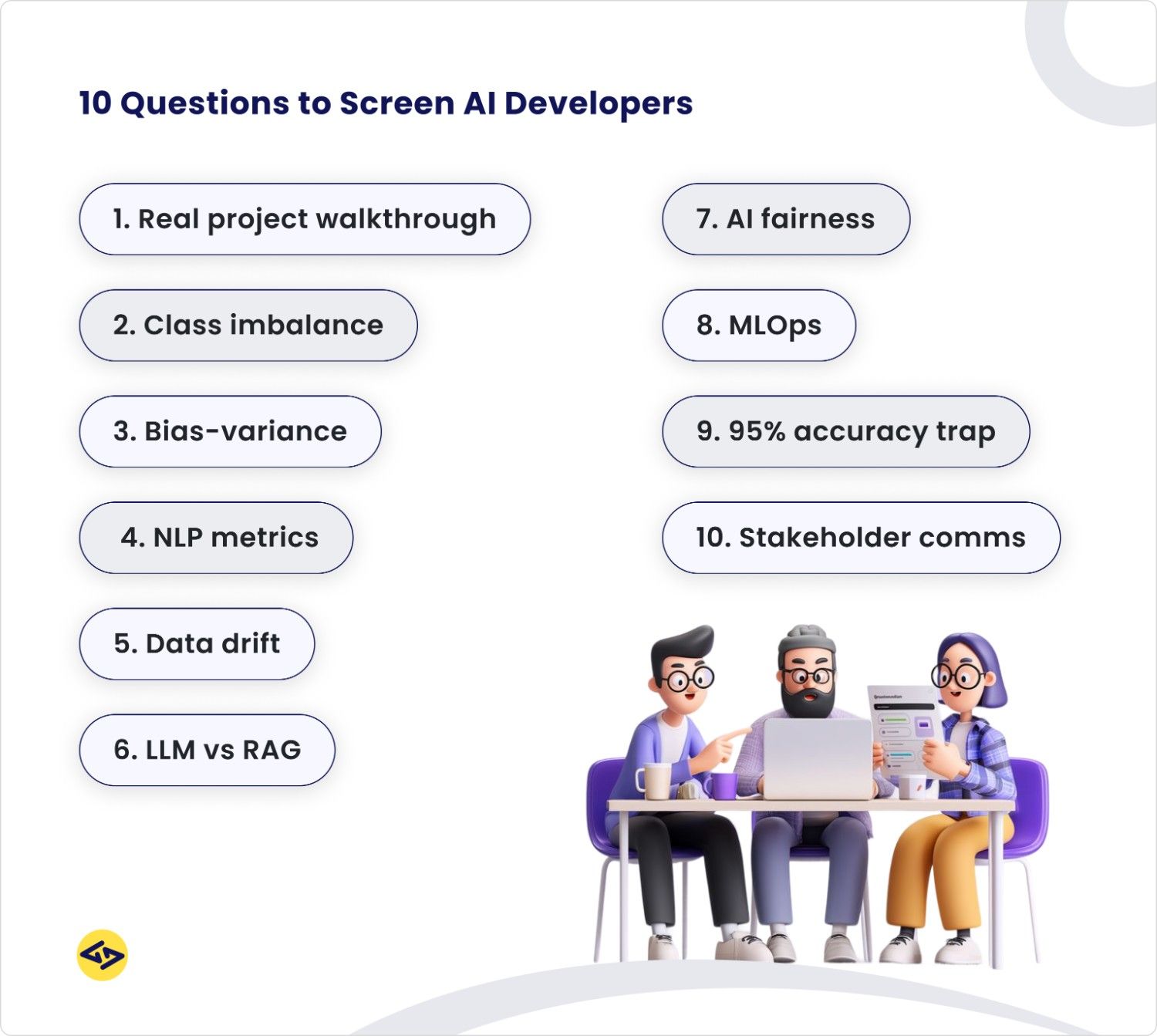
Use these questions to cut through polished CVs and identify genuine expertise:
- Walk me through a machine learning project you took from data collection to production deployment. What were the hardest parts?
- How do you handle class imbalance in a classification dataset? What techniques have you used in practice?
- Explain the bias-variance tradeoff. How does it influence your modelling and architecture decisions?
- What metrics would you use to evaluate an NLP model for customer sentiment analysis — and why would you choose those over accuracy alone?
- How would you detect and remediate data drift in a deployed model over time?
- What is the difference between fine-tuning a pre-trained LLM and using RAG (Retrieval-Augmented Generation)? When would you choose each approach?
- How do you ensure your AI system does not encode or amplify harmful biases? What evaluation methods do you use?
- Describe your MLOps setup. How do you version models, track experiments, manage feature stores, and handle rollbacks?
- A stakeholder says their model has 95% accuracy. How do you respond? What further questions do you ask?
- How do you explain model uncertainty or prediction confidence to non-technical stakeholders?
| 🎯 Pro Tip: For LLM or generative AI roles, add a 30-minute practical exercise — give candidates a real business scenario and ask them to design a solution architecture. This separates applied thinkers from theoretical ones. |
Reference: → Machine Learning Interview Questions (interviewbit.com)
Why Hire AI Developers Through iCoderz Solutions |
iCoderz Solutions is a full-service AI and software development company with 12+ years of experience delivering production-grade AI systems for startups, enterprises, and digital agencies across the globe.
What Sets Us Apart
- Pre-vetted AI talent pool — ML Engineers, NLP Specialists, CV Developers, LLM Developers, and Data Scientists available within 1–2 weeks
- Full-stack AI capability — data strategy, model development, MLOps, integration, and ongoing maintenance
- Flexible engagement models — fixed-cost projects, time-and-material, or dedicated team retainers
- IP protection and NDA as standard — robust legal frameworks included in every engagement
- Proven delivery record — 500+ AI and software projects across healthcare, fintech, retail, logistics, and more
Our Core AI Services
| Service | What We Deliver |
| AI Strategy & Consulting | Project scoping, architecture review, technology selection |
| Custom ML Development | Model design, training, evaluation, and deployment |
| LLM Integration & RAG | GPT/Claude/Gemini integration, RAG pipelines, fine-tuning |
| AI App Development | End-to-end AI-powered mobile and web applications |
| Data Analytics & BI | AI-driven dashboards, forecasting, and decision intelligence |
| MLOps & Infrastructure | Model monitoring, retraining pipelines, cloud deployment |
Explore: AI Development | Machine Learning | AI Software | AI Data Analytics | AI in BI
| Hire Dedicated AI Developers
Tell us about your project — we’ll recommend the right team, no commitment required. |
Frequently Asked Questions |
Can I hire AI developers for short-term or project-based work?
Yes. iCoderz offers flexible engagement models: project-based contracts, monthly retainers, and dedicated team arrangements. Whether you need a single sprint to build a proof-of-concept or a 12-month engagement for a full AI platform, we structure the right arrangement for your budget and timeline.
Will my intellectual property be protected?
Absolutely. All engagements include a comprehensive NDA and full IP assignment agreement as standard. Your code, models, training data, and proprietary algorithms remain entirely yours throughout and after the engagement.
What AI specialisations does iCoderz cover?
Our team covers the full AI spectrum: machine learning, deep learning, NLP, computer vision, LLM development, generative AI, MLOps, AI-driven analytics, and business intelligence. We have active experience in healthcare, fintech, e-commerce, logistics, and manufacturing verticals.
How quickly can a dedicated team be deployed?
For most engagements, we mobilise a dedicated team within 5–10 business days following scoping and agreement. Urgent projects with pre-allocated resources can often begin within 48–72 hours.
How does iCoderz ensure model and code quality?
We follow structured delivery processes including code review, unit and integration testing, model evaluation against agreed benchmarks, and regular sprint reviews with clients. Every AI engagement includes a model documentation deliverable covering architecture, limitations, retraining triggers, and maintenance guidance.
→ Further reading: How to Hire Remote Developers | AI in App Development | AI in Business Intelligence