When Employee Transport Becomes a Business Problem Worth Solving
Most large enterprises already have some form of employee transportation in place — shuttle contracts, empanelled cab vendors, or reimbursement programs. The real challenge is not the absence of transport, but the inefficiency hiding inside it: vendor bills that are difficult to audit, routes that do not adapt to shift changes, employees who cannot track their assigned vehicle, and operations teams spending hours each week reconciling attendance with trip logs.
At a certain scale — typically once a company is managing transport for 300 or more employees across multiple shifts or locations — these inefficiencies stop being minor irritants and start showing up as measurable costs. Fuel is wasted on unoptimized routes. Vendor overbilling goes unchecked without data. Employee dissatisfaction rises when transport feels unreliable, even when vehicles are technically running on time.
A purpose-built corporate employee transport app development does not replace your existing transport operation — it puts a smart, data-driven layer on top of it, giving every stakeholder (employees, drivers, transport managers, and finance teams) the visibility and control they actually need.
In this blog, we will learn how to build a smart corporate transport app that saves costs and boosts safety.
What Is Corporate Transportation?
Corporate transportation refers to any organized, employer-managed system that moves employees between their homes and the workplace — or between multiple office sites. It includes shuttle services, cab aggregation, vanpooling, and on-demand ride management, all coordinated under a single policy and budget.
Unlike personal commuting, corporate employee transportation service is owned by the business. The company decides the routes, controls the vendors, monitors the vehicles, and bears the cost. This responsibility also comes with opportunity: a well-run transport program is one of the most visible and appreciated employee benefits you can offer.
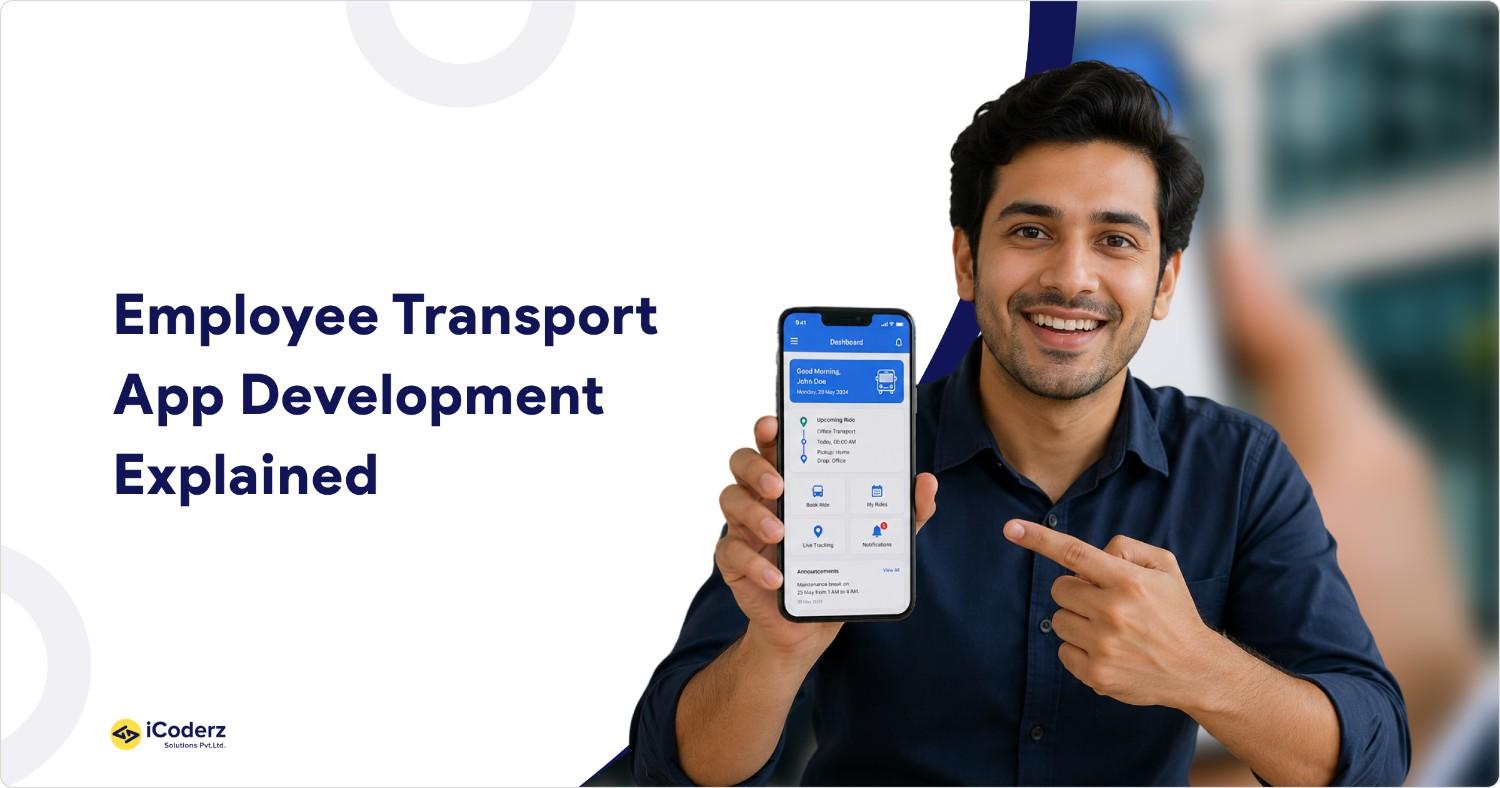
What distinguishes modern corporate transportation from older models is technology. Today’s best solutions are powered by enterprise mobile application development — combining a mobile-first Employee App, an Admin Control Panel, and a Driver App, all connected in real time.
Why Business Owners Are Investing in This Now: The Market Reality
The numbers make a compelling case. According to The Business Research Company, the global corporate employee transportation service market was valued at $35.52 billion in 2024 and is projected to reach $53.24 billion by 2029 — growing at a CAGR of 8.3%. This is not a niche trend; it is mainstream enterprise spending.
Research from Emergen Research shows that companies implementing comprehensive transportation programs report a 15–25% reduction in employee turnover rates and a 12% improvement in punctuality metrics. Replacing a skilled employee costs between 50% to 200% of their annual salary, which makes retaining talent through better commute programs one of the highest-ROI investments a business can make.
Mordor Intelligence further notes that AI-driven dynamic routing — the core of modern Employee Transport Management Systems — can lower cost per employee-mile by 20–30% relative to fixed traditional routes. For a company running 200 rides daily, that saving adds up to millions annually.
If you want to understand the business model behind ride-based corporate transport, our deep-dive on the Uber business model explains how on-demand dispatch, dynamic pricing, and fleet management economics work — all directly applicable to a corporate transport platform.
Who Needs a Corporate Employee Transport App?
The short answer: any business that moves people at scale. But the specific use cases vary significantly:
- IT & BPO companies running night shifts or multi-location campuses with hundreds of employees
- Manufacturing plants and industrial facilities in remote areas with no public transit access
- Hospitals, hotels, and healthcare networks managing shift-based staff — also served by our specialized team through our Hospitality & Travel Software Development practice, built for multi-property, round-the-clock transport needs
- Large retail chains coordinating staff transport across city-wide store networks
- Construction and infrastructure companies transporting workers to project sites
- Tech startups and scaleups validating a transport product concept before full build
Whether you are managing 50 employees or 50,000, the operational challenges are the same. Only the scale changes — and a well-architected app scales with you.
What Should Be in a Corporate Employee Transport App? (Full Feature Breakdown)
Drawing from platforms like Uber for Business, Lyft Business, and the architecture behind on-demand taxi booking app development, here is the complete feature architecture your corporate transport app needs:
1. Employee-Facing Mobile App
This is what your workforce interacts with every single day, so it must be intuitive and reliable under real-world conditions — spotty networks, early mornings, and stressed employees.
- Ride booking with pickup location, preferred time, and destination
- Real-time GPS tracking of assigned vehicle on a live map
- ETA notifications and driver arrival alerts via push, SMS, or WhatsApp
- SOS / emergency panic button with instant admin notification
- Digital attendance check-in upon boarding
- Ride history and expense statements for reimbursement claims
- In-app rating and feedback for each trip
2. Driver App
Your drivers need an equally powerful tool to execute routes efficiently and safely.
- Daily trip assignment and roster visibility
- Turn-by-turn navigation with AI-optimized routes
- Real-time passenger list with pickup/drop confirmation
- Live two-way chat with transport admin
- Vehicle inspection checklists and compliance alerts
- Trip completion and earnings summary
3. Admin Control Panel (Web + Mobile)
This is where business owners and transport managers get full visibility and control over every vehicle, route, and cost in the system.
- Centralized dashboard for all active trips, vehicles, and drivers
- Automated route creation and optimization based on employee locations
- Dynamic vehicle allocation using GPS and demand data
- Roster management: self-booking, manager-authorized, and team-based
- Geofencing and zone-based pickup/drop management
- Cost tracking, billing automation, and vendor management
- Compliance and audit reports for transport policy enforcement
- Multi-location and multi-shift management
4. Employee Transport Management System (ETMS) — Core Feature Table
| Feature | What It Does For Your Business |
| AI Route Optimization | Reduces fuel costs and commute time by 20–30% using real-time traffic, weather, and employee location data |
| Real-Time GPS Tracking | Admins and employees see vehicle location live, cutting delay-related complaints to near zero |
| Automated Scheduling | Eliminates manual roster-making; system allocates vehicles based on demand and shift data |
| SOS & Safety Alerts | Panic button notifies admin and emergency contacts instantly; critical for night shift employees |
| Analytics & Reports | Fuel usage, vehicle utilization, trip costs, and employee satisfaction — all in one dashboard |
| Contactless Check-In | QR or app-based boarding confirmation removes paper logs and reduces fraud |
| Vendor Integration | Connect third-party cab vendors, aggregators, or your own fleet under one platform |
| HR / Payroll Integration | Sync transport data with HRMS for seamless reimbursement and policy compliance |
How to Develop a Corporate Employee Transport App: Step-by-Step
Corporate employee transport app development is a structured process. Here is how iCoderz Solutions — a proven Employee Transportation App Development Company — approaches every engagement:
Step 1: Discovery & Business Analysis
The first step is understanding your exact transport operation — number of employees, shift timings, office locations, fleet size, and current pain points. This stage defines the scope, technology stack, and integration requirements. A proper discovery phase saves months of costly rework later.
Step 2: UX/UI Design — Built for Real Users
Transport apps must work flawlessly under pressure — a driver checking a route at 5 AM or an employee tracking their cab in a spotty network zone. Design must prioritize speed, clarity, and accessibility over visual complexity. Prototypes are user-tested before a single line of code is written.
Step 3: Technology Stack Selection
A typical enterprise-grade corporate transport app uses React Native or Flutter for cross-platform mobile, Node.js or Python for backend APIs, Google Maps or HERE Maps SDK for navigation and tracking, and AWS or Google Cloud for scalable infrastructure with 99.9% uptime SLA.
Step 4: Core Development — Agile Sprints
Development follows two-week sprint cycles, with each sprint delivering a testable module. Our on-demand app development practice uses the same proven agile delivery model — business owners get a live staging environment to review progress continuously, not just at the end.
Step 5: Integration Layer
An enterprise transport app does not live in isolation. It connects with your existing HRMS (SAP, Workday, Darwinbox), ERP, payroll systems, and third-party fleet vendors. API integrations are built, tested, and security-audited at this stage.
Step 6: QA, Security Testing & Compliance
Every feature undergoes functional, performance, and security testing. GPS accuracy, real-time sync latency, server load capacity, and data encryption are validated to enterprise standards. Compliance with local transport regulations and data privacy laws (GDPR, India IT Act) is verified before launch.
Step 7: Deployment & Post-Launch Support
The app is deployed to app stores and your web infrastructure, with a phased rollout starting with a pilot group. A dedicated support team monitors real-world performance and resolves issues within SLA windows. Ongoing feature updates and scale expansions are planned in quarterly roadmaps.
How Much Does Corporate Employee Transport App Development Cost?
Development cost depends on feature complexity, number of platforms (Android, iOS, Web Admin), and integration depth. For a detailed breakdown of what drives app development budgets in the ride/transport space, read our guide on the cost to build an app like Uber — the same cost drivers apply directly to corporate transport platforms.
Here is a realistic range based on enterprise projects iCoderz has delivered:
| Tier | What’s Included | Estimated Cost |
| MVP / Starter | Employee App + Admin Panel + Basic Tracking | $15,000–$30,000 |
| Professional | Employee + Driver + Admin + Integrations + Analytics | $30,000–$70,000 |
| Enterprise | Full ETMS with AI routing, multi-location, HR sync, white-label | $70,000–$150,000+ |
Timeline: 3 months (MVP) to 9–12 months (enterprise). iCoderz offers fixed-price and dedicated-team engagement models.
Not sure how large a build you need? Starting with an MVP (Minimum Viable Product) lets you validate the core transport workflow with real employees before committing to the full enterprise build — reducing risk and time-to-value significantly.
Best Practices for Building the Best Employee Transport Management Software
Not all transport apps are created equal. Here is what separates a truly effective platform from an expensive disappointment:
Brand consistency matters in enterprise tools. Many businesses choose white-label mobile app development so the transport platform carries their own brand identity — building internal trust and making adoption significantly easier across a large workforce.
- Design for offline-first: Drivers operate in patchy network zones. The app must queue actions locally and sync when connectivity returns.
- Prioritize safety by design: SOS, driver verification, ride-sharing confirmation, and escalation workflows must be built in from day one — not added as an afterthought.
- Build for scale, not just today: Choose a cloud-native, microservices architecture that handles 10x volume without a full rebuild.
- Make data actionable: The admin dashboard must surface insights — peak demand windows, underutilized routes, driver performance trends — not just raw logs.
- Respect data privacy: Transport apps handle real-time employee location data. GDPR, India’s DPDP Act, and internal HR policies require explicit consent, data minimization, and access controls.
- Integrate, not replace: The best Employee Transport Management Software connects to your existing HRMS, ERP, and communication tools rather than creating a parallel workflow.
Why Choose iCoderz Solutions as Your Employee Transportation App Development Company?
iCoderz Solutions has been building enterprise-grade mobility applications for businesses across India, the Middle East, the US, and Europe for over a decade. Our transport app development practice combines deep domain expertise in fleet management, real-time systems, and enterprise integration with a delivery model that keeps business owners in control at every stage.
We build corporate transport apps that are white-labeled to your brand, scalable to your workforce size, compliant with local regulations, and integrated with your existing HR and operational stack. Whether you need an MVP in 90 days or a full-scale Employee Transport Management System, our team delivers on time and within scope.
Our clients include IT companies, logistics firms, manufacturing plants, and hospital networks — organizations where a single day of transport failure is not acceptable. We understand the stakes, and we build accordingly.
Frequently Asked Questions
What is the difference between a corporate transport app and a regular ride-hailing app?
A corporate transport app is built for the employer, not the individual consumer. It includes admin controls, policy enforcement, bulk routing, fleet management, cost reporting, and HR integration — none of which exist in consumer apps like Uber or Lyft at the enterprise level needed.
Can the app handle multiple office locations and shifts?
Yes. A well-built Employee Transport Management System handles unlimited locations, dynamic shift patterns, and multiple vendor integrations simultaneously. Route optimization automatically adjusts based on active employees per shift per location.
How long does corporate employee transport app development take?
An MVP with core features typically takes 3 to 4 months. A full enterprise platform with advanced AI routing, HRMS integration, and multi-location management takes 8 to 12 months. iCoderz uses agile delivery so you see working software within the first few weeks.
Is the app scalable as my company grows?
Yes, provided it is built on cloud-native architecture with microservices. iCoderz designs all transport applications to handle 10x current volume without architectural changes. Scaling is an infrastructure decision, not a rebuild.
What makes a transport app safe for female employees on night shifts?
Key safety features include an SOS panic button with real-time admin alerts, live trip sharing with family or emergency contacts, driver identity verification before boarding, escort optimization in vehicle allocation, and geofencing alerts for route deviations.
Ready to Build Your Corporate Employee Transport App?
| iCoderz Solutions builds corporate employee transport apps that automate routing, track vehicles in real time, and give you full financial visibility — all under your brand.
Free consultation. No commitment. Response within 24 hours. |