Same-day delivery is no longer a “nice to have.” It’s the new baseline. Borzo, formerly WeFast is one platform riding that wave, delivering over 4 million packages a month across 8 countries.
So what does it take to build something like it? That’s exactly what this guide covers. We break down the features, tech stack, costs, and step-by-step process — everything you need to go from idea to a live courier delivery platform.
Have a Delivery App Idea?
Talk to our team today. We’ll map out the right features, timeline, and budget for your market — free, no commitment.
Get a Free Consultation →
What Is Borzo & Why Does It Matter?
Borzo is an on-demand, intra-city courier delivery platform. It connects senders with a network of independent couriers for same-day deliveries — often within 90 minutes. Originally launched in Russia in 2012 under the name Dostavista, it rebranded as Borzo in 2021 to unify operations across 10 countries.
Today, Borzo is headquartered in Mumbai. India contributes 60–65% of its total GMV and 78% of all deliveries. The India business turned profitable in 2024.
The key difference: Traditional couriers use a hub-and-spoke model — your package goes to a warehouse, gets sorted, then ships out. Borzo skips all of that. It matches your order directly to the nearest available courier in real time. That’s how it delivers in 90 minutes instead of 90 hours.
Borzo serves two distinct markets. B2C users send documents, gifts, keys, and packages across town. B2B businesses — e-commerce stores, pharmacies, restaurants, and florists — use it as their last-mile delivery engine. No minimum order volume. Fully transparent pricing. That combination is hard to beat.
The Market Opportunity: Why 2026 Is the Right Time
The numbers make a strong case. The global parcel delivery market is valued at $500.13 billion in 2025 and is expected to cross $528.26 billion in 2026 (Source: Market Intelligence). The last-mile segment grows even faster — at 16.2% annually.
Three forces are driving that growth. First, e-commerce keeps accelerating — consumers now expect same-day or next-hour delivery as standard. Second, small businesses need delivery without a fleet, and on-demand platforms solve that instantly. Third, the gig economy provides a massive, ready-to-deploy courier workforce.
Asia-Pacific is the biggest opportunity of all. India alone has 23+ cities covered by Borzo — and demand still outpaces supply. There is real room for well-built, regional-specific competitors to carve strong market share.
How Borzo Works: The Business Model Explained
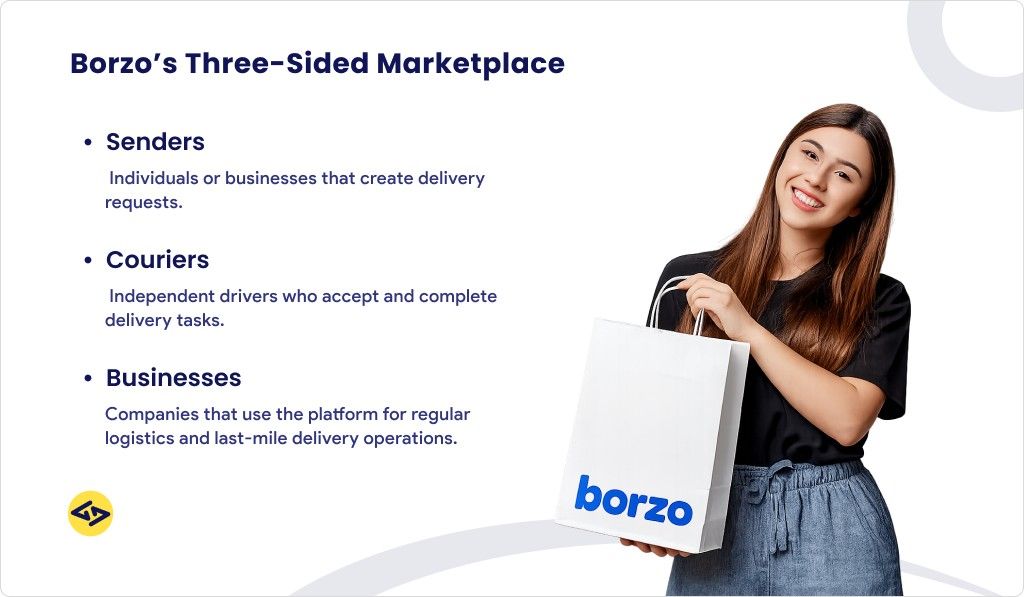
Borzo runs as a three-sided marketplace — senders, couriers, and businesses. Understanding how each side works is critical before you build your own version.
The Sender Flow
- Sender enters pickup and drop-off addresses on the app or website.
- The app calculates the fare upfront — no hidden fees.
- Sender picks a vehicle type: walker, bike, car, or truck.
- The algorithm assigns the nearest, highest-rated available courier instantly.
- Both sender and recipient receive SMS updates at every stage.
- After delivery, the sender rates the courier — feeding future assignments.
The Courier Flow
- Couriers register via the Borzo Delivery Partner app (separate from the customer app).
- They go online and receive nearby order notifications.
- The app provides optimized routing for multi-stop orders.
- On delivery, couriers collect signatures, OTPs, or cash (COD) and get paid.
How Borzo Makes Money
Borzo earns a commission on every delivery — typically 15–30% of the delivery fee. Additional revenue comes from COD handling fees, package insurance, business subscription plans, and API integration fees for e-commerce platforms.
Core Features to Build in a Borzo-Like App
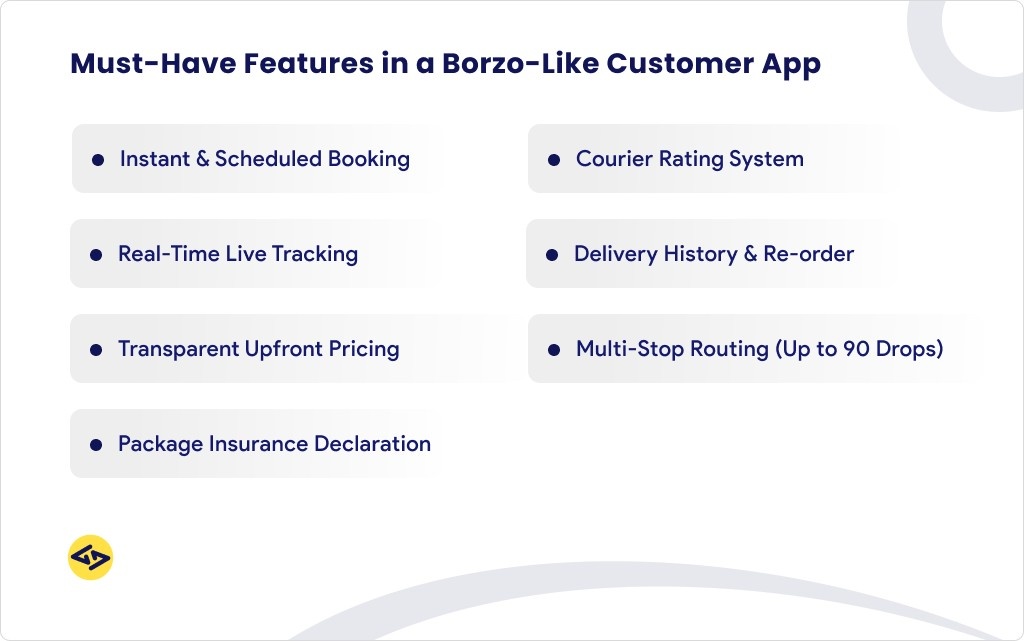
When you build an app like Borzo, you’re not building one app — you’re building three. A Customer App, a Courier Driver App, and an Admin Dashboard. Each serves a different user with very different needs.
Customer App — Must-Have Features
- Instant & Scheduled Booking: Book now or schedule ahead. Smart time-slot suggestions based on courier availability and traffic patterns.
- Real-Time Live Tracking: GPS-powered live map showing courier location, ETA, and delivery status. Non-negotiable in 2025.
- Multi-Stop Routing (Up to 90 Drops): One order, up to 90 addresses, automatically optimized. Critical for B2B bulk delivery use cases.
- Transparent Upfront Pricing: Show the full fare before the user taps ‘Order.’ Dynamic pricing based on distance, weight, and vehicle.
- Courier Rating System: Post-delivery ratings feed the dispatch algorithm. Top-rated couriers get first priority.
- Delivery History & Re-order: View all past deliveries and duplicate any order with one tap. Great for repeat business customers.
- SMS & Push Notifications: Automated alerts for sender and recipient at every status change — no app needed on the receiver’s end.
- Package Insurance Declaration: Users declare package value before booking. Compensation is based on that declared value if lost or damaged.
B2B Business Features
- API Integrations: Connect directly to Shopify, WooCommerce, and OpenCart. Auto-dispatch triggers on every sale.
- Bulk Order Upload: Upload an Excel file to create hundreds of orders at once — no manual entry.
- Cash on Delivery (COD): Courier collects payment from the end customer and remits back to the business.
- Buyout Feature: Courier buys the item at pickup with their own money. Receiver reimburses on delivery.
- Prepaid Business Wallet: Maintain a balance for fast, frictionless ordering at scale.
- Dedicated Account Managers: Human support for high-volume business clients.
Courier Driver App Features
- Order accept/reject with upfront earnings preview
- Optimized multi-stop navigation via Google Maps Integration
- Proof of delivery: photo upload, digital signature, OTP
- Earnings dashboard and payout history
- In-app chat with customer and support team
- Online/offline availability toggle
Admin Dashboard Features
- Live order map with fleet heatmaps across the city
- Courier verification, onboarding, and document management
- Dynamic pricing rules and surge pricing controls
- Revenue analytics: GMV, commission, COD reconciliation
- Customer and courier support ticketing system
- Promo code and referral campaign management
Recommended Tech Stack
Your tech choices define your app’s speed, scalability, and cost to maintain. Here’s what top-tier on-demand delivery platforms use — and why.
| Layer | Technology | Why It Works |
| Mobile (Cross-Platform) | Flutter / React Native | One codebase for iOS and Android. Faster to build, cheaper to maintain. |
| Mobile (Native) | Swift (iOS) / Kotlin (Android) | Best raw performance for heavy GPS and background tasks. |
| Backend | Node.js / Python (Django) | Node.js handles real-time, event-driven requests extremely well. |
| Database | PostgreSQL + MongoDB | PostgreSQL for structured order data; MongoDB for fast-read delivery logs. |
| Real-Time Engine | WebSockets / Socket.io | Required for live courier tracking, order updates, and in-app chat. |
| Maps & Routing | Google Maps API / MapMyIndia | Google Maps for global markets; MapMyIndia for India-specific accuracy. |
| Push & SMS | Firebase (FCM) / Twilio | FCM for in-app alerts; Twilio for SMS delivery to non-app recipients. |
| Payments | Razorpay / PayU / Stripe | Razorpay/PayU for India (UPI, wallets, COD); Stripe for global markets. |
| Cloud & DevOps | AWS / Google Cloud / Docker | Auto-scaling cloud handles peak delivery hours without downtime. |
| Admin Dashboard | React.js / Next.js | Fast, component-based UIs with live data refresh for fleet monitoring. |
Fleet & Vehicle Types to Support
Supporting multiple vehicle types is one of Borzo’s biggest advantages. It makes your platform useful for everyone — from a student sending a document to an e-commerce brand dispatching 50 orders a day.
- Walking couriers — best for hyperlocal deliveries like documents or keys within a few blocks
- Two-wheelers (bikes/motorcycles) — ideal for fast city delivery of parcels, food, and flowers
- Cars — for bulkier or fragile packages that need extra protection
- Vans and trucks — for B2B bulk shipments, furniture, or large e-commerce dispatches
- Three-wheelers (EV/CNG) — Borzo launched these in 2024 for sustainable mid-weight B2B deliveries
Each vehicle tier has its own pricing algorithm, capacity limits, and courier pool. Build this flexibility in from day one — retrofitting it later is expensive.
Step-by-Step Development Process to Develop an App like Borzo
- Step 1: Discovery & Market Research
Define your target city, user personas (B2C vs B2B focus), and what gap you’re filling. Study Borzo, Porter, and Shadowfax. Document your unique value proposition, pricing model, and launch plan. - Step 2: Scope Your Features
Create a product requirements document (PRD) covering all three panels — Customer, Courier, Admin. Be ruthless about MVP vs Phase 2. Scope creep is the #1 reason delivery apps go over budget. - Step 3: UI/UX Design
Design wireframes and high-fidelity prototypes for every key flow — booking, tracking, rating, and payment. The customer app should feel fast and simple. The driver app must minimize cognitive load at every step. - Step 4: Backend Architecture
Design your database schema, API structure, and real-time WebSocket layer before writing frontend code. Get your cloud infrastructure and CI/CD pipelines set up early. This phase determines your long-term scalability. - Step 5: Core Feature Development
Build all three panels in parallel: Customer app (booking, tracking, payments), Courier app (dispatch, navigation, POD), and Admin dashboard (monitoring, analytics). Integrate Maps, Payments, SMS, and Push Notification APIs at this stage. - Step 6: Dispatch Algorithm & Route Optimization
This is the intelligence layer of your platform. Build an auto-dispatch engine that matches each order to the nearest, highest-rated, available courier in real time. For multi-stop orders, integrate a route optimization API to sequence stops efficiently. - Step 7: QA, Testing & Security Audit
Run functional, performance, and security tests. Load-test for peak concurrent orders. Implement SSL encryption, multi-factor authentication, fraud detection, and PCI-DSS compliance for payments. - Step 8: Launch & App Store Optimization
Deploy to iOS App Store and Google Play with keyword-optimized listings. Launch courier-side first — supply drives experience quality. Then activate demand-side marketing through referral programs and local SME partnerships. - Step 9: Maintain, Analyze & Iterate
Track delivery SLA performance, user retention, and booking funnel drop-offs daily. Push regular app updates. Build your analytics layer before launch — not after.
Monetization Strategies for a Courier Delivery App
A delivery platform like Borzo generates revenue from multiple streams — not just delivery fees. Build these into your business model from day one.
- Delivery Commission: Charge 15–30% of each delivery fee. Primary revenue engine — scales directly with order volume.
- Business Subscriptions: Monthly/annual plans for businesses with discounted rates, priority courier assignment, and dedicated account managers.
- COD Handling Fee: Charge a small % for collecting cash and remitting to businesses. High-margin in cash-heavy markets.
- Package Insurance: Premium insurance tiers for high-value shipments. Revenue on no-claim declarations is nearly pure profit.
- API Integration Fees: Setup or monthly fee for white-label API integrations with Shopify, WooCommerce, or custom checkout systems.
- Surge Pricing: Dynamic pricing during peak hours or bad weather. Increases per-order revenue with zero added infrastructure cost.
Development Cost Breakdown for Parcel Delivery App like Borzo
Cost depends on three things: your team’s location, your feature scope, and your chosen tech stack. Here is a realistic estimate for a full-featured platform built with an India-based development team.
| Phase | Duration | Estimated Cost (USD) |
| Discovery & UI/UX Design | 3-4 Weeks | $3,000 – $5,000 |
| Customer App (iOS & Android) | 8-10 Weeks | $10,000 – $15,000 |
| Courier App (iOS & Android) | 8-10 Weeks | $10,000 – $15,000 |
| Admin Panel & Backend | 6-8 Weeks | $7,000 – $12,000 |
| QA, Testing & Launch | 3-4 Weeks | $3,000 – $5,000 |
| Total Estimated Cost | 5-7 Months | $33,000 – $52,000+ |
Start Your Delivery Business with iCoderz Solutions
Building a logistics powerhouse like Borzo requires a technical partner that understands the nuances of real-time dispatching and fleet management. At iCoderz Solutions, we specialize in creating custom logistics delivery solutions designed to scale.
Whether you are a startup looking to launch an MVP or an enterprise automating your last-mile delivery, we provide the expertise to get you there faster.
Let’s build the future of delivery together. Get a Free Consultation & Quote
Check Out Our Case Studies