
An honest, up-to-date breakdown of Bubble.io’s capabilities, limitations, and whether it’s right for your project — updated March 2026.
Is Bubble.io Still Worth It in 2026?
In 2026, the no-code market is noisier than ever. AI-first builders like Lovable and Base44 are grabbing headlines, while more established tools are racing to add features. Against this backdrop, one question keeps coming up in founder circles, agency Slack groups, and Reddit threads: Is Bubble.io still the right choice?
With over 7.2 million apps now built on the platform (per Bubble’s 2025 year in review), Bubble is clearly not slowing down. But platform size is not the same as platform fit. This guide gives you an honest look at what Bubble does well, where it genuinely struggles, and how to decide if it’s the right tool for your specific project — based on the latest data as of March 2026.
What Is Bubble.io?
Bubble.io is a full-stack no-code development platform that lets you design frontends, build backend workflows, manage relational databases, handle user authentication, and integrate third-party APIs — all through a visual drag-and-drop editor, without writing traditional code.
Unlike website builders such as Webflow or Squarespace, Bubble is engineered for dynamic, data-driven web applications. It has historically been the go-to for SaaS platforms, marketplaces, CRMs, booking systems, internal tools, and AI-powered products. If you want to understand the platform in depth before reading further, our What is Bubble.io guide covers the full picture.
What types of apps is Bubble best suited for?
Bubble works best when your product involves users, dynamic data, and custom logic. The platform covers a wide range of business application types, including:
- SaaS platforms — subscription dashboards, user portals, and admin panels
- Two-sided marketplaces — buyer/seller flows, booking, ratings, and escrow logic
- Internal business tools — CRMs, project trackers, operations dashboards
- AI-powered web apps — chatbots, content automation, intelligent workflows powered by models like ChatGPT or Claude
- MVPs and early-stage products validating product-market fit before a larger engineering investment
- Fintech and HR platforms with authentication, payment flows, and role-based access
- Educational platforms, community portals, and customer self-service tools
Real-world examples include Faceless.video (850,000+ users built entirely on Bubble), VoiceDrop (an AI-powered voicemail platform that hit 7-figures ARR in its first 12 months), SuiteOp (raised $3M, serves 30,000 daily users), and BuyTicket (Brazil’s top ticket resale platform, built by two high schoolers in two months). Our project portfolio includes production apps across several of these categories.
Top Features of Bubble.io
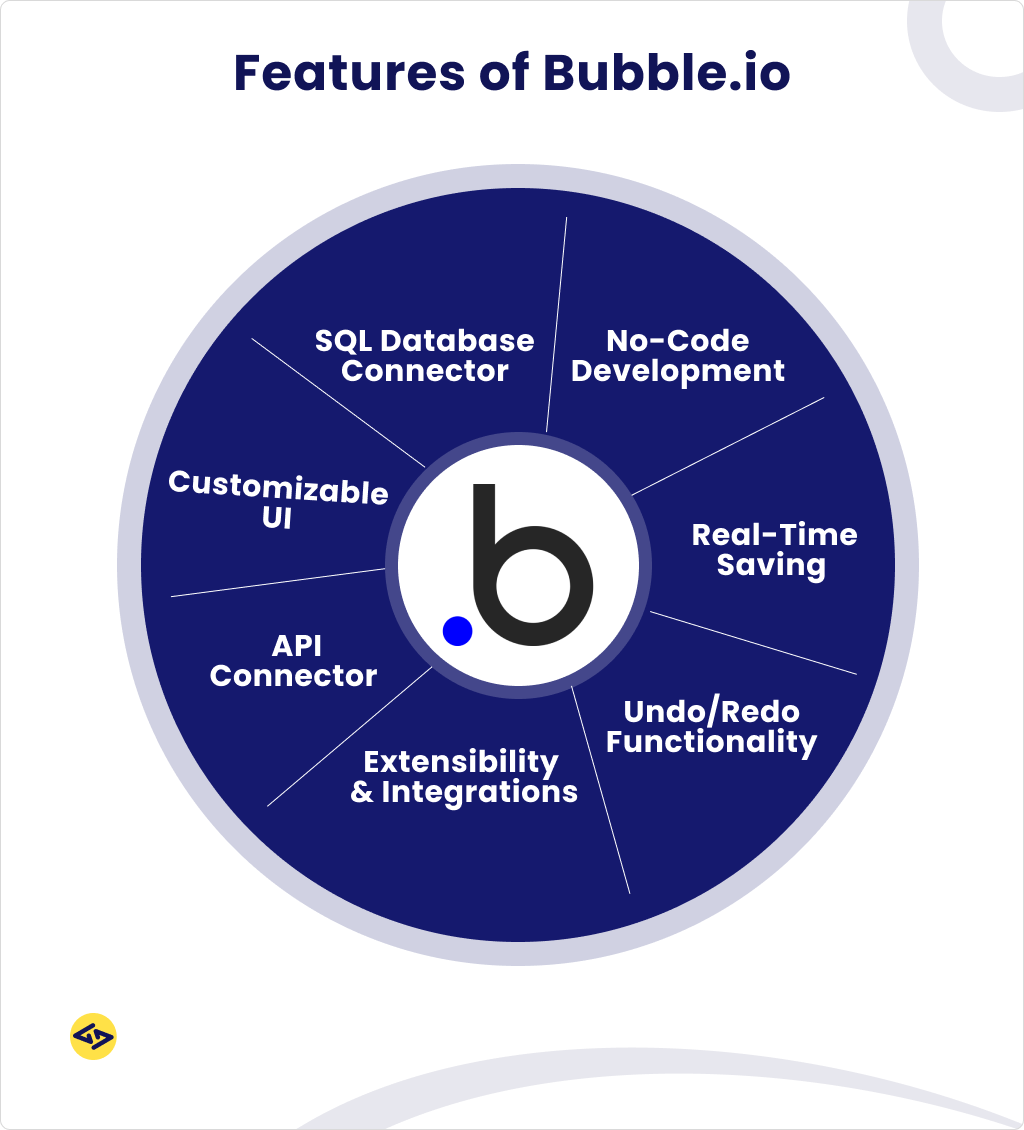
- Visual Drag-and-Drop Editor: Design responsive UIs without writing a line of CSS or HTML.
- Built-In Database: Full relational database with privacy rules, real-time data, and no external setup required.
- Workflow Engine: Visual backend logic for user actions, scheduled tasks, and API triggers — no code needed.
- API Connector: Connect to any REST API. Now lives in its own dedicated tab (as of Feb 2026) with improved search and notes.
- SQL Database Connector: Link directly to external databases like Postgres, MySQL, and Microsoft SQL.
- Native Mobile Builder: Build and publish iOS and Android apps directly from Bubble — shared backend with your web app.
- AI Agent: In-editor co-pilot powered by Claude Sonnet 4.6 — generate pages, edit UI, and fix logic through a chat interface.
- Plugin Marketplace: 6,000+ plugins including Stripe, SendGrid, Google Maps, and 300+ AI integrations.
- User Authentication: Built-in sign-up, login, password reset, SSO, and magic login links — no third-party auth service needed.
- Real-Time Saving & Version Control: Changes save instantly with undo/redo and a full changelog for tracking edits.
Bubble.io Pros: What It Does Really Well
Here are several Bubble.io no-code platform advantages.

1. Full-Stack No-Code in One Place
Bubble’s biggest differentiator is that it handles everything in a single environment: frontend design, backend workflows, relational database, user authentication, and API integrations. Most no-code tools require you to stitch together separate platforms for each layer. Bubble keeps it unified, which reduces complexity and makes iteration faster.
2. Native Mobile App Builder
For years, mobile was Bubble’s biggest gap. That changed in June 2025 with the launch of the native mobile app builder (public beta). According to Bubble’s official 2025 recap, builders had already created over 180,000 mobile apps on the platform by year end. The builder uses React Native under the hood, allowing you to publish directly to the App Store and Google Play, share your database and backend with your web app, and access device features including camera, GPS, push notifications, and in-app purchases.
In February 2026, Bubble upgraded the mobile builder to React Native’s new architecture, improving startup time (especially on Android), scrolling performance, and animations. High-quality image loading also improved — automatically condensed to 1080p for roughly a 60% reduction in load time, noticeably better on weaker mobile connections.
3. AI-Powered Development — Including the Latest Claude Model
Bubble’s AI tools have accelerated significantly. In February 2026, Bubble upgraded its app generation engine to Claude Sonnet 4.6 on Anthropic’s public release day — Bubble was an early partner in testing the model. The upgrade brought distinct style improvements to AI-generated UI and made app generation 2x faster than before. A working MVP with authentication, database, and workflows can now be scaffolded in 5–7 minutes from a text prompt.
The AI Agent (launched October 2025 at Bubble Tour) works as an in-editor co-pilot: it understands your app’s existing architecture, generates pages from prompts, edits UI components, and renders clickable links directly from the chat to relevant pages in your app. The Agent is being expanded to non-AI-generated apps through Q1–Q2 2026, with compound edits (multiple changes in a single prompt) and self-correction capabilities on the roadmap for May and June respectively. Beyond its own tools, Bubble integrates natively with 300+ AI models and plugins including OpenAI, Anthropic, and Cohere.
4. Massive Plugin and Template Ecosystem
Bubble’s marketplace now includes over 6,000 plugins — from Stripe and SendGrid to Google Maps, analytics suites, CRM connectors, and niche integrations. The marketplace also features 1,357+ templates, many of which provide a full starting architecture for common app types. This depth of ecosystem is unmatched in the no-code world and directly reduces time-to-launch for most projects.
5. Workflow Automation Built In
Bubble’s workflow engine lets you automate repetitive backend tasks without writing server-side code — user onboarding sequences, email triggers via SendGrid, payment confirmations via Stripe, scheduled data updates, and conditional logic branching all run natively. This removes a category of work that typically requires a separate automation tool like Zapier or a custom backend service.
6. Rapid Prototyping and Proven Startup Speed
Teams building on Bubble consistently report shipping 3–10x faster than traditional development. This is not just marketing language — it’s reflected in real outcomes: Pockla raised £1.6M after validating their MVP on Bubble, and BuyTicket became Brazil’s top ticket resale platform within one month of launch. For startups that need to validate ideas before committing to a full engineering team, Bubble provides a level of speed that custom code cannot match at early stage.
7. Enterprise-Grade Security
Bubble is SOC 2 Type II certified and GDPR-compliant. It uses AES-256 encryption, automatic SSL, field-level privacy rules, and DDoS protection via Cloudflare. In November 2025, Bubble launched its secrets scanner — formerly Flusk, now integrated directly into the Bubble security dashboard — which detects leaked API keys in your app and suggests mitigation steps. Enterprise plans include dedicated server hosting, SSO, centralized admin, and custom infrastructure location.
8. Cost Efficiency Relative to Custom Development
Bubble’s free plan is functional enough to prototype and test without spending anything. Paid plans start at $29/month (Starter, billed annually). Bubble’s own enterprise data suggests 85% of enterprise users save between $300,000 and $1,000,000 annually compared to building with a traditional development team. For startups and lean teams, this cost difference is often the deciding factor between launching quickly or waiting to raise funding first.
9. Active Community and Structured Learning Resources
Bubble’s community forum is one of the most active in no-code, with thousands of daily posts and responses typically within a few hours. In Q1 2026, Bubble launched The New Build podcast and its Q1 Launch Program — a structured 90-day guided program for founders going from idea to paying customers, with dedicated Slack support, live building sessions, and co-marketing through Launch Lab. Bubble Academy also received a major visual overhaul this quarter to make learning resources more structured and accessible.
Bubble.io Cons: The Honest Limitations
1. Steep Learning Curve
Bubble is not beginner-simple. Most experienced users put basic competency at 1–3 months and production-ready confidence at 6–12 months. The workflow engine, responsive layout system, data privacy rules, and API connector all require genuine investment to master. The new property editor (in public beta since December 2025, with ongoing iterative improvements) is improving the editor experience, but the underlying complexity of building real apps remains.
If you need to build fast without investing in that learning curve, working with experienced Bubble developers from the start is typically more cost-effective than building in-house from scratch.
2. Workload Unit Pricing Can Surprise You at Scale
Bubble’s billing model combines plan fees with Workload Unit (WU) consumption. Every database query, workflow run, and API call draws from your monthly WU allocation. Independent testing reported on the Bubble community forum suggests typical apps consume 400–500 WUs per user per day. On a Starter plan (175,000 WUs/month), a moderately active app can exhaust its allocation quickly. Overage charges are $0.30 per 1,000 WUs — a marketplace with 10,000 monthly active users could easily consume 500,000+ WUs per month, nearly tripling effective cost versus the plan fee.
WU optimization is a real skill: a poorly architected workflow can consume 2x the WUs of a well-built one doing the same job. Build WU efficiency into your app architecture from day one, not as an afterthought.
3. No Code Export — Permanent Vendor Lock-In
Bubble does not allow you to export your application’s code. Your app lives on Bubble’s servers and within Bubble’s ecosystem indefinitely. Migrating to custom code or another platform means rebuilding from scratch. This is the platform’s most fundamental trade-off and should be evaluated carefully before committing — especially if your investor roadmap, compliance requirements, or long-term technical strategy require code ownership.
4. Performance Is Better, But Not Best-in-Class
Bubble’s infrastructure has improved significantly since 2023. AWS and Cloudflare now underpin the platform, and the September 2025 database update delivered 50% faster search queries and 90% faster reference deletion. That said, independent benchmarks typically show page load times in the 2–10 second range depending on app complexity and optimization — acceptable but slower than fully custom-coded applications. Google PageSpeed scores generally land in the 60–75 range on mobile and 80–90 on desktop. For apps with clean data architecture and optimized workflows, performance is rarely a dealbreaker; for apps with heavy concurrent writes and complex real-time logic, it can be.
5. Native Mobile Builder Is Still Maturing
The mobile builder is a genuine step forward, but it carries important caveats in early 2026. Deep linking (via push notifications) is targeted for April 2026. The mobile plugin editor is in alpha testing and targeting a broader beta in April. Some community members have noted the builder is better suited for standard app types (social, marketplace, productivity) than for apps requiring advanced hardware access or complex native integrations. Bubble’s official mobile roadmap is worth reviewing against your specific feature requirements before committing.
6. Design Flexibility Has Real Limits
Bubble’s drag-and-drop editor gives you substantial control over layout and styling, but achieving pixel-perfect or highly custom UI designs that deviate from the platform’s conventions requires effort. Complex animations, game-style interactions, or heavily custom UI components typically need JavaScript integration. For designers used to handing off Figma files to a developer, the translation into Bubble requires a different mindset.
7. Not the Right Tool for Every App Type
Bubble’s strength is application construction and display logic — not complex computation. It is the wrong choice for apps requiring ultra-low latency (real-time trading, live multiplayer gaming), complex mathematical algorithms, 3D or graphics-intensive experiences, or true offline-first architecture. Advanced calculations or game-like visuals require JavaScript integration, and for graphics-heavy applications Bubble is simply the wrong foundation. Being clear about these boundaries upfront is more useful than discovering them six months into a build.

Bubble.io Pros and Cons: Summary Table
|
Aspect |
Pros |
Cons |
|---|---|---|
|
Development Speed |
Ship MVPs in days, not months — visual editor replaces weeks of coding setup |
Steep learning curve; advanced features take 1–3 months to master |
|
Cost Efficiency |
Free plan for prototyping; paid plans from $29/mo; saves $300K–$1M vs custom dev (per Bubble enterprise data) |
Usage-based WU billing can spike unpredictably as your app scales |
|
Customization |
6,000+ plugins, SQL connector, full API access, custom code injection |
Pixel-perfect UI or heavy animations require JavaScript workarounds |
|
Mobile (2025–2026) |
Native iOS/Android builder (public beta since June 2025); share backend with web app |
Mobile builder still maturing — deep links and plugin editor in beta |
|
AI Integration |
Claude Sonnet 4.6-powered generation; AI Agent for chat-based editing; 300+ AI plugins |
Agent still in rollout; compound edits and self-correction coming Q2 2026 |
|
Scalability |
AWS + Cloudflare infra; dedicated server plans for enterprise |
Heavy data-reliant apps need manual WU optimization to avoid overages |
|
Security |
SOC 2 Type II, AES-256 encryption, secrets scanner, SSO for enterprise |
Privacy rules must be manually configured — misconfiguration risk |
|
Maintenance |
Automatic hosting, SSL, updates — no DevOps needed |
No code export = permanent vendor lock-in if you migrate later |
What’s New in Bubble.io?
Source: Bubble’s official community updates and the March 2026 roadmap AMA.
- AI Agent (Oct 2025): In-editor co-pilot that generates pages, edits UI, and troubleshoots workflows through a chat interface.
- Claude Sonnet 4.6 integration (Feb 2026): AI app generation upgraded to Anthropic’s latest model — 2x faster generation, noticeably better UI quality.
- React Native new architecture (Feb 2026): Mobile apps now run on RN’s latest core — faster startup, smoother scrolling and animations.
- Secrets scanner (Nov 2025): Built-in tool at scan.bubble.io that detects leaked API keys and suggests fixes.
- API Connector in its own tab (Feb 2026): No longer buried in plugins — includes search, notes, and drag-and-drop reordering.
- Database performance (Sep 2025): 50% faster searches, 90% faster reference deletion, significant automatic indexing improvements.
- Property editor beta (Dec 2025–ongoing): Redesigned editing panel with improved layout, inputs, and popover behaviour. Still iterating.
Coming in Q2 2026
- Deep linking via push notifications — April 2026
- Mobile plugin editor (community-built mobile extensions) — April 2026
- AI Agent compound edits and self-correction — May/June 2026
- Native JSON parsing for API responses in workflows — June 2026
Bubble.io vs Custom Development: When to Use Which
This decision matters more than platform comparison charts suggest. Here is a practical framework based on real project patterns.
Choose Bubble.io Over Custom Development When:
- You are validating a product idea and need to move in days or weeks, not months
- Budget is a constraint — Bubble cuts development cost by 60–80% for an MVP vs hiring a custom dev team
- You do not have technical co-founders or an in-house engineering team
- Your app fits proven business models: SaaS, marketplace, CRM, booking platform, internal tool
- Speed of iteration matters more than absolute technical optimization at this stage
- You want hosting, scaling, and security handled automatically without DevOps overhead. Many businesses find it useful to explore our Bubble.io development services to assess feasibility before committing.
Choose Custom Development When:
- You need ultra-low latency: real-time trading, live multiplayer, or edge-computed AI inference
- Code ownership and portability are non-negotiable — due to regulatory requirements, investor expectations, or long-term platform independence
- You are building a native mobile app requiring advanced hardware access or offline-first architecture that Bubble’s current mobile builder does not yet support
- Your product is inherently graphics-intensive: 3D visualization, gaming, AR/VR
- You have achieved product-market fit and need to optimize aggressively for performance and cost at scale
A proven pattern: many successful companies start on Bubble to find product-market fit, then rebuild on custom code after raising a funding round. Bubble to validate, custom code to scale. If your timeline or product type sits between these two paths, our team at iCoderz can help you think through the right approach for your specific project.
Bubble.io Pricing in 2026
Bubble’s pricing combines subscription tiers with Workload Unit (WU) consumption. Current plans as of March 2026 (see bubble.io/pricing for the most up-to-date rates):
- Free: 50,000 WUs/month. Build and test — no custom domain, no live deployment. Best for learning and prototyping.
- Starter ($29/mo annually): 175,000 WUs/month. Custom domain, no Bubble branding, live app deployment. Best for indie builders and small apps.
- Growth ($119/mo annually): 250,000 WUs/month. Better server capacity, 2 editors, additional environments. Best for growing customer-facing products.
- Team ($349/mo annually): 500,000 WUs/month. High capacity, sub-apps, enhanced team collaboration. Best for scaling products with active dev teams.
- Enterprise (custom): Dedicated server, custom WU allocation, SSO, priority support, custom infrastructure location, enhanced compliance. For large-scale and regulated applications.
Important: Overage charges are $0.30 per 1,000 WUs beyond your plan allocation. A poorly optimized app can burn through 2x the WUs of a well-architected one completing the same tasks. WU management should be part of your architecture planning from day one, not an afterthought when bills arrive.
Should You Build on Bubble.io in 2026?
Bubble.io in 2026 is genuinely powerful for the right use cases. If you are building a web-first product — a SaaS platform, marketplace, internal tool, or AI-powered application — and you need full-stack capability without a dedicated engineering team, Bubble remains one of the strongest options available.
The caveats are real: the learning curve is steep, WU pricing scales in ways that require active management, and vendor lock-in is permanent. Getting your app architecture right, your plan choice appropriate for your traffic model, and your workflows built for WU efficiency from the start makes a material difference in your long-term economics.
That is where experienced Bubble.io developers make a difference. At iCoderz Solutions, we have built production-grade Bubble apps across SaaS, marketplace, fintech, and enterprise use cases. We help you scope correctly, architect for WU efficiency, and ship without the mistakes that cost money and time later.
Ready to discuss your project? Contact Us to Discuss Your Project
Frequently Asked Questions
Is Bubble.io still worth it in 2026?
Yes — for the right use cases. Bubble remains one of the strongest no-code platforms for complex web apps, SaaS products, and marketplaces. The recent wave of updates (native mobile builder, AI Agent, Claude Sonnet 4.6 integration, database performance improvements) directly addresses previous weaknesses. That said, it is not the right tool for every project. Apps requiring native-mobile-first performance, ultra-low latency, or code ownership should explore alternatives.
What is Bubble.io best suited for?
Bubble.io is best suited for SaaS platforms, two-sided marketplaces, internal business tools, MVPs, AI-powered web apps, and customer portals. It excels when you need full-stack capabilities without a traditional development team and when shipping speed is more important than absolute technical optimization.
Can Bubble.io handle high-traffic applications?
Yes, with proper architecture. Bubble runs on AWS and Cloudflare infrastructure and supports dedicated server plans for enterprise-level traffic. Apps like Faceless.video serve 850,000+ users on Bubble. However, high-traffic apps require deliberate workflow optimization and WU management. Without that, performance degrades and costs scale unexpectedly. If you are building for high traffic, our team can help you architect for scale from the start.
Can I export my Bubble.io app’s code?
No. Bubble does not allow code export. Your app lives within Bubble’s ecosystem, and migrating to custom code or another platform requires rebuilding from scratch. If code ownership is non-negotiable for your business or compliance requirements, this is the most important limitation to weigh before committing.
Does Bubble.io support native mobile apps?
Yes, as of June 2025. Bubble’s native mobile builder (public beta) uses React Native to generate iOS and Android apps directly from the visual editor, sharing your existing database and backend. Device features including camera, GPS, push notifications, and in-app purchases are supported. The builder continues to mature — deep linking via push notifications and the mobile plugin editor are both expected in April 2026. See Bubble’s mobile page for the current feature list.
How does Bubble.io’s pricing work?
Bubble uses a tiered subscription model combined with Workload Unit (WU) consumption. Plans start at free (for prototyping), $29/month for Starter (live deployment with custom domain), $119/month for Growth, and $349/month for Team — all billed annually. WUs measure the server resources your app uses. Exceeding your monthly allocation triggers overage charges at $0.30 per 1,000 WUs. Active WU monitoring and workflow optimization are essential to keeping costs predictable as your app scales.
How long does it take to learn Bubble.io?
Most users reach basic competency in 1–3 months and production-grade confidence in 6–12 months of active building. The AI Agent and app generation tools are reducing the initial learning barrier for prototyping. For production projects with a tight timeline, working with an experienced Bubble development team compresses the timeline significantly and avoids costly architectural mistakes.